
Enjoy the benefits of a premium membership!
Upgrade Account
-
TalkBass has been independent since 1998. Add your voice.
Create a free account to reply to discussions, view embedded media, and browse with fewer display ads.
Join free Log in
Want zero display ads or expanded classifieds tools? Compare plans.
You are using an out of date browser. It may not display this or other websites correctly.
You should upgrade or use an alternative browser.
You should upgrade or use an alternative browser.
Tonewood Experiment.
- Thread starter KrisWarrington
- Start date
More options
Who Replied?
So along these same lines, I conducted an experiment about a month ago using the same simple short 30 second portion of a tune, same bass, amp, distance, to the recorder, etc. Same strings, same control settings, same body, passive bass.
Only one thing on the bass changed between these 2 recordings.
Listen with good quality headphones or speakers and see if anyone can guess:
1. What changed?
2. Specifically, what's the difference between the two?
Tone Test
In this case I hear no difference at all
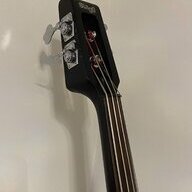
My own unscientific experience produced alternate results. I transferred ALL the hardware, electronics, neck, tuners, and even the strings ( year old and fully broken in) from my Steinberger XP2 bass, which had a rock maple body and graphite neck, to a new mahogany body. The only variable is the wood. It sounds quite different, perhaps a slight decrease in sustain, but much warmer sounding. A friend heard it and reached the same conclusion on his own. I accept that tiny differences in the neck pocket dimensions could change the energy transfer from neck to body, but if that's irrelevant to electric pickups, it shouldn't matter. For the record, I used a micrometer to try to get the pocket identical to the original, and used the original neck bolts. The scientific debate continues, but based on direct experience, I still believe the wood is one of many factors contributing to tone. A fascinating and apparently endless debate until a fully controlled, vetted, and peer reviewed study is published by professionals with A track record for good science.
Edit:
FWIW, the original maple Steinberger body has a thick two.part epoxy paint finish, while the new body is Watco Danish Oil over mahogany. Again, if its just strings and pickups, that should be an irrelevant variable, but the sound difference remains unexplained, at least to me.
Any audio clips?
I realize the OP didn't post any either, but I would like to hear it if you have them. FWIW, I do believe your test sounds more inline with what I'd expect.
Hello, recently I completed a project for my electroacoustic class regarding the use of tone wood in for an electric bass guitar. My experiment left me with some questions, but before I begin I'm going to explain my set-up, findings, and my reasoning behind my results.
The experiment itself was quite simple. Take three common tone woods (Maple/Alder/Bass Wood), create completely identical instruments in terms of dimensions, throw some strings and a pick up on it and do a blind test. We've all herd the argument, seen the youtube videos, watched all the masters debate it but one thing always stood out to me about previous experiments: They're using two identical specification guitars but are they REALLY identical? They're using the same make/model strings and pickups but does that make them truly identical? In my electrical engineering class we learned that different ores from different parts of the earth have slightly different properties. For instance, if you go to Mouser Electronics and buy 100 1k resistors and individually test them, chances are no two resistors are going to have the same resistance value. They will vary slightly simple because they are made from the exact same ore. Do all "Pro Steel" strings of the same gauge have exactly the same magnetic properties? Do two EMGHZ pickups have exactly the same magnetic properties? Wouldn't small variations affect the electrical signal being output from the guitar? These are just some of the questions I asked myself going into the experiment. So what I ended up doing was buying one pack of strings and using one passive stock pickup with the leads connected directly to a TRS cable into an amplifier.
For the sake of having a control in the experiment I just so happen to have two identical ESP LTD F-404FM Tribal basses which were restrung with the same make/model/gauge strings and I replaced the 9v batteries with the same brand prior to the experiment. They should sound exactly the same right? They're identical in every way after all.
For the experiment all I did was install the pickup, string, and tune to A440 for each of the guitars using the exact same strings,passive pickup, TRS cable, and amplifier. For the first round of the experiment I allowed my peers to view and hear the guitars for themselves in a non-blind test scenario. To my ears, they sounded completely identical but of course my peers were skeptical and insisted that the guitars were indeed different in tonality. I then plugged in the ESP basses and while they were pretty similar most of my peers, and myself, agreed there was a difference in tonality. Which to me is pretty odd, there had to be an explanation for two completely identical guitars sounding slightly different (which was an uncontested view of the entire class.)
Round two was the blind testing. I had one student stand near me to verify that I was indeed playing each guitar and not trying to be sneaky and just pluck one over and over. The results overall were a complete failure to identify any specific tone wood and even still I was accused of not actually changing out the guitars. Even though it obviously took me a few minutes to set up each guitar for the experiment having used the same strings and pickups.
The results amazed me. I've always been a die hard believer in tone woods. Obviously for an acoustic instrument the wood DOES contribute to the timbre of the instrument but for an electrical set-up does it REALLY matter? Why are 90% of guitars manufactured with cheap woods? (This is obviously a rhetorical question) Are there some ebony guitars out there? Sure, but pretty much any instrument you buy from a major manufacturer is going to be the same types of wood that have been used since the dawn of the electric guitar.
My only logical explanation to explain my results is this: The same make/model/gauge strings are indeed not the same in terms of metallic properties and neither are two identical pickups. Look up any tone wood video on youtube. They use two identical guitars but they aren't using the same strings/pickups/cables (aside from the A/B box out) Why is that? Could this be the reason? I believe the small variations in the properties of the electrical components are to blame for the tonality of an electrical instrument. As far as I know, there aren't any woods used in electrical guitars that have magnetic properties.
Now, I could have gone about this the wrong way. Let me state for the record: I am not a luthier with decades of experience, I do not have a doctorate in electrical engineering, and I am not a geologist. All I simply did was ask questions based on what I learned in school and test those questions in a very basic way. Perhaps they did sound different, but my ears didn't perceive it and during a blind test it wasn't completely obvious to my peers either. I'm looking to the experts that are hopefully here to answer my remaining two questions. "Why did my two identical ESP guitars sound different", and "why did my tone wood guitars sound the same to the vast majority"? It's important to note that outside of the amp, they did sound different acoustically. I'm NOT contesting tone woods in an acoustical setting, only in solid body electrical instruments. I know that I'm going to get a lot of hate over this post, but I ask that if you truly have the answer don't just say "They're different, trust me I've been building guitars for 100000+ years". I want scientific reasons that are backed up by physics, testing, math, anything that can be re-created and verified by ANYONE like my experiment. Anyone can re-create it and test it for themselves. I'm not uploading any videos for that very reason, you can't trust them. I don't want to be accused of doctoring the videos or whatever else people will try to say to just try to deny my findings. This is something you have to do and hear for yourself, in person, to truly believe it.
Again, I could be completely wrong and my experiment could have just been some weird coincidence but that's why I'm here. Thank you to anyone who took the time to read this post and respond. Unlike most people, if you prove me wrong I won't be mad at all because knowing the truth is better than defending a fallacy.
EDIT: Grammatical Errors.
I thought of an important question regarding these tests:
By your own admission, it took a few minutes to change electronics and stuff from one of the new wood basses to another, and people heard no differences. About how many minutes were these gaps between playing the different new wood basses? Also, how long was the gap in between playing the same ESP basses?

An idea i've raised before..create some sort of crowd funding vehicle in order to hire the right experimental physicist to design and run the right experiments, and publish in a peer reviewed journal.
I'll bet if every TB member pitched in a buck, we'd be close.
I'll bet if every TB member pitched in a buck, we'd be close.

So along these same lines, I conducted an experiment about a month ago using the same simple short 30 second portion of a tune, same bass, amp, distance, to the recorder, etc. Same strings, same control settings, same body, passive bass.
Only one thing on the bass changed between these 2 recordings.
Listen with good quality headphones or speakers and see if anyone can guess:
1. What changed?
2. Specifically, what's the difference between the two?
Tone Test
The one recorded after (at 5:44) sounds a little brighter to me, but only by a hair... I have no idea what changed, though the second recording was a bit slower.

1. Plucking hand position.
2. In clip 2 you played closer to the bridge.

So along these same lines, I conducted an experiment about a month ago using the same simple short 30 second portion of a tune, same bass, amp, distance, to the recorder, etc. Same strings, same control settings, same body, passive bass.
Only one thing on the bass changed between these 2 recordings.
Listen with good quality headphones or speakers and see if anyone can guess:
1. What changed?
2. Specifically, what's the difference between the two?
Tone Test
All very interesting guesses so far. I'm going to let it go a little longer so that others might weigh in with their opinions.
OP, sorry for the highjack, but folks were asking for audio and I remembered I did this experiment not long ago for my own amusement.
I guess we're all in on this. Patrick got it right; the difference was the neck. Being a tonewood guy generally myself, I was frankly pretty surprised at how similar they sounded. I expected much more of a difference given that the maple is softer and coated while the ebony is harder and uncoated. They feel different though and while I like the Jazz neck because I made it, I prefer the feel of the P neck more.
Ipe neck with Gaboon ebony fingerboard - Homemade Jazz neck
March 8, 2015 at 5_24_09 PM.mp3

Maple one piece - 1974 Fender factory fretless P neck
March 8, 2015 at 5_44_20 PM.mp3

Ipe neck with Gaboon ebony fingerboard - Homemade Jazz neck
March 8, 2015 at 5_24_09 PM.mp3
Maple one piece - 1974 Fender factory fretless P neck
March 8, 2015 at 5_44_20 PM.mp3
I guess we're all in on this. Patrick got it right; the difference was the neck. Being a tonewood guy generally myself, I was frankly pretty surprised at how similar they sounded. I expected much more of a difference given that the maple is softer and coated while the ebony is harder and uncoated. They feel different though and while I like the Jazz neck because I made it, I prefer the feel of the P neck more.
Ipe neck with Gaboon ebony fingerboard - Homemade Jazz neck
March 8, 2015 at 5_24_09 PM.mp3
View attachment 594661
Maple one piece - 1974 Fender factory fretless P neck
March 8, 2015 at 5_44_20 PM.mp3
View attachment 594662
Wow Ebony on a Jazz, never seen or heard that combo before! looks a beauty but really I could not tell any difference with the tone on this occasion.
I guess we're all in on this. Patrick got it right; the difference was the neck. Being a tonewood guy generally myself, I was frankly pretty surprised at how similar they sounded. I expected much more of a difference given that the maple is softer and coated while the ebony is harder and uncoated. They feel different though and while I like the Jazz neck because I made it, I prefer the feel of the P neck more.
Ipe neck with Gaboon ebony fingerboard - Homemade Jazz neck
March 8, 2015 at 5_24_09 PM.mp3
View attachment 594661
Maple one piece - 1974 Fender factory fretless P neck
March 8, 2015 at 5_44_20 PM.mp3
View attachment 594662
Truthfully, it doesn't surprise me that they sounded similar... The surface of a raw ebony neck is nearly as hard as a coated maple neck. If you went from either of them to a raw rosewood neck, I'd suspect you'd hear a bigger difference in tone.
I find that with fretlesses, the difference between harder/softer fingerboard surfaces are one of the biggest influences in tone (more so than a fretted rosewood neck to a fretted maple neck). Once a fingerboard wood is coated, the fingerboard wood underneath has even less influence in tone as the coating soaks into the wood anyway so soft wood like cedar, pine, maple, etc, may sound the same as coated ebony... In fact, ebony is so hard that to coat it, you usually have to dilute the epoxy/finish a bit for it to even penetrate the wood.
interesting - on a fretted neck, no part of the vibrating string is touching the wood, and the contact behind the fret, to my laymans mind, would not really affect the vibration? Anyone have thoughts on that?

I would think that the fret would act like a tiny bridge, and transfer the vibration to the fretboard, how much this effects amplified sound I don't know.interesting - on a fretted neck, no part of the vibrating string is touching the wood, and the contact behind the fret, to my laymans mind, would not really affect the vibration? Anyone have thoughts on that?
Truthfully, it doesn't surprise me that they sounded similar... The surface of a raw ebony neck is nearly as hard as a coated maple neck. If you went from either of them to a raw rosewood neck, I'd suspect you'd hear a bigger difference in tone.
I find that with fretlesses, the difference between harder/softer fingerboard surfaces are one of the biggest influences in tone (more so than a fretted rosewood neck to a fretted maple neck). Once a fingerboard wood is coated, the fingerboard wood underneath has even less influence in tone as the coating soaks into the wood anyway so soft wood like cedar, pine, maple, etc, may sound the same as coated ebony... In fact, ebony is so hard that to coat it, you usually have to dilute the epoxy/finish a bit for it to even penetrate the wood.
I used TI flats for both of these observations so I suspect that if I had put rounds on, they may sound different from each other. Perhaps not.
What's curious to me is that the focus in the tonewood debate has always been on the species of wood, not necessarily the existence of a coating or not. Ebony, as a species, is twice as hard as maple so the coating doesn't double that hardness to more than that of ebony. Maple necks are almost always going to come with a coating for stability while most ebony necks are going to be uncoated. If they sounded the same, what would be the point of using ebony (other than aesthetics)?
In the recordings, I actually hear just a bit more growl on the ebony neck and the maple neck has a bit more of a mellow tone. But that could easily be chalked up to research bias.
I'm inclined to disagree about the uncoated rosewood vs. ebony fingerboard comparison as a hypothesis but I would have to actually build one in order it prove it either way.
interesting - on a fretted neck, no part of the vibrating string is touching the wood, and the contact behind the fret, to my laymans mind, would not really affect the vibration? Anyone have thoughts on that?
Blessed with super sonic hearing. I can't tell the difference between rosewood and maple fingerboards with frets. I could only tell the difference in this experiment because it was a fretless bass. I was still wrong. I thought the bass with the ebony fingerboard was rosewood. Maybe the neck material evened it out to the point that you could barely tell the difference. I found over the years that I like solid maple necks the best. The fingerboard material makes no difference and the solid maple necks seem more stable. I like what he did with this bass. I was going to do the same thing with my Warmoth fretless project. You get the hardness and beauty of the ebony without stripping the neck of warmth. Maple necks with ebony fingerboards on a fretless sound almost like graphite.
I think the base neck material has a bigger impact on the tone of the bass than the body wood or the fingerboard. Though everything makes a difference. Mostly a small difference.
@neckdive
I think the softer base material of the neck with the ebony evened it out. It would have sounded more dramatic if you went with maple for the base material.
I think the softer base material of the neck with the ebony evened it out. It would have sounded more dramatic if you went with maple for the base material.
@neckdive
I think the softer base material of the neck with the ebony evened it out. It would have sounded more dramatic if you went with maple for the base material.
The neck material on the ebony neck was Ipe which is anything but soft. In fact, Ipe is much harder than ebony with a Janka rating of 3684 compared to ebony's rating at 3220.
For comparisons sake, hard maple has a janka rating of only 1450 and rosewood at 1780.
I could only tell the difference in this experiment because it was a fretless bass.
Could you tell that the two recordings were on a fretless before I showed the photos?
I'm wrong again. LOL
The neck with the ebony/Ipe is slightly warmer than the maple neck. I guess the coating made a bigger impact in this case.
I could tell they were fretless because of the lack of "clang".
Interesting thread. I'm going to use rosewood/ebony on my fretless build. I guess I'll see how it sounds.
The neck with the ebony/Ipe is slightly warmer than the maple neck. I guess the coating made a bigger impact in this case.
I could tell they were fretless because of the lack of "clang".
Interesting thread. I'm going to use rosewood/ebony on my fretless build. I guess I'll see how it sounds.


