• TalkBass has been independent since 1998. Add your voice.
    Create a free account to reply to discussions, view embedded media, and browse with fewer display ads.
    Join freeLog in
    Want zero display ads or expanded classifieds tools? Compare plans.

Tonewood Experiment.

I originally theorized that the two necks would sound distinctively different. Frankly, I'm kind of disappointed. I really wish they sounded much differently from each other.


Tonewood is sort of a joke. You have to make drastic changes in wood types. Like mahogany vs. maple, not maple vs. Ipe. Like people said on here 1,000 times, a bass is the sum of it's parts. If you had a bass made of all maple and then a bass made of all mahogany, it MIGHT change the tone 5-10% at best. Anybody that thinks wood in an electric bass makes a huge difference is wrong. Anybody that thinks wood makes no difference at all is wronger. :)
 
There is an instrument on the market that is designed to exploit the (very real, IMEO) differences in the tonal responses and characteristics of different woods.
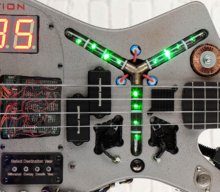
It's the "Birdfish" guitar, made by Ulrich Teuffel in Germany. It's a very modern, avant-garde guitar, for sure.

The construction is such that the entire load of the strings travels through two wooden cylinders in the upper bout area of the guitar.
Without these, the guitar would collapse. They are attached with threaded inserts to the metal components at the neck and bridge end.

Each Birdfish guitar comes with several different sets of wooden cylinders (maple, mahogany, and alder IIRC), which can be switched out.
If you do them one at a time, then the switch can happen without detuning the guitar.
This is the best-case scenario for control on all other variables - EVERY other part of the guitar stays exactly the same.

And yes, it does make a difference. I've played them and done the switches, and it was clearly audible. Teuffel, who is as OCD about detail and nuance as any builder in the game,
is convinced by the results. I've spoken with a Teuffel artist who does extensive recording for TV and film, who had clear preferences (based on experience) on which
materials were best for specific applications.

Expectation bias? Could be. But it could also just as easily be that people who have spent their lives doing this, and who seem to overwhelmingly agree
as to the value and meaningful contribution of woods to all instruments (electric and acoustic), might be on to something, and not simply subject to some sort of mass hallucination...:)

Cheers!
Martin
 
  • Like
Reactions: wraub
Tonewood is sort of a joke. You have to make drastic changes in wood types. Like mahogany vs. maple, not maple vs. Ipe. Like people said on here 1,000 times, a bass is the sum of it's parts. If you had a bass made of all maple and then a bass made of all mahogany, it MIGHT change the tone 5-10% at best. Anybody that thinks wood in an electric bass makes a huge difference is wrong. Anybody that thinks wood makes no difference at all is wronger. :)

I've been avoiding this thread because I believe people will believe what they believe, and will unconsciously adjust their playing to match their expectations. That said, I just finished a build using all mahogany and it is anything but "warm". It's as bright as any of my maple builds. I believe it's bright because that's how I play a bass. My "style", for lack of a better word, accentuates an instrument's high end. So when people who have an ear see and hear me play my Ric's, they'll estimate that my playing sounds bright because I'm playing an all maple bass. I think it's the opposite - my Ric's sound bright because that's the way I play, just like when I play my all mahogany bass.

I wouldn't quite call it a joke, but I don't believe the wood from which a bass is made has any significant effect on its sound. It's all strings, pickups, electronics, and above all else, ones playing style.
 
I'll throw this out there

One of the biggest contributors to tone is finish!
My perspective: Fretless bass.
A plain fingerboard, vs a highly polished board vs epoxy vs CA, will yield you different tonal characteristics
For fretted instruments, this probably isn't as true, if at all.
 
  • Like
Reactions: scottyd
Here are a few thoughts on this topic.

I have built a number of basses and find that woods have a huge impact on tone. There are however some qualifiers.

1. The finish as stated by Scoops (above) is very important. Take a MIM P bass with its thick and hard finish. When testing maple or rosewood fretboards I find the difference is subtle because the body of the bass is so dead pan, it has little vibrancy. Take the opposite end of the spectrum of such finish, French polishing or a thin nitro and the differences become a lot more obvious. The wood has a chance to shine through the finish.

2. Bodies and their build have an impact as well. Take a three piece body or a body made of a single piece of wood and the importance of tone wood will be magnified. Glue had no tone!

3. The wood themselves can minimize or exacerbate the difference between fretboards. For example, walnut only pairs well with rosewood fretboards; it does not sound good with maple or ebony fretboards to my ears. That being said it depends on your taste and tonal goals. Mahogany takes rosewood and ebony well. Ash seems to pair really well with maple fretboard. I have come to these conclusions by listening to different necks on different bodies. All the bodies were made of one single piece of wood with French polishing finish (no grain fillers were used). I could hear huge differences between different combinations.

4. Wood will sit in the mix differently as well. A walnut body imposes itself through a mix incredibly well. An ebony freboard will cut through as well. These two show big differences.

Tone for instrument is a lot more complicated than people assume and everything to an extent has an impact on tone. Pickups and strings have the most, then necks (their size, and woods) have the most impact then bodies (wood, construction, finish, weight). Bridges have an impact as well. It never ends!

Hearing wood tonal differences is also an education. It's like tasting wine, most adults will tell you if they like a wine or not but their senses are not educated enough to tell you how much oak aging it received or what grapes it's made from. A winemaker will tell you all that with a pretty high degree of accuracy. So take 3 people off the street and ask them to tell you if they hear any differences between maple and rosewood fretboard on a MIM body and the result is obvious, they won't.

I am not going to convince people who think wood has no tonal impact, it's a personal belief. If they are happy with a MIM or US AVRI P bass, great, they are both good instruments that will do their job well and sit in the mix like champs. However if you're looking for more tonal diversity between your instruments and are interested in exploring this topic, you will find some rewards and education in that journey.
 
Last edited:
I always refer to Invalid Link Removed of Carl Thompson when someone asks about what wood sounds like. I surely don't have enough experience to say definitively one way or another, though I do know that I can do dramatic things with my tone with EMG DC pickups and the knobs on the EMG BQC preamp.

Q: Do you look for any specific properties when selecting wood?
Carl: [Pause] Neck wood I do yeah. Neck wood I look for quarter sawn, hard rock Maple, good Honduran Mahogany, Anything that's really hard and straight grained. I don't use too many fancy woods anymore for necks. That's been my experience. Fancy woods on necks get funny. It's tough enough trying to keep a piece of wood straight as it is. As far as the bodies are concerned, I know a lot of people talk about tone woods and all that stuff. But I really think the best way to get a good tone it to practice a lot. So I really don't get into that much. But looks nice, looks like a nice piece of wood.

I like to say what Ken Parker said when they asked him what kind of wood he used and Ken said, "I use good wood." I always liked that. Another time he said, I think he said, "I use guitar wood." Hope Ken doesn't mind me saying that. I remember him telling me that. That's about all I can tell you about wood.
 
  • Like
Reactions: Deep Cat
I'll be 60 years old on my next birthday, so I'm not going to tell anyone that they aren't hearing correctly. What I can say is that when I was maybe 14 or so, I "re-finished" my early 70's Precision bass. Sanded off the poly, or what ever was on there with an angle grinder, and brushed on some polyurethane. (I know, sacrilege) I didn't do it for sound, I just didn't like the sunburst and wanted it natural. I heard no difference in tone. Even when I strung it up before I put on any finish. These days, when I play a bass, it sounds like me. Whether I play an all maple Ric, or my maple/alder Precision, it sounds like me. Now I can hear a difference between the Ric and the Precision, but both basses still sound like me playing.

Further, when someone else plays either of those basses, they don't sound like me. I still hear a difference between the two, but they both sounds like that other person.

Point is, the individual player. in my opinion, makes a big difference in the sound of the bass. These 60 year old ears can easily hear that. Swapping out pickups results in a similar difference. Wood? Not so much. My old Dan Armstrong plexi bass still sounded like me. And that's when I was listening with my teenaged ears.
 
Hearing wood tonal differences is also an education. It's like tasting wine, most adults will tell you if they like a wine or not but their senses are not educated enough to tell you how much oak aging it received or what grapes it's made from. A winemaker will tell you all that with a pretty high degree of accuracy. So take 3 people off the street and ask them to tell you if they hear any differences between maple and rosewood fretboard on a MIM body and the result is obvious, they won't.
If nobody can hear it, is there really a difference. I'm not going to say that there is no difference it just has to be a fairly big difference between the woods, like pine or paulowina (sp), vs hard maple. And then most of that can be EQ'd out,
 
I've been avoiding this thread because I believe people will believe what they believe, and will unconsciously adjust their playing to match their expectations. That said, I just finished a build using all mahogany and it is anything but "warm". It's as bright as any of my maple builds.

+1. I have an all-maple neck-through Pedulla thunderbass with an ebony fretboard, SS frets. Most would say 'that must be very bright sounding.' Nope. Darkest sounding (even unplugged) bass I've ever owned. You just never know.
 
  • Like
Reactions: mapleglo
Going out on a limb here. For those who say it makes a difference, nothing opposing will change their mind, and vice versa.

I'd change my mind in a heartbeat if I were shown verifiable repeatable scientific evidence that wood mattered in constructing the timbre of an instrument. All signs presently point to the electronics, strings and witness points of the strings.

Timbre, however, isn't "tone."

I think one of the points of contention is that we can't agree on terminology.

Timbre has pretty specific meanings regarding music and sound. "Tone" also has some pretty specific meanings, but regarding the selling of musical instruments, it's pretty much a marketing term. It's lack of specific meaning makes it ideal for selling. It means what you think it means.

For my purposes, I'd rather just pick something pretty and unusual and then try to make the best constructed instrument I can than worry about other considerations.

One of these days though because I'm even a contrarian to myself, I'll build a bass to try to get a certain "tone" using "tonewood" guide lines.
 
More from the CT interview:

Aaron: Suppose a customer is describing the sound they wanted to get from a bass. What key words would make you think a set neck would be best for that person or a bolt on?
Carl: I have no idea. I wouldn't know what anyone was talking about. Anyone talks about how I can get them the sound I don't know what they are talking about.

Somebody wants a bright sound. What's a bright sound? Explain to me exactly so I understand what you mean by a bright sound. Explain that to me. I'll make you a free bass if you can do it. Where I understand exactly what you mean. Without question I have no doubts in my mind exactly what you mean by a bright sound, or a funky sound or a warm sound, or any other kind of sound. Explain it to me exactly so I know exactly what you're talking about. And then I'm supposed to go find wood that's going to get you that exact sound. No matter what I do to the wood. Whether I bolt it in or glue it in. There's just so many things involved there to really get a good sound. I get a good sound all the time if that's what you mean. I can get a good sound out of anything. I never even thought about it. When I first started making the bass. I was not disappointed with the sound of any bass I ever played. I'm still not disappointed. I can play any bass and get a sound. I like playing the Danelectro basses. I think they are great. I get a good sound out of a Dano-I really do. I can get a good sound out of a Fender. I can get a good sound out of almost anything, you hear me. But I have a sound in my head that I hear and I just find it on any instrument, somehow. So why would anyone want to buy my instrument if I can get that sound? I can get it. Because I have an attitude in my head when I'm going to be looking for something. A certain piece of wood is going to get me something. I'll get it. I'll find a way to get it. I'll get it. I'll just get it and you should be able to get it too.

I get a lot of questions from people, you know, "I want a bass like-the bass that Les Claypool has really sounds great. I'd like to get that." I've played Les' bass. I can't make it sound the way he does. I'm a pretty good player, you know.
 
Going out on a limb here. For those who say it makes a difference, nothing opposing will change their mind, and vice versa.
The conversation in general usually ends up being akin to discussing religion. I know of a few people who were die hard tonewood "believers" that converted to become staunch opponents. In my opinion it doesn't really matter whether it's true or not, or whether psychoacoustics plays a major role. Are you happy with the way your bass plays, and can you swap components such as strings, pickups, pots, preamps, etc. to get the tone you are looking for? If so - great!