• TalkBass has been independent since 1998. Add your voice.
    Create a free account to reply to discussions, view embedded media, and browse with fewer display ads.
    Join freeLog in
    Want zero display ads or expanded classifieds tools? Compare plans.

Total solar eclipse 2017 - official thread

hbarcat

Supporting Member
Aug 24, 2006
10,227
18,610
Rochelle, Illinois
There will be a total solar eclipse on August 21st, 2017, which will be visible from all of North America.

Invalid Link Removed

The purpose of this thread is to provide information and support to anyone who wants to view this wonderful, yet rare, event.

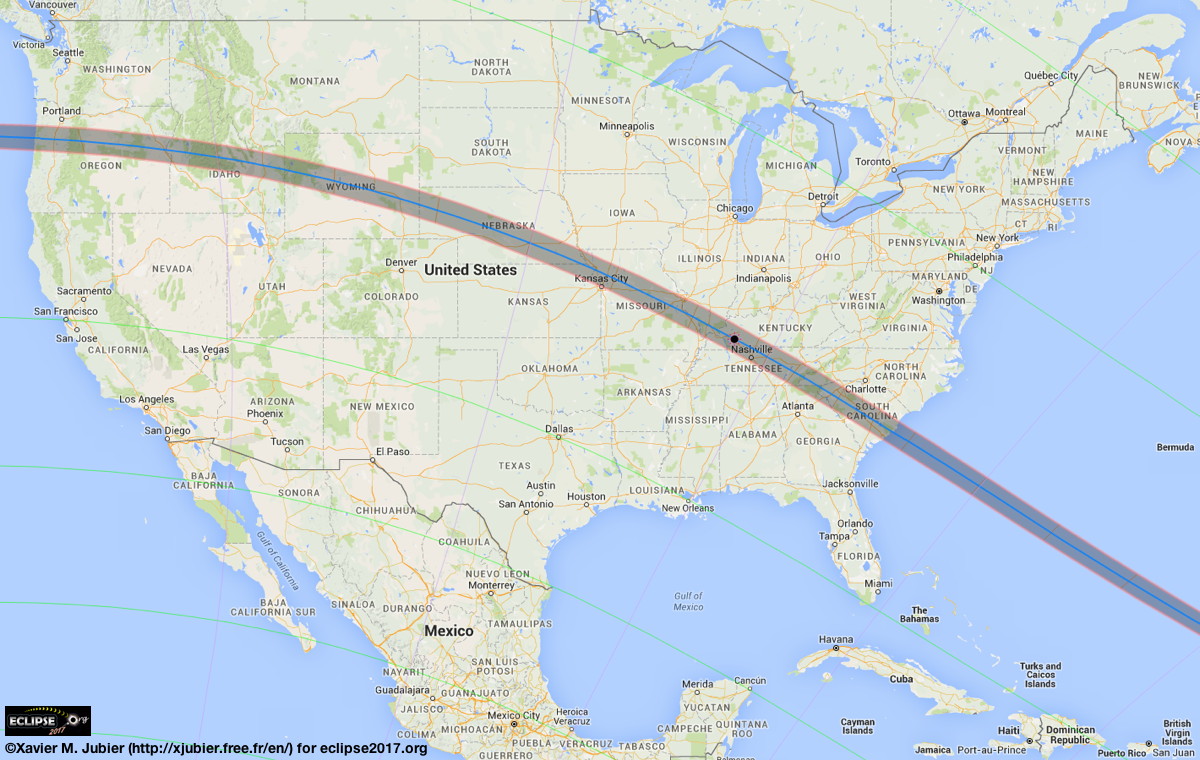
The path of totality:
whole-us.jpg


If you wish to view the eclipse in totality (the sun is entirely covered by the moon and the sky is completely dark) you will need to be in the shaded area of the map at the correct time. Observers outside of the shaded zone will see a partial eclipse. Weather permitting, of course.
 
@hbarcat , can you explain to me weather or not that shaded path is the same width/diameter of the moon itself?

It is not.

The width of the totality path is determined by the relative geometry of these two factors.

1) The apparent width of the sun as seen from the Earth's surface

2) The apparent width of the moon as seen from the Earth's surface.

Obviously, the real width of sun and moon are fixed, but the apparent widths change slightly since the distance from each body to the Earth is sometimes nearer or farther.

By coincidence, both sun and moon appear very nearly the same size in the sky. During a typical eclipse, the moon just barely covers the sun. But there are often eclipses when the moon is near it's farthest point in orbit around Earth and its disc doesn't quite cover the sun's disc. This is called an annular eclipse and we see a thin ring of sunlight surrounding the moon. There is no dark path along the ground during an annular eclipse because there is no totality.

annular.jpg


Extremely rarely, the sun and moon will be at the precise distance so their discs are the exact same size and totality lasts for only an instant. Tiny rays of sunshine actually sneak through valleys between mountains on the edge of the moon's disc (called Bailey's beads) and the dark path of totality on Earth is so narrow you could walk right across it.

Solar_eclips_1999_5.jpg
 
Last edited:
It is not.

The width of the totality path is determined by the relative geometry of these two factors.

1) The apparent width of the sun as seen from the Earth's surface

2) The apparent width of the moon as seen from the Earth's surface.

Obviously, the real width of sun and moon are fixed, but the apparent widths change slightly since the distance from each body to the Earth is sometimes nearer or farther.

By coincidence, both sun and moon appear very nearly the same size in the sky. During a typical eclipse, the moon just barely covers the sun. But there are often eclipses when the moon is near it's farthest point in orbit around Earth and its disc doesn't quite cover the sun's disc. This is called an annular eclipse and we see a thin ring of sunlight surrounding the moon. There is no dark path along the ground during an annular eclipse because there is no totality.

Extremely rarely, the sun and moon will be at the precise distance so their discs are the exact same size and totality lasts for only an instant. Tiny rays of sunshine actually sneak through valleys between mountains on the edge of the moon's disc (called Bailey's beads) and the dark path of totality on Earth is so narrow you could walk right across it.

Yes, I think I see that, thank you!
 
As a follow-up to your question -- In order for the shadow on Earth of an object in space near the Eart to be the same size as the object, the light source would have to be so far away that its light rays would be paralell.

Technically, the light source would need to be infinitely far away, but that's not really necessary for our purposes. As long as the light source is far enough away that it appears to be a pin-point object, then it can be considered as virtually infinitely distant.

Any bright star or planet can be the source of light. Occasionally, a known asteroid will pass between the Earth and the light path of a distant star causing the asteroid's shadow to fall on the Earth (so very, very faintly) in actual size. Using an army of volunteer, amateur astronomers to observe begining and ending times around the world of this miniature eclipse, scientists can re-construct the shadow on paper (or computer) and discover the exact size and shape of the asteroid.

Since the size and shape of only a small percentage of the very largest asteroids are known, this technique is the only tool astronomers have to learn this information.
 
Last edited:
  • Like
Reactions: Gazman
Thanks for the info Hbarcat - I'll be watching from about 125 miles north of the shaded area.

My wife & I are seriously considering taking a vacation to coincide with this so that we'll be watching from directly within the shaded area! Personally I think Grand Teton National Park in Wyoming sounds like the most appealing spot, but we're also kicking around Nashville TN and Charleston SC.

Great thread, and thanks for the heads up @hbarcat !
 
For anyone planning to travel to watch the eclipse, it may be helpful to consider the possibility of cloudy weather at your chosen area. Some regions of the country are more likely to have clouds in August than other areas. There's a little better than a 50% chance of clear skies in most of the Midwest whIle it's probably more than 90% likely in the far west. Close to the Pacific Ocean, the chance of clouds is much higher.

My plan is to monitor the weather forecast the night before the eclipse and drive east or west if the weather looks doubtful.
 
I am very fortunate to be squarely in the center of the path. I have seen partial eclipses before, but have never been fortunate to see a full eclipse and I am dead center of the path on this one. Pretty excited about it. There is an outfit offering super cheap viewing glasses. Posting a link below. If you plan to enjoy this event I would order the glasses now. They might be hard to get closer to August.
Total Solar Eclipse 2017 - The best prices you'll find on CERTIFIED SAFE Eclipse Glasses!