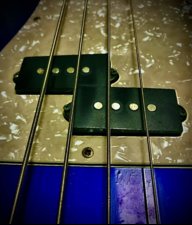

Thank You. I Love your Jazz Bass.
I have a Set of Red DR's already for it. I'm waiting till I'm certain this neck is stable. I have a really good righty Neck standing by in case this one is un-stable.

TalkBass has been independent since 1998. Add your voice.
Create a free account to reply to discussions, view embedded media, and browse with fewer display ads.
Join free Log in
Want zero display ads or expanded classifieds tools? Compare plans.
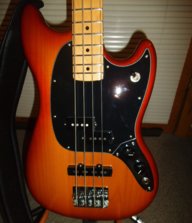


Interesting! You oughta share it with the Dual P Pickup Club.Squier Mustang with double Mustang pickups and stacked knobs:
View attachment 4007709 View attachment 4007710


Squier Mustang with double Mustang pickups and stacked knobs:
View attachment 4007709 View attachment 4007710
Crazy-looking, but very intriguing setup. Do the E and A strings have a very different tonality from the D and G when both pickups are running?
 )
)
If you shop smart (...shop S-Mart!Thoughts on buying a used squier and upgrading the neck, pickups, bridge etc.. vs getting a used American Standard?
 ), you could conceiveably build something quite nice for a fraction of the cost an American-made bass. However, the trick is finding a good/great neck and body to build up from. Pull that off, while not going too crazy on the upgrades, and you’ll succeed. I know I have.


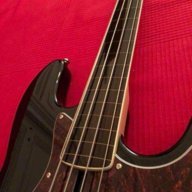
Impressive. How did you do the p stack?It sounds deep phat and awesome. They go together great, my fave two tones in one bass. No loss of thunder, I’m not a fan of PJ basses because the J is too thin for me. My Fatfish has a J in the neck which I love and decided to do this one in a similar manner with the Ric pickup in the same position and it delivers
Been there! Both of mine needed work. Glad I did thoughI wasn't planning on re-doing the writing. This is my "fly" bass. However, once I saw the old wiring, I couldn't unsee it.
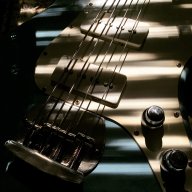
It’s wired like a ‘62 JazzImpressive. How did you do the p stack?

Thoughts on buying a used squier and upgrading the neck, pickups, bridge etc.. vs getting a used American Standard?[/QUO
…assuming Drew is talking about a Jazz bass, the control plate may need to be replaced as well. If the Squier is using mini-pots, the plate's first three holes will be too narrow for standard-sized CTS pots. (The fourth hole is larger to accommodate a ¼" inner-diameter output jack.) Whenever I'm looking for a control plate online, I make sure the numeric specs AND the diagram show all the holes are the same size.The only thing I did right off the bat with the two passive ones was to update the pots/wiring/jack, as this is a classic cost-cutting measure on any low retail price instrument (you can't see 'em), and updating to CTS or Bourns and a little wiring and a good jack isn't much money.