
Enjoy the benefits of a premium membership!
Upgrade Account
-
TalkBass has been independent since 1998. Add your voice.
Create a free account to reply to discussions, view embedded media, and browse with fewer display ads.
Join free Log in
Want zero display ads or expanded classifieds tools? Compare plans.
You are using an out of date browser. It may not display this or other websites correctly.
You should upgrade or use an alternative browser.
You should upgrade or use an alternative browser.
Trickfish Amps
- Thread starter silky smoove
- Start date
More options
Who Replied?


At BassPlayer Live...
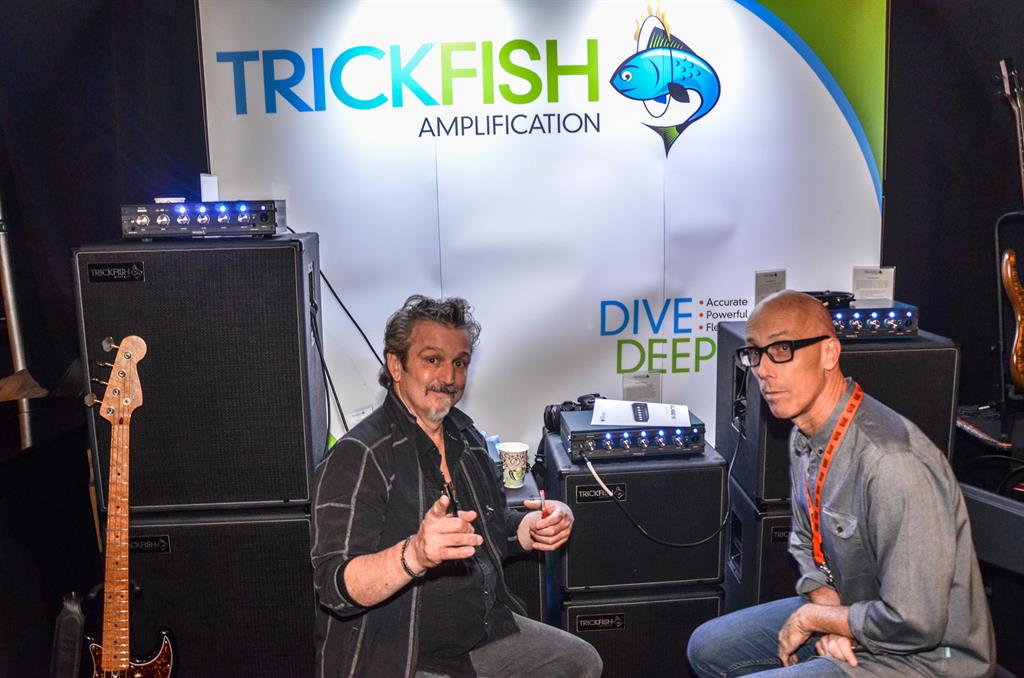
Photo by either Jon D'Auria or Alex Kluft, who were snappin' for BassPlayer Magazine
Photo by either Jon D'Auria or Alex Kluft, who were snappin' for BassPlayer Magazine

Played through some trickfish gear this weekend at another local bass players house and posted this in another thread.
"I played through the Trickfish Bullhead 1k using the 4 X 10 then the 1 X 12 cab this weekend. Very neutral powerful sound. The head is bigger than I thought it would be. Think GK RB Series without the weight. The controls are very smooth and predictable. Cool guy 70's receiver knobs are a nice touch. The 4X10 just sounded rock solid. With the Bullhead amp set flat EQ adjustments on the bass were plenty to tweak the sound anyway I wanted (it was a flexcore loaded Jazz bass). The same head through the 1 X 12 was pure magic. Smaller but similar sound with a lot of focus. I personally like the newer 1 X 12's as they can usually cover most of my gigs and the Trickfish 1 X 12 would be perfect. A stack would be interesting too. The 4 X 10 sounded great but like most 410's just too much cabinet for me. I like my rig to have a small footprint because I guess I have a big one.
Everything was beautifully built and executed and I'd be happy to gig everything I tried out. I am not in anyway affiliated with trickfish. Just hadn't seen much feedback."
"I played through the Trickfish Bullhead 1k using the 4 X 10 then the 1 X 12 cab this weekend. Very neutral powerful sound. The head is bigger than I thought it would be. Think GK RB Series without the weight. The controls are very smooth and predictable. Cool guy 70's receiver knobs are a nice touch. The 4X10 just sounded rock solid. With the Bullhead amp set flat EQ adjustments on the bass were plenty to tweak the sound anyway I wanted (it was a flexcore loaded Jazz bass). The same head through the 1 X 12 was pure magic. Smaller but similar sound with a lot of focus. I personally like the newer 1 X 12's as they can usually cover most of my gigs and the Trickfish 1 X 12 would be perfect. A stack would be interesting too. The 4 X 10 sounded great but like most 410's just too much cabinet for me. I like my rig to have a small footprint because I guess I have a big one.
Everything was beautifully built and executed and I'd be happy to gig everything I tried out. I am not in anyway affiliated with trickfish. Just hadn't seen much feedback."

Hey Sandman64,I hope they come out with a 500 or 600 watt version of this head. My cabs can only handle so much and I'd not have to go out and buy cabs to match the heads power etc.
There has been some discussion about whether the Bullhead 1K is 1000W RMS or peak. There has been extensive conversation about this issue in the Trickfish thread. In either case having the extra power/headroom, even if you don't need it, will run your speakers more efficiently getting the most out of them even at lower volume. Just be sure you have the correct impedance 4 or 8 ohms. Trickfish debuted their new 3000 watt amp at the 2016 NAMM show so I don't think a 500-600 watt amp is on their foreseeable future.
What kind of cabs do you have, what is the power handling rating and what impedance are they?
Hey Sandman64,
There has been some discussion about whether the Bullhead 1K is 1000W RMS or peak. There has been extensive conversation about this issue in the Trickfish thread. In either case having the extra power/headroom, even if you don't need it, will run your speakers more efficiently getting the most out of them even at lower volume. Just be sure you have the correct impedance 4 or 8 ohms. Trickfish debuted their new 3000 watt amp at the 2016 NAMM show so I don't think a 500-600 watt amp is on their foreseeable future.
What kind of cabs do you have, what is the power handling rating and what impedance are they?
I pretty well always use both my cabs, which means my heads always put out max power to them. My cabs are, GB 2X12 Rated 600 watts 4 ohm. Two Markbass 1x12 New york cabs 400 watts each, 8 ohm cabs and two Aguilar GS 1x12's 300 watts each, again 8 ohm cabs. I'm thinking a 1k amp might be a little too much power for those.
All of the your cabs can handle the Trickfish amp no problem. You can use any two of your 8 ohm cabs together but only one 4 ohm cab unless your amp is rated down to 2 ohms. Most, but not all, heads are designed to produce max power at 4 ohms. If you overload the amp, running a speaker load below 4 ohms, you can do serious damage to your speakers and amplifier.I pretty well always use both my cabs, which means my heads always put out max power to them. My cabs are, GB 2X12 Rated 600 watts 4 ohm. Two Markbass 1x12 New york cabs 400 watts each, 8 ohm cabs and two Aguilar GS 1x12's 300 watts each, again 8 ohm cabs. I'm thinking a 1k amp might be a little too much power for those.
All of the your cabs can handle the Trickfish amp no problem. You can use any two of your 8 ohm cabs together but only one 4 ohm cab unless your amp is rated down to 2 ohms. Most, but not all, heads are designed to produce max power at 4 ohms. If you overload the amp, running a speaker load below 4 ohms, you can do serious damage to your speakers and amplifier.
Oh I'm sure they could handle it, but for how long? lol All my heads pretty well match my speaks cabs power specs which is what I like, For example. My Markbass Little III supplies 500 watts of power into two 400 watt 8 ohm New York 1x12 cabs. These cabs combined give me 800 watts to play with. The Aguilar ToneHammer 500 supplies 500 watts of power into my two GS 1X12 300 watt 8 ohm cabs. Again, these two cabs combing can handle 600 watts. My GB Streamliner 600 supplies 600 watts of power into my 2x12 GB 600 watt Neox 4 ohm cab.
They all have very different tonal characteristics which is what I like. I do mix and match my cabs with difference heads for fun and to see if it makes a big difference tone wise. I personally believe that your cabs should match relatively closely what your heads power rating is. More power is always good as you actually have less of a chance of destroying your speakers with an amp that has more juice than an amp you have to continually max out etc. However an amp that puts out 1k might be a little too much for a 600 watt cab. 800 watts would probably be fine though and yes a lot would depend on ones playing style etc.
I'm sure that if enough of us bugged Trckfish about perhaps producing a 500 or 600 watts version of that head that they would seriously consider it. That seems to be the go to watts range of most of these class D amps. It would benefit then as well to be a player in that area.
Just my 2 cents!

- Feb 12, 2006
- 61,031
- 5
- 220,918
- Disclosures
- Development Engineer-Mesa Boogie, Development Engineer-Genzler (pedals), Product Support-Genz Benz
It is wise IMO to express some concern about power available and power handling. The real challenge is that different companies (and/or their marketing guys) tend to rate things in different ways which makes direct comparison more difficult.
In fact, defining power handling of a speaker is much more difficult than it might seem because it is not (and can not be) a single number but is a range of numbers depending on specific conditions such as frequency.
The basic process is to determine how the amplifier rated (is the number provided based on "RMS" or peak units, where peak is defined as 2x the "RMS" value but the signal is identical)
Then you will need to determine how the speaker is rated, noting that the mechanical power handling of a speaker is usually less than the "RMS" (or thermal, or continuous average) power.
I do not know how the amp in question is rated, but with regard to your GB 212, the rating is based on "RMS" or continuous average power. I can also say that the mechanical power handling is at least 80% of the thermal power all the way down to the F3 point on the low end (the point that the frequency response falls 3dB below nominal flat).
For longevity of the cabinet, I typically recommend matching up the RMS power handling of the cabinet with an amp of similar RMS capability. This leaves some latitude regarding low frequency mechanical limits and the possibility of driving the amp hard into overdrive.
Regarding cabinet longevity, lifespan is a direct function of the number of hours the drivers are driven very hard (especially close to or beyond its mechanical limits). Driving the snot out if a cabinet does decrease lifespan. That said, an amp larger than the cabinet's power handling is not a problem IF you are careful not to drive the amp so hard that you enter the speaker damaging territory.
Hope this helps.
In fact, defining power handling of a speaker is much more difficult than it might seem because it is not (and can not be) a single number but is a range of numbers depending on specific conditions such as frequency.
The basic process is to determine how the amplifier rated (is the number provided based on "RMS" or peak units, where peak is defined as 2x the "RMS" value but the signal is identical)
Then you will need to determine how the speaker is rated, noting that the mechanical power handling of a speaker is usually less than the "RMS" (or thermal, or continuous average) power.
I do not know how the amp in question is rated, but with regard to your GB 212, the rating is based on "RMS" or continuous average power. I can also say that the mechanical power handling is at least 80% of the thermal power all the way down to the F3 point on the low end (the point that the frequency response falls 3dB below nominal flat).
For longevity of the cabinet, I typically recommend matching up the RMS power handling of the cabinet with an amp of similar RMS capability. This leaves some latitude regarding low frequency mechanical limits and the possibility of driving the amp hard into overdrive.
Regarding cabinet longevity, lifespan is a direct function of the number of hours the drivers are driven very hard (especially close to or beyond its mechanical limits). Driving the snot out if a cabinet does decrease lifespan. That said, an amp larger than the cabinet's power handling is not a problem IF you are careful not to drive the amp so hard that you enter the speaker damaging territory.
Hope this helps.
Excellent explanation by Agedhorse. Obviously a knowledgeable electronics engineer. Sure, I love to mix and match heads and cabs too but have never blown anything up even at high spl's. I have owned 500 and 800 watt Markbass heads, a Tonehammer 500, Genz Benz Streamliner 900 and GB ShuttleMax 12.0. While all different tonally I never had an issue overdriving or damaging cabs, including single 110 and 112's.Oh I'm sure they could handle it, but for how long? lol All my heads pretty well match my speaks cabs power specs which is what I like, For example. My Markbass Little III supplies 500 watts of power into two 400 watt 8 ohm New York 1x12 cabs. These cabs combined give me 800 watts to play with. The Aguilar ToneHammer 500 supplies 500 watts of power into my two GS 1X12 300 watt 8 ohm cabs. Again, these two cabs combing can handle 600 watts. My GB Streamliner 600 supplies 600 watts of power into my 2x12 GB 600 watt Neox 4 ohm cab.
They all have very different tonal characteristics which is what I like. I do mix and match my cabs with difference heads for fun and to see if it makes a big difference tone wise. I personally believe that your cabs should match relatively closely what your heads power rating is. More power is always good as you actually have less of a chance of destroying your speakers with an amp that has more juice than an amp you have to continually max out etc. However an amp that puts out 1k might be a little too much for a 600 watt cab. 800 watts would probably be fine though and yes a lot would depend on ones playing style etc.
I'm sure that if enough of us bugged Trckfish about perhaps producing a 500 or 600 watts version of that head that they would seriously consider it. That seems to be the go to watts range of most of these class D amps. It would benefit then as well to be a player in that area.
Just my 2 cents!
Last edited:
One problem with Trickfish is they have never answered, to my knowledge, the question raised by several Tbers. Is the 1000 watt rating continuous or peak? Based on my own, non-scientific personal observation and experience with the amp, I think it is 1000W peak. This would make it 5-600W RMS and a good match for Sandman64's cabs.It is wise IMO to express some concern about power available and power handling. The real challenge is that different companies (and/or their marketing guys) tend to rate things in different ways which makes direct comparison more difficult.
In fact, defining power handling of a speaker is much more difficult than it might seem because it is not (and can not be) a single number but is a range of numbers depending on specific conditions such as frequency.
The basic process is to determine how the amplifier rated (is the number provided based on "RMS" or peak units, where peak is defined as 2x the "RMS" value but the signal is identical)
Then you will need to determine how the speaker is rated, noting that the mechanical power handling of a speaker is usually less than the "RMS" (or thermal, or continuous average) power.
I do not know how the amp in question is rated, but with regard to your GB 212, the rating is based on "RMS" or continuous average power. I can also say that the mechanical power handling is at least 80% of the thermal power all the way down to the F3 point on the low end (the point that the frequency response falls 3dB below nominal flat).
For longevity of the cabinet, I typically recommend matching up the RMS power handling of the cabinet with an amp of similar RMS capability. This leaves some latitude regarding low frequency mechanical limits and the possibility of driving the amp hard into overdrive.
Regarding cabinet longevity, lifespan is a direct function of the number of hours the drivers are driven very hard (especially close to or beyond its mechanical limits). Driving the snot out if a cabinet does decrease lifespan. That said, an amp larger than the cabinet's power handling is not a problem IF you are careful not to drive the amp so hard that you enter the speaker damaging territory.
Hope this helps.
The module used is good for around 700w with 120v input. Trickfish did beef up the power supply with extra caps. A Crest Prolite 2.0 rated at 1150 @ 8 ohms does put out more sound. The Crest can sustain that power for a few seconds.
It has plenty of power for the majority of situations and cabs. It's a very nice amp.
It has plenty of power for the majority of situations and cabs. It's a very nice amp.
Last edited:
If you need more power than that you probably need a slave or p.a. support. That said, I am intrigued by the 3000 watt version they're coming out with.The module used is good for around 700w with 120v input. Trickfish did beef up the power supply with extra caps. A Crest Prolite 2.0 rated at 1150 @ 8 ohms does puts out more sound. The Crest can sustain that power for a few seconds.
It has plenty of power for the majority of situations and cabs. It's a very nice amp.

So if fastslapper is correct this is really only around 700 watts anyway which puts it squarely in the middle of the sweet spot for sanwin17 and sandman64, right!? No excuses not to buy one now. Haha
- Feb 12, 2006
- 61,031
- 5
- 220,918
- Disclosures
- Development Engineer-Mesa Boogie, Development Engineer-Genzler (pedals), Product Support-Genz Benz
This is not correct for the newer generation modules. The difference is very small.Euro users get more power out of it. I believe the universal power Ice modules work similar.


