• TalkBass has been independent since 1998. Add your voice.
    Create a free account to reply to discussions, view embedded media, and browse with fewer display ads.
    Join freeLog in
    Want zero display ads or expanded classifieds tools? Compare plans.

Double Bass Trouble installing my Realist Lifeline Pickup

Hey guys, I know what I'm about to ask might be a very basic or 'noob' question. I live in a country where there is literally no double bass luthiers and there are only a handful of double basses and double bass players.

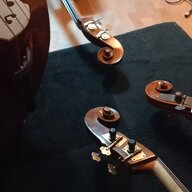
I recently ordered the lifeline pickup but I've encountered trouble installing it. I am supposed to wedge it between the non-threaded side of the bridge action adjuster and the bridge body. However, I am unable to even in the slightest move the bridge body off of the action adjuster. It does not budge even a bit. I've completely loosened both the E and A strings, and have let loose the other two strings quite a bit also. You can see the photo. (I wasn't able to upload a video)

I've tried communicating to the seller overseas who sold me the bass but that didn't result in anything. This pickup cost me a lot of money so I'm kind of desperate in trying to make us of it. I hope you all understand my situation.

I would appreciate any guidance.
 

Attachments

  • IMG_9264.JPG
    IMG_9264.JPG
    367.6 KB · Views: 12
  • IMG_9277.jpg
    IMG_9277.jpg
    239.4 KB · Views: 9
Hi, there was a thread related to a similar issue. Here it is.


If you do this with another person helping you is easier. You have to loosen the E+A in such a way to remove then from the bridge, lose a couple of turns the D+G. Let the other person push a bit on the area where the soundpost is located, to avoid it falling (and that would be a visit to a luthier for sure).
With the uttermost calm and some concise effort, you should be able to pull the upper part of the bridge on the E side. I understand that's scary, but that's the way to do it.
If the bridge doesn't move a bit, it would mean that the adjuster is stuck into the bridge.
 
In your shoes, I would put the bass laying on the back on the floor, then fully detune E+A+D+G and move the bridge away from the bass to ease the manipulation. I never heard of a soundpost falling off when the bass is lying down and not moving. (I heard that you can tighten the body by a rope tightened around in the F-hole area, just like the belt tightens your pants. Never felt the need to try it.)

When installing the bridge back, make sure to place it in the right location, and when you are tuning the strings, control the movement of the bridge top. It has a tendency to lean towards the fingerboard, as the strings are pulling it. The bridge should be perpendicular to the top, which you can check by trying to insert a very thin piece of paper (or something) under any corner of the leg. With a good setup, the bridge is shaped exactly like the top, and there's no chance to insert anything under a leg. (The string grooves should be greased with a soft pencil to lessen the leaning effect.)
 
I never heard of a soundpost falling off when the bass is lying down and not moving.
My soundpost dropped while I was loosening the strings with the bass flat on its back on a bed. My luthier explained that even if a soundpost is perfectly fit, it's not wedged under extreme pressure. When you release all string tension, the top and back could act like a spring and flex outward just a tiny bit. That slight expansion could be enough to make the post fall right over. We're talking fraction of millimeters.
Given the fact that our friend is not nearby any luthier, I'd avoid that route, unless he wants to master the art of re-setting the post, of course (that would be a great skill to learn).
 
My soundpost dropped while I was loosening the strings with the bass flat on its back on a bed. My luthier explained that even if a soundpost is perfectly fit, it's not wedged under extreme pressure. When you release all string tension, the top and back could act like a spring and flex outward just a tiny bit. That slight expansion could be enough to make the post fall right over. We're talking fraction of millimeters.
Given the fact that our friend is not nearby any luthier, I'd avoid that route, unless he wants to master the art of re-setting the post, of course (that would be a great skill to learn).
I really have a feeling that the adjuster is stuck somehow because it's not budging even a little bit with the strings loosened. However, I will give it one more try and put in a bit more strength into removing the bridge body from the foot. And as you said, I will have a friend putting pressure on where the soundpost is.
 
My soundpost dropped while I was loosening the strings with the bass flat on its back on a bed. My luthier explained that even if a soundpost is perfectly fit, it's not wedged under extreme pressure. When you release all string tension, the top and back could act like a spring and flex outward just a tiny bit. That slight expansion could be enough to make the post fall right over. We're talking fraction of millimeters.
Given the fact that our friend is not nearby any luthier, I'd avoid that route, unless he wants to master the art of re-setting the post, of course (that would be a great skill to learn).
Not so difficult with one of these.
Every double bassist should have one, just in case.
 

Attachments

  • IMG_7759.png
    IMG_7759.png
    718.9 KB · Views: 10
  • Like
Reactions: Luca Visconti
Those are really nice. I put one on my gig-bass last year and really like it.

Was going to suggest just slipping the A & E off, and twisting the adjuster a bit to loosen it. Sounds like you got it!
 
  • Like
Reactions: DoubleMIDI
... But I had my wife putting pressure on where the soundpost is just in case. ...
Great about your wife's help, but 2 things to consider in the future:

1) when you place your double bass on its back, make sure the peg box and neck are elevated in mid air so there is no extra tension on the neck joint. An elevated level table is a better platform for the body, not the floor where the peg box is likely to receive weight tension from the body and focus it on the neck joint.

2) if your wife is not available, a sand bag or other soft and smooth weight can provide similar tension over the sound post to prevent it from falling. We're talking about a very small amount of play between the sound post and the top when there is no string tension, so between 2 and 5 pounds(US) -- depending on the type and thickness of the top -- gently applied over the sound post location, should be enough.

Congrats on getting the pickup working!
 
EDIT: Looks like you are Golden. Sound post grabber is cheap. Get one anyway


A sound post can fall off even if the bass is on its back even with the strings just detuned a step or less. Happened to me but the post was probably tilted. You need another person unless you have a sound post grabber. My advice even if just changing strings to look at the sound post and make sure it is still straight. Same if you bump or nudge the bridge. Soundpost fitting should be done anyway to get the most out of your bass. Good luck
 
Putting the bass on the treble side rib means that the soundpost can only move a bit towards the rib if it gets loose. (But it can fall if you are very unlucky.)

Bass on its back with a weight or a tightened belt with some books between belt and top below the treble side bridge foot is a bit safer.
But less safe without any top pressure.

In middle Europe the humidity swing is not as large than in some other places in the world. I had the bridge off my bass several times when it was laying on the back (on a bed or a soft carpet) with no weight or pressure. No problem, but also handling with a lot of care.
 
  • Like
Reactions: Don Hergert
1) when you place your double bass on its back, make sure the peg box and neck are elevated in mid air so there is no extra tension on the neck joint. An elevated level table is a better platform for the body, not the floor where the peg box is likely to receive weight tension from the body and focus it on the neck joint.
Also, as I learned the hard way, even gently lifting the pegbox with the strings off will flex the body just enough that the soundpost will fall over. This happened to my cello, and then to my Kay bass.
 
  • Like
Reactions: Don Hergert
Also, as I learned the hard way, even gently lifting the pegbox with the strings off will flex the body just enough that the soundpost will fall over. This happened to my cello, and then to my Kay bass.
As a public service announcement, (off the top of my head), I will say that the sound post is supposed to have a slot in it. With the strings loosened, the pointy end of the sound post setter I showed earlier fits into the slot and holds and positions the sound post in place. The slot will typically face towards the fingerboard. The top of the sound post sits under the bridge foot or very close to it, left foot if you are looking from the fingerboard towards the endpin. The strings are tightened a bit to hold the sound post up vertically, and the non pointy side of the sound post setter taps the sound post for fine positioning according to how you want the bass to sound. Gentle tapping ensures that you don’t knock the sound post down. You can Google this procedure to glean the finer points.
 
  • Like
Reactions: fdeck
I have to confess that I have set soundposts with a large pair of spring-loaded Tongs whose origins are unknown to me. They were in the house when I was a kid. I haven't touched the innards of my nice bass, but the tongs have seen the inside of some student cellos including mine, and my Kay bass.

My Kay came to me in pieces, without a post. My dad and I could not figure out any good reason why the post had to be round, so we found an old spruce board and cut it to our best guess as to the correct size. Because the plates of a plywood bass are of uniform thickness, you can guess the angles of the post from the outside of the bass. We set up some angled cuts on my dad's radial arm saw, and after we got it down to length, it fit quite nicely and has done its job for more than 40 years. The square profile made it easier to position in the saw.