

Enjoy the benefits of a premium membership!
Upgrade Account
-
TalkBass has been independent since 1998. Add your voice.
Create a free account to reply to discussions, view embedded media, and browse with fewer display ads.
Join free Log in
Want zero display ads or expanded classifieds tools? Compare plans.
You are using an out of date browser. It may not display this or other websites correctly.
You should upgrade or use an alternative browser.
You should upgrade or use an alternative browser.
Tutmarc audiovox model 736: where are they?
- Thread starter beebassdude
- Start date
More options
Who Replied?

Wow! This new bass is very cool. I could get really excited about one of these.
Do you plan to go into production?
Do you plan to go into production?
Wow! This new bass is very cool. I could get really excited about one of these.
Do you plan to go into production?
No, it's just a hobby.

I've started a new thread: Video of an original Tutmarc 736 bass!
Video of an original Tutmarc 736 Bass!
Video of an original Tutmarc 736 Bass!

Last set... The last of these is the notes that I wrote while I was examining the bass:
View attachment 1916696
View attachment 1916697
View attachment 1916698
View attachment 1916699
Here is a pic of the Audiovox Lap Steel that came with the bass:
View attachment 1916700
Moonshine
Wow, thanks for sharing!

Just a beautiful build… wow.Here is Luthier David Searle playing my 2014 replica of the Tutmarc 736 Bass.
View attachment 817665
I would love to see more photos of this lovely bass of yours… backside, etc. Also I'd like to know more about the pickup.

Here We Go Again
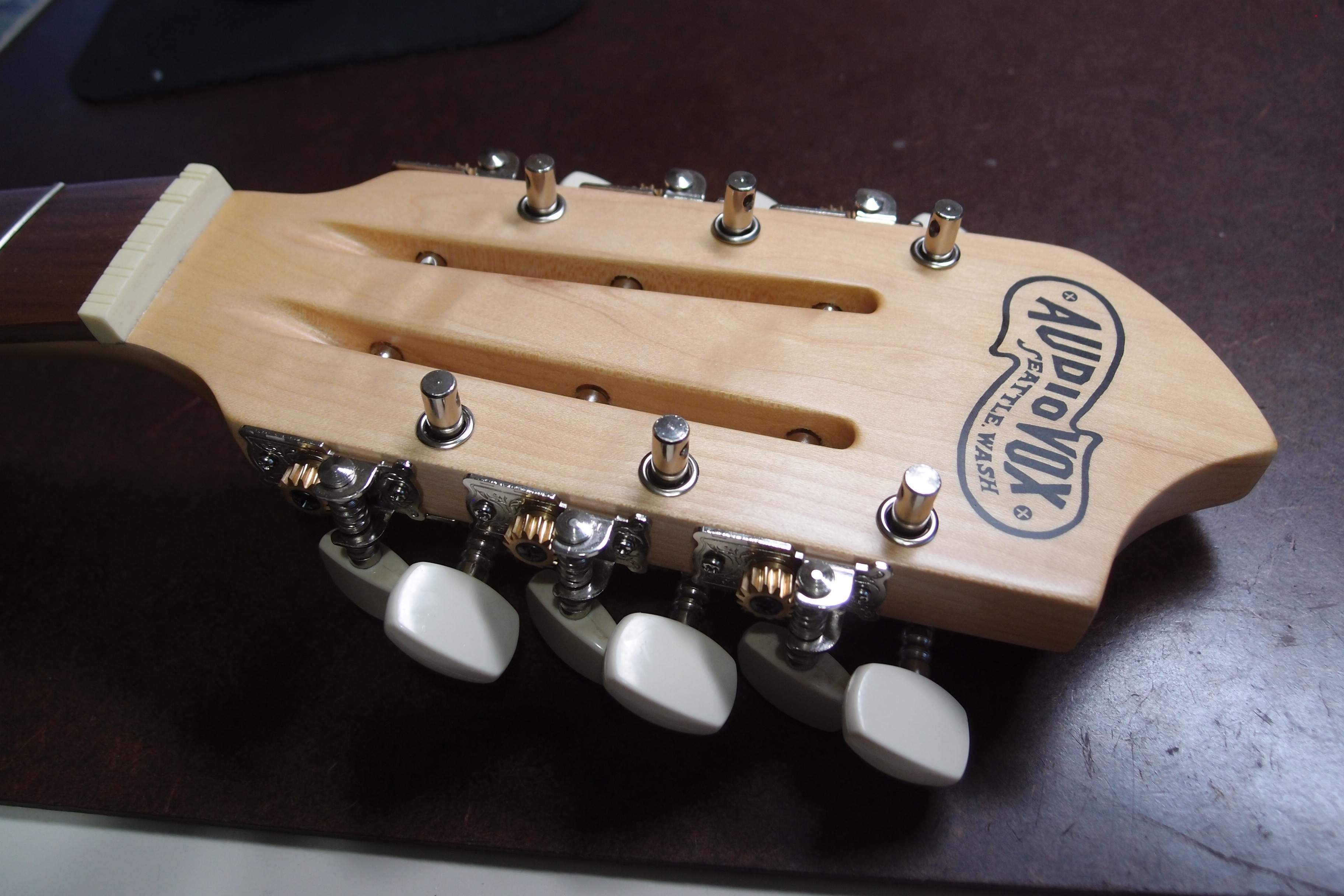
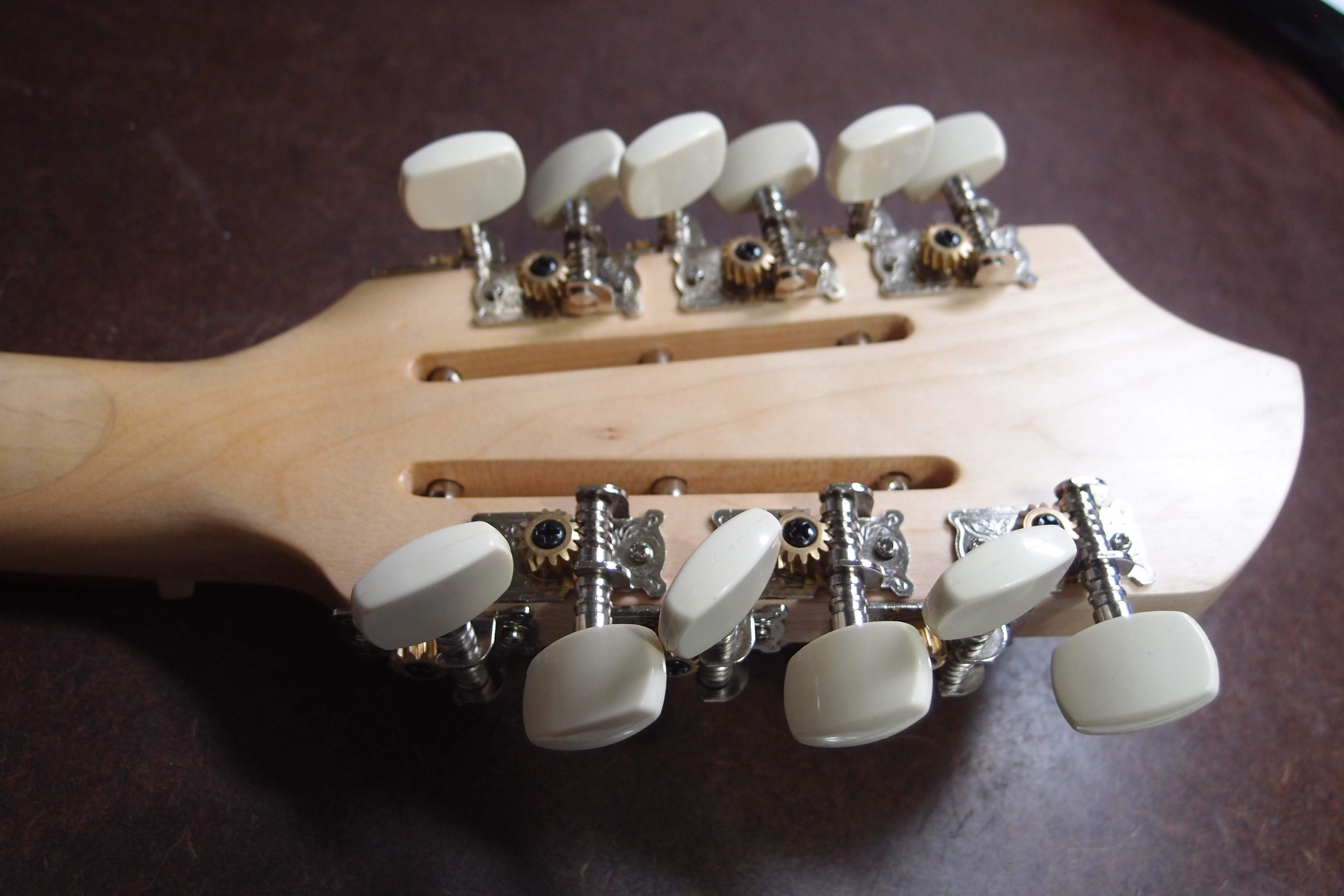
I've always loved these. Never owned a Ric 12, not a millionaire, and they are reputedly very bad players. I once built a six-string to Ric specs, and it was awful. I rebuilt it to Fender specs, and it turned out great.
The first time I did interleaved tuners like this, I used six-on-a-plate tuners. Big mistake - you have to get the hole spacing perfect, I mean perfect, or the tuners won't go on. Even after building a special jig for it, I still had to do a lot of adjusting to make it work. ( Strat headstock, all on one side, much cooler than an actual Fender 12. )
This was much easier. I can tell the spacing is not perfect, and it doesn't matter. I love the way these open-gear tuners look, especially crowded together like this, very steampunk. I had to disassemble half of them and flip them, the whole job took maybe half an hour. This sort of headstock ends up being about an inch longer than a standard six, although noticeably heavier.
The fretboard is walnut from the hobby store, sealed with polyurethane. The frets are hanging in there just fine, why wouldn't they? The body will be the same construction as the Uke. After this, I have four more in the pipeline, and this is not the craziest one. I've had these in work for several years now, but get busy with other things. Hopefully I can get this one together in the next few days.
I've always loved these. Never owned a Ric 12, not a millionaire, and they are reputedly very bad players. I once built a six-string to Ric specs, and it was awful. I rebuilt it to Fender specs, and it turned out great.
The first time I did interleaved tuners like this, I used six-on-a-plate tuners. Big mistake - you have to get the hole spacing perfect, I mean perfect, or the tuners won't go on. Even after building a special jig for it, I still had to do a lot of adjusting to make it work. ( Strat headstock, all on one side, much cooler than an actual Fender 12. )
This was much easier. I can tell the spacing is not perfect, and it doesn't matter. I love the way these open-gear tuners look, especially crowded together like this, very steampunk. I had to disassemble half of them and flip them, the whole job took maybe half an hour. This sort of headstock ends up being about an inch longer than a standard six, although noticeably heavier.
The fretboard is walnut from the hobby store, sealed with polyurethane. The frets are hanging in there just fine, why wouldn't they? The body will be the same construction as the Uke. After this, I have four more in the pipeline, and this is not the craziest one. I've had these in work for several years now, but get busy with other things. Hopefully I can get this one together in the next few days.
Last edited:
I would love to see more photos of this lovely bass of yours… backside, etc. Also I'd like to know more about the pickup.
I'll quote myself from earlier in this thread: "The brilliant Peter Biltoft (Invalid Link Removed) made a replica pickup. I sent him what specs I knew plus this link to the Patent document from Arthur Stimson (www.google.com/patents/US2078350). He made a custom split coil humbucker bass pickup with Bar magnets, two blade pole pieces separated by a piece of non-metallic material. I chose to position the pickup in the "middle" position as seen on the white painted model in the Seattle museum."
Peter Biltolft said "The coils are wound with 40 gauge wire and the DC resistance of the two coils in series is about 2.8 k-Ohms (very close to the vintage specifications). As you may recall, this blade polepiece is comprised of two mild steel blades and a non-metallic spacer to fill the gap between these blades."
My sources for pickup info included the following:
1. Blecha, Peter, 2005. Tutmarc, Paul (1896-1972), and his Audiovox Electric Guitars,
HistoryLink.org Essay7479 http://www.historylink.org/index.cfm?DisplayPage=output.cfm&File_Id=7479
"One split-polepiece magnetic "humbucking" pickup"
2. Teagle, John, March 1999, Vintage Guitar Magazine. Fender Myth Debunked! (Part I). Invalid Link Removed
"Art Stimson filed two patent applications for pickups for Dobro. The first application was filed April 7, 1933. The second was after that date. "This [second] pickup is similar to the George Beauchamp Electro/ Rickenbacher string-driven horseshoe pickup in many respects, but does not extend over the strings, (…) being entirely under the strings. It also has twin coils (bass side/treble side) wired in series, each with its own blade-style polepiece attached to an opposite end (polarity) of the horseshoe magnet. Assuming the coils were reverse-wound (why else would they bother with two), you have the first humbucking pickup for a guitar, as seen on split-pickup P-basses (the theory behind hum cancellation was well-established by the mid '30s)."
3. Tutmarc, Bud, 1996, The True Facts on the Invention of the Electric Guitar and Electric Bass, (published in Lorene Ruymar, The Hawaiian Steel Guitar and its Great Hawaiian Musicians (Anaheim Hills, CA: Centerstream Publishing, 1996) Invalid Link Removed
Pickup "Wire gauge: 38 or 40"
4. Wilson, Rick. Date TBA. Notes and photographs posted online on TalkBass Forum by Rick Wilson of Moonshine Guitars after his inspection of a black walnut Audiovox 736. [email protected]
"Output 2.97 ohms"
Last edited:


I'll quote myself from earlier in this thread: "The brilliant Peter Biltoft (Invalid Link Removed) made a replica pickup. I sent him what specs I knew plus this link to the Patent document from Arthur Stimson (www.google.com/patents/US2078350). He made a custom split coil humbucker bass pickup with Bar magnets, two blade pole pieces separated by a piece of non-metallic material. I chose to position the pickup in the "middle" position as seen on the white painted model in the Seattle museum."
Peter Biltolft said "The coils are wound with 40 gauge wire and the DC resistance of the two coils in series is about 2.8 k-Ohms (very close to the vintage specifications). As you may recall, this blade polepiece is comprised of two mild steel blades and a non-metallic spacer to fill the gap between these blades."
My sources for pickup info included the following:
1. Blecha, Peter, 2005. Tutmarc, Paul (1896-1972), and his Audiovox Electric Guitars,
HistoryLink.org Essay7479 http://www.historylink.org/index.cfm?DisplayPage=output.cfm&File_Id=7479
"One split-polepiece magnetic "humbucking" pickup"
2. Teagle, John, March 1999, Vintage Guitar Magazine. Fender Myth Debunked! (Part I). Invalid Link Removed
"Art Stimson filed two patent applications for pickups for Dobro. The first application was filed April 7, 1933. The second was after that date. "This [second] pickup is similar to the George Beauchamp Electro/ Rickenbacher string-driven horseshoe pickup in many respects, but does not extend over the strings, (…) being entirely under the strings. It also has twin coils (bass side/treble side) wired in series, each with its own blade-style polepiece attached to an opposite end (polarity) of the horseshoe magnet. Assuming the coils were reverse-wound (why else would they bother with two), you have the first humbucking pickup for a guitar, as seen on split-pickup P-basses (the theory behind hum cancellation was well-established by the mid '30s)."
3. Tutmarc, Bud, 1996, The True Facts on the Invention of the Electric Guitar and Electric Bass, (published in Lorene Ruymar, The Hawaiian Steel Guitar and its Great Hawaiian Musicians (Anaheim Hills, CA: Centerstream Publishing, 1996) Invalid Link Removed
Pickup "Wire gauge: 38 or 40"
4. Wilson, Rick. Date TBA. Notes and photographs posted online on TalkBass Forum by Rick Wilson of Moonshine Guitars after his inspection of a black walnut Audiovox 736. [email protected]
"Output 2.97 ohms"
What about the transformer?
The big steel horseshoe magnet looks like a very clumsy solution, but AlNiCo material had only recently been discovered in Japan, and was probably not yet known in the U.S.
Last edited:
Good guy, Pete. He once fixed up a set of pickups for my Realistic violin bass and made that bass sing.View attachment 2880812 View attachment 2880813 Two more photos of the pickup Peter Biltoft built for me.
I got a nice polish on this, maybe I'll get it all together tonight.
Bad news for this one. I mounted the neck, and realized there is no way the lightweight pine body is ever going to balance 12 tuners at the end of the neck. So rather than build something I know will be awful, I will do some kit-bashing. I have several of these that I started all at once, in different styles, but all to the same specs, so the parts are largely interchangeable.
So I took a much heavier finished body from another one with an incomplete neck. That balances much better. I just need to drill the holes for the bridge studs.
In the meantime though, I took the random-orbital sander to the pine body, and it is almost like glass now. I already have an idea for it. The nice thing about these expansive pickguards is that they cover a multitude of sins.
Number 4
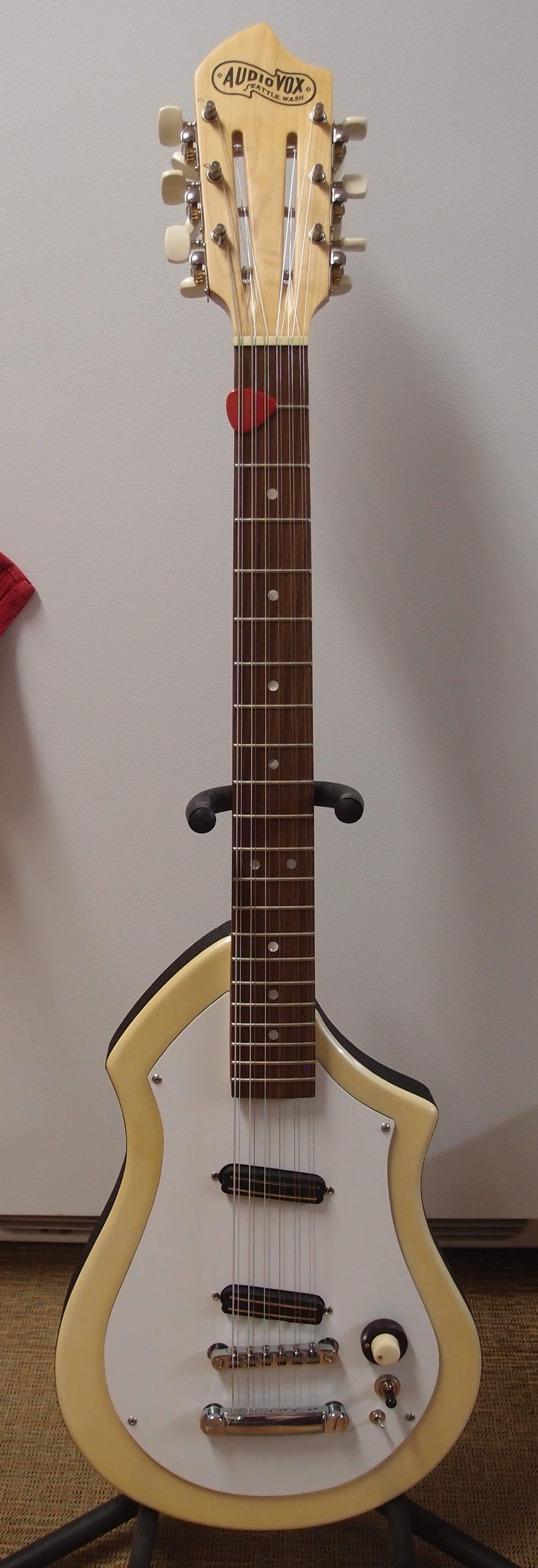
While this is most certainly not a bass, it is a Tutmarc. Although Tutmarc made guitars, I don't think he ever made a twelve, so this is probably the first and only. I've been pushing this project in different directions, and this is one of them.

Here is the headstock, a la Rickenbacker. If you have sharp eyes, you'll notice that it is strung backwards like a Rickenbacker as well. That required filing out some of the nut slots, but has the distinct advantage of putting the self-destructing high-G on a front post, where it is easy to change, rather than buried in the slot. Tuning is confusing at first: for E A D the octave is on the back tuner and the main string is on the front, for G B E it is the reverse. If you've never had to tune more than four strings, one of these will drive you crazy.
The neck is finished walnut over maple, with a 15 degree back angle on the headstock. I put a 0.20" plywood shim in the neck pocket to raise it up to the bridge height while still remaining flat. I could have simply angled it back, but this is easier to work with. The neck has a 1/2" square steel tube for a truss rod.
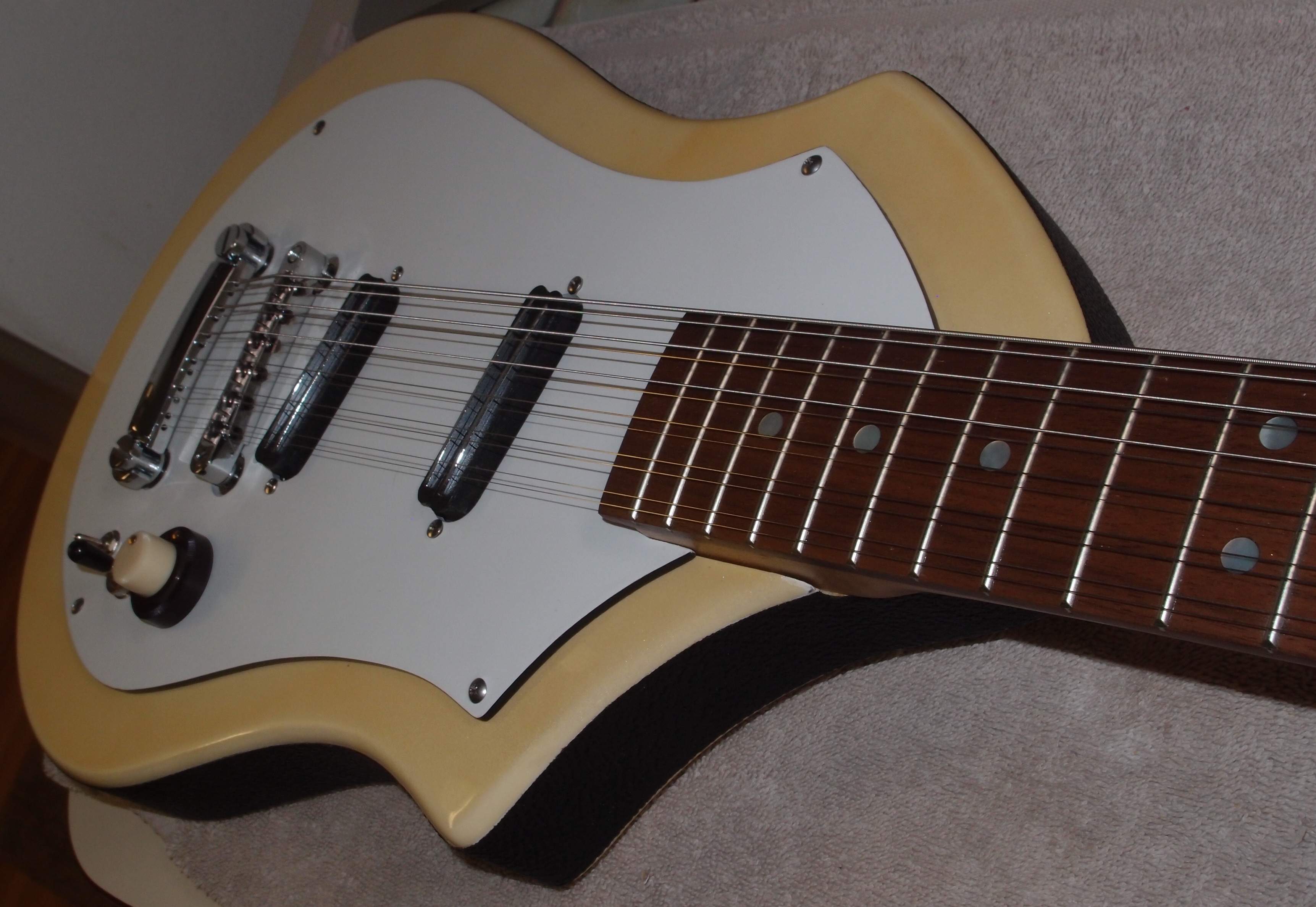
Here is the body. It is Danelectro-style construction: Masonite over a hollow plywood frame, with Tolex side binding. I put half a pound of lead tire weights in the back end of it for balance. The end result is a hefty 8.1 pounds, but it feels good. The finish is polyurethane over white pearl. The pickguard is also Masonite. The controls are Danelectro tone over volume, pickup selector (parallel wiring) and a pickup mode switch. Down puts the pickup coils in the standard series mode, up is parallel, for a brighter more jangly sound. Both modes are humbucking.
Anyway, the guitar plays and sounds pretty good, considering it has only been strung up for a couple of hours. Once it settles in, I will fine-tune the setup.
While this is most certainly not a bass, it is a Tutmarc. Although Tutmarc made guitars, I don't think he ever made a twelve, so this is probably the first and only. I've been pushing this project in different directions, and this is one of them.
Here is the headstock, a la Rickenbacker. If you have sharp eyes, you'll notice that it is strung backwards like a Rickenbacker as well. That required filing out some of the nut slots, but has the distinct advantage of putting the self-destructing high-G on a front post, where it is easy to change, rather than buried in the slot. Tuning is confusing at first: for E A D the octave is on the back tuner and the main string is on the front, for G B E it is the reverse. If you've never had to tune more than four strings, one of these will drive you crazy.
The neck is finished walnut over maple, with a 15 degree back angle on the headstock. I put a 0.20" plywood shim in the neck pocket to raise it up to the bridge height while still remaining flat. I could have simply angled it back, but this is easier to work with. The neck has a 1/2" square steel tube for a truss rod.
Here is the body. It is Danelectro-style construction: Masonite over a hollow plywood frame, with Tolex side binding. I put half a pound of lead tire weights in the back end of it for balance. The end result is a hefty 8.1 pounds, but it feels good. The finish is polyurethane over white pearl. The pickguard is also Masonite. The controls are Danelectro tone over volume, pickup selector (parallel wiring) and a pickup mode switch. Down puts the pickup coils in the standard series mode, up is parallel, for a brighter more jangly sound. Both modes are humbucking.
Anyway, the guitar plays and sounds pretty good, considering it has only been strung up for a couple of hours. Once it settles in, I will fine-tune the setup.
Next Up
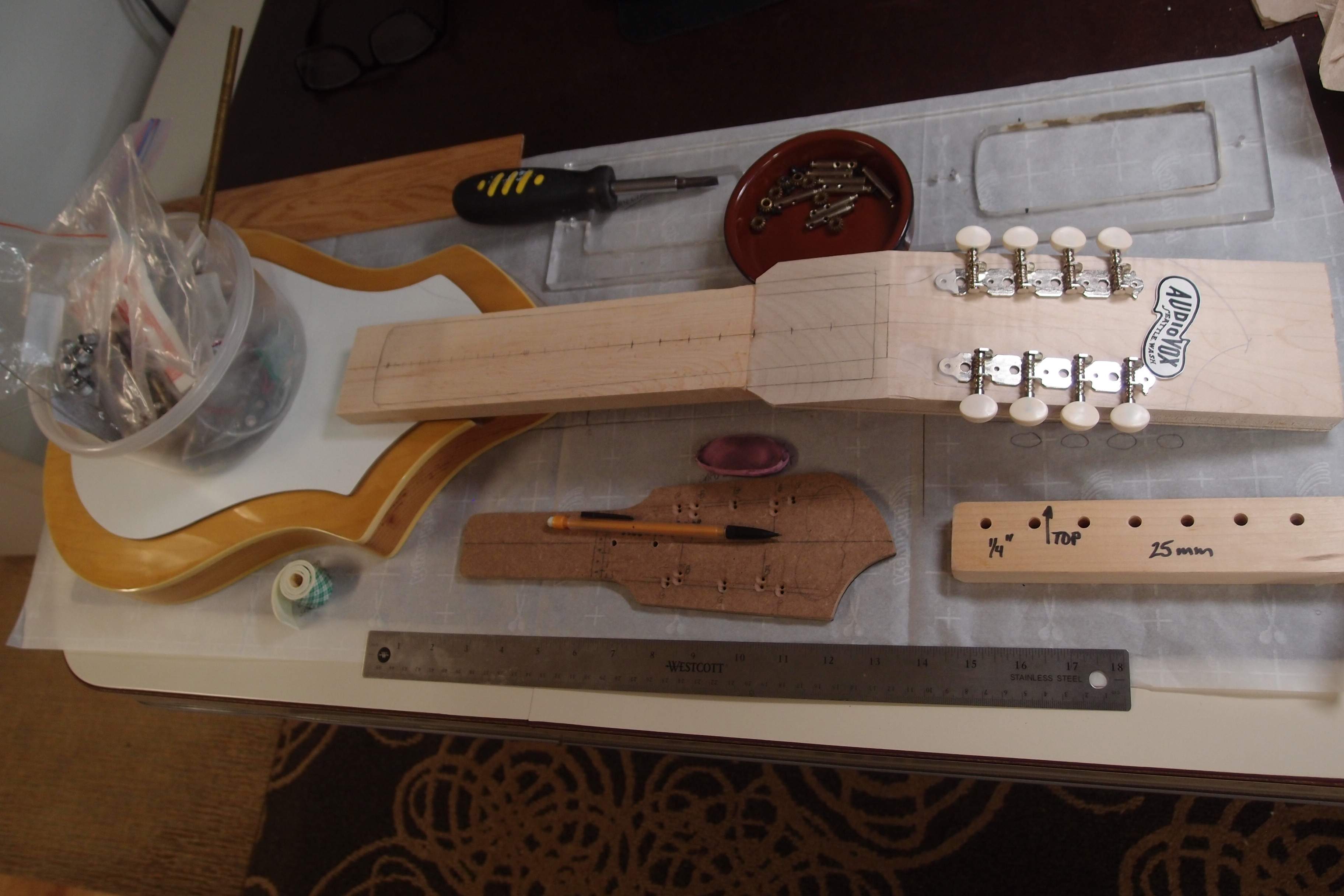
This is the body I had intended for the 12-string, with a new neck that will work much better with it. That leaves another body that I have already roughed-out for this neck. That one will eventually get the half-built guitar neck that was orphaned by the 12-string. In all, I have four more Audiovoxes in the works, that will make eight all together, which I think is enough:
On another note, I've been progressively setting up the 12-string, and it is getting better and better. Today I filed the nut and bridge to even out the strings. Both parts were made for standard stringing, not reverse Rickenbacker stringing, so things were rather off. Much better now. The neck has crept into a barely discernible bow; the steel tube truss rod is working out well. The A-frame truss rod I used on my previous 12 proved to be a little weak. The steel tube is heavy though, and exacerbates the balance issues of a 12-string. In the future I would use a lightweight adjustable rod.
This is the body I had intended for the 12-string, with a new neck that will work much better with it. That leaves another body that I have already roughed-out for this neck. That one will eventually get the half-built guitar neck that was orphaned by the 12-string. In all, I have four more Audiovoxes in the works, that will make eight all together, which I think is enough:
- solid poplar 30" bass (finished)
- solid poplar guitar (finished)
- hollow pine Uke bass (finished)
- hollow 12-string guitar (finished)
- hollow pine this thing (next)
- hollow 30" bass
- hollow 30" fretless bass
- solid pine guitar
On another note, I've been progressively setting up the 12-string, and it is getting better and better. Today I filed the nut and bridge to even out the strings. Both parts were made for standard stringing, not reverse Rickenbacker stringing, so things were rather off. Much better now. The neck has crept into a barely discernible bow; the steel tube truss rod is working out well. The A-frame truss rod I used on my previous 12 proved to be a little weak. The steel tube is heavy though, and exacerbates the balance issues of a 12-string. In the future I would use a lightweight adjustable rod.
Last edited:
Dude, you constantly outdo yourself with these Turmarc replicas. I suppose this next one is a mandolin?
Audiocaster ?
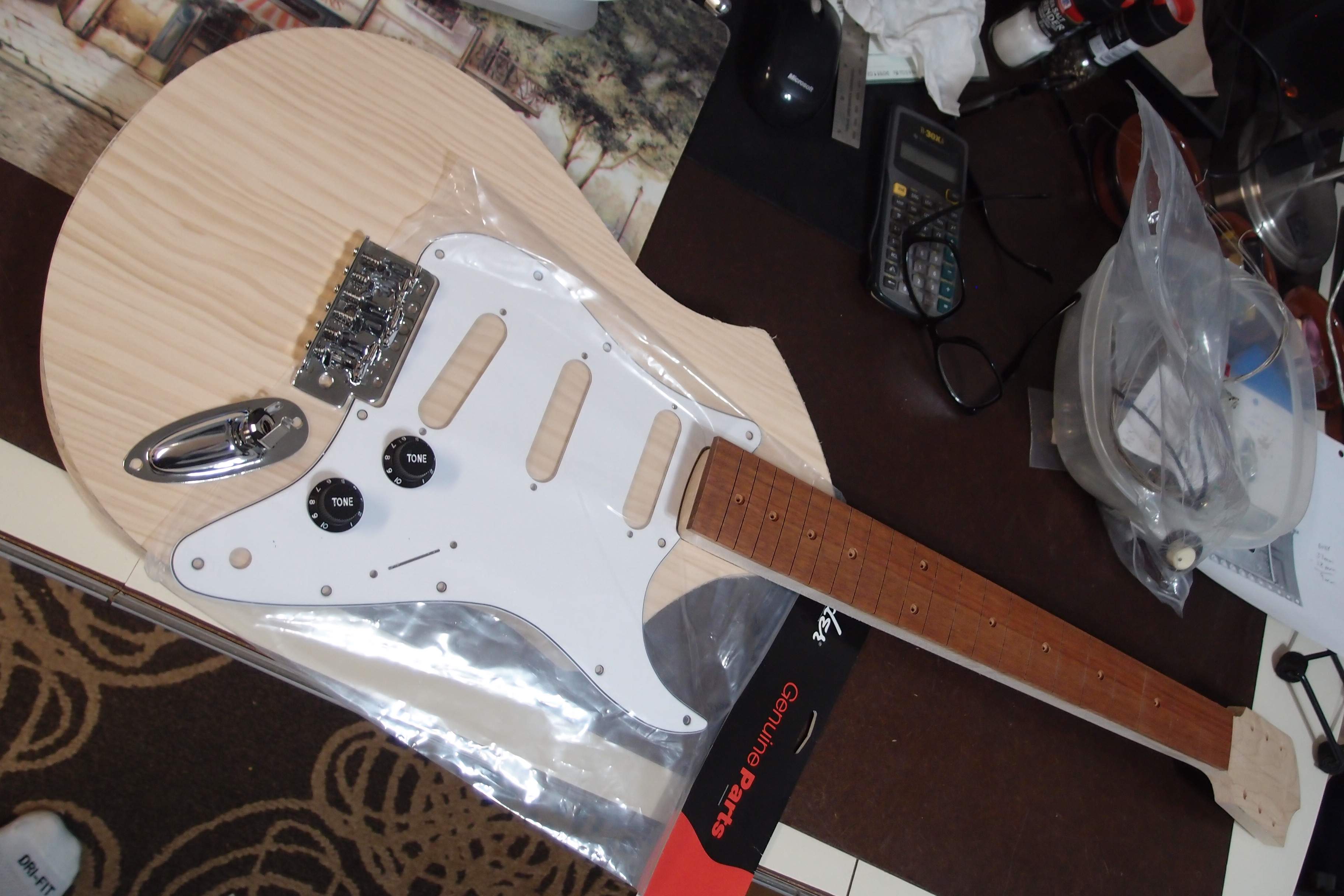
This body and neck have become surplus after changes in other projects. I could build it up with the rest of the surplus parts, but I always like to do something fresh, and this came to me. The body is only 1-1/2" thick, and will require some modification to the tremolo block. I had some short ones once, but I guess I tossed them. It will also need one of the cheap box-type switches, the normal ones I have are too deep. Need to find some proper pickups as well, unless I go with lipsticks. I'm thinking three-tone burst, and maybe even tort.
This body and neck have become surplus after changes in other projects. I could build it up with the rest of the surplus parts, but I always like to do something fresh, and this came to me. The body is only 1-1/2" thick, and will require some modification to the tremolo block. I had some short ones once, but I guess I tossed them. It will also need one of the cheap box-type switches, the normal ones I have are too deep. Need to find some proper pickups as well, unless I go with lipsticks. I'm thinking three-tone burst, and maybe even tort.


