
Enjoy the benefits of a premium membership!
Upgrade Account
-
TalkBass has been independent since 1998. Add your voice.
Create a free account to reply to discussions, view embedded media, and browse with fewer display ads.
Join free Log in
Want zero display ads or expanded classifieds tools? Compare plans.
You are using an out of date browser. It may not display this or other websites correctly.
You should upgrade or use an alternative browser.
You should upgrade or use an alternative browser.
More options
Who Replied?
Horizontal stacking versus side by side stacking
Link Removed
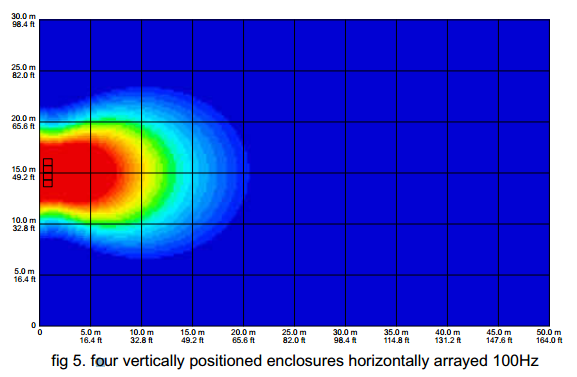
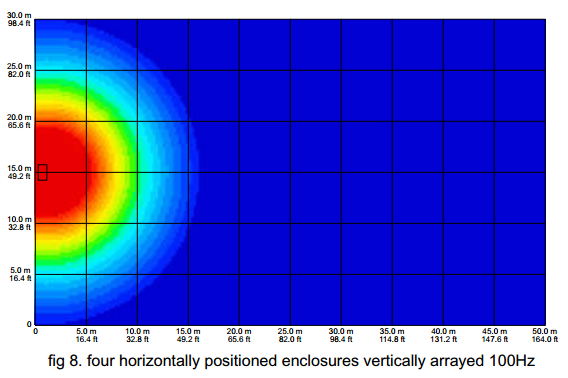
fig 8 shows four enclosures horizontally positioned and vertically arrayed at 100Hz.
If you compare fig 8. with fig 5. which shows the same four enclosures but horizontally arrayed, you can see that a
vertical array has little or no effect on the radiation pattern in the horizontal plane. The radiation pattern remains
omni directional with the vertical array of four enclosures even at 100Hz. This comes at the expense of front to
side rejection, with the four enclosure vertical array being 2dB quieter at 15 m (49.2 ft) out compared with the
horizontal array.
Side by side stacking improves low end versus vertical stacking. That's a statement based on simualtion that I could confirm in practice many times .
While vertical stacking is beneficial if the cabs have to cover a fairly short length where width extends the length of the audience.
Of course it should be noticed that all of the simulations shown within the linked pdf document reflect exclusively outdoor conditions with only the floor ground as an acoustical reflecting boundary with zero absorption.
It's valid to expect very different SPL radiation patterns if there is indoor conditions with reflecting walls.
Either way for best low end reinforcment the longish horizontal array beats off the vertical stacking thing.
@lowplaces
If cabs are apart it may help to improve the sound by experimenting with different horizontal angles of the cabs regarding crossfireing each other to get a sweet spot.
Although sub (PA) cabs are mainly considered to be omnidirectional the sound can be fine tuned with different horizontal angles of the cabs (see also the documents linked above).
Link Removed
fig 8 shows four enclosures horizontally positioned and vertically arrayed at 100Hz.
If you compare fig 8. with fig 5. which shows the same four enclosures but horizontally arrayed, you can see that a
vertical array has little or no effect on the radiation pattern in the horizontal plane. The radiation pattern remains
omni directional with the vertical array of four enclosures even at 100Hz. This comes at the expense of front to
side rejection, with the four enclosure vertical array being 2dB quieter at 15 m (49.2 ft) out compared with the
horizontal array.
Side by side stacking improves low end versus vertical stacking. That's a statement based on simualtion that I could confirm in practice many times .
While vertical stacking is beneficial if the cabs have to cover a fairly short length where width extends the length of the audience.
Of course it should be noticed that all of the simulations shown within the linked pdf document reflect exclusively outdoor conditions with only the floor ground as an acoustical reflecting boundary with zero absorption.
It's valid to expect very different SPL radiation patterns if there is indoor conditions with reflecting walls.
Either way for best low end reinforcment the longish horizontal array beats off the vertical stacking thing.
@lowplaces
If cabs are apart it may help to improve the sound by experimenting with different horizontal angles of the cabs regarding crossfireing each other to get a sweet spot.
Although sub (PA) cabs are mainly considered to be omnidirectional the sound can be fine tuned with different horizontal angles of the cabs (see also the documents linked above).
Last edited:

I agree 100% with the idea of not positioning subs spaced horizontally.
I have used the graphs posted above to argue this point with my associate in a little retirement hobby business of providing sound for bands. He owns the subs, and he does position them at each side of the stage. I don't argue with him about it. I have listened carefully to detect comb filtering at many of the shows we have done this way, and have noticed it distinctly only at outdoor shows, and in the largest halls.
Notice the distances on the SPL plots above. The scale of these plots is more like the outdoor show, and large hall indoor venue distances where I was able to hear the effect rather than the smaller places we often operate in.
I think as the size of the room increases, the more pronounced the effect will be, and in smaller rooms it may not be something to be too concerned about.
Edit to add:
Notice that the plots above do not show any reflected sound. I think when I read the information associated with those plots a long time ago, there was something that stated that the plots were ideal models to illustrate the effect, and were not based on actual measurements in a real environment.
The real world is more complicated than what the plots show.
I have used the graphs posted above to argue this point with my associate in a little retirement hobby business of providing sound for bands. He owns the subs, and he does position them at each side of the stage. I don't argue with him about it. I have listened carefully to detect comb filtering at many of the shows we have done this way, and have noticed it distinctly only at outdoor shows, and in the largest halls.
Notice the distances on the SPL plots above. The scale of these plots is more like the outdoor show, and large hall indoor venue distances where I was able to hear the effect rather than the smaller places we often operate in.
I think as the size of the room increases, the more pronounced the effect will be, and in smaller rooms it may not be something to be too concerned about.
Edit to add:
Notice that the plots above do not show any reflected sound. I think when I read the information associated with those plots a long time ago, there was something that stated that the plots were ideal models to illustrate the effect, and were not based on actual measurements in a real environment.
The real world is more complicated than what the plots show.
Last edited:
Different considerations and importance of delayed signals for detection of direction of any acoustic source.
The hearing ability to detect perfectly the direction of a source is based on delay detection. The ears are a couple of inches appart thus hear naturally similar "cancelation" patterns and lobes at mids and treble band as shown in the documents above.
You may want face to the source directly and then turn your head to the left and then to the right side and try to evaluate at which direction of your head the sound will be best.
I'm pretty sure you will fail to call it a poor sound that sucks on mids or tell any remarkable difference soundwise at the treble although there will at any time lots of different radiation "cancelation" patterns around your head.
You'll totally fail to tell different sounds due to cancelations at highish frequencies beyond 1.5kHz but you will always perfectly tell the direction of the source.
So to tell the direction of a source actually is the ability of delay detection of a signals incoming into left versus right ear.
I wonder why the phace policy don't sends a complaint addressed to evolution or the creator cause we suffer on two ears which both in combination cause lots of delay (respectively phase cancelations).
May be the evolution did a fatal error and we better should have vertical stacked ears just to avoid phase cancelation stuff that appears naturally all around the head
The hearing ability to detect perfectly the direction of a source is based on delay detection. The ears are a couple of inches appart thus hear naturally similar "cancelation" patterns and lobes at mids and treble band as shown in the documents above.
You may want face to the source directly and then turn your head to the left and then to the right side and try to evaluate at which direction of your head the sound will be best.
I'm pretty sure you will fail to call it a poor sound that sucks on mids or tell any remarkable difference soundwise at the treble although there will at any time lots of different radiation "cancelation" patterns around your head.
You'll totally fail to tell different sounds due to cancelations at highish frequencies beyond 1.5kHz but you will always perfectly tell the direction of the source.
So to tell the direction of a source actually is the ability of delay detection of a signals incoming into left versus right ear.
I wonder why the phace policy don't sends a complaint addressed to evolution or the creator cause we suffer on two ears which both in combination cause lots of delay (respectively phase cancelations).
May be the evolution did a fatal error and we better should have vertical stacked ears just to avoid phase cancelation stuff that appears naturally all around the head
Last edited:
Personally way to often I struggle with my band mates to gain best place for FOH rigs. While my band mates keep most of attention on a pretty nice looking stage picture where narrow FOH gear may look annyoing while to the contrary I try to get best sound in the house.I agree 100% with the idea of not positioning subs spaced horizontally.
I hope I will never ever experience a situation like this (case example) I might have to place the right hand PA rig right in front of the bass players place on stage just to improve the sound FOH while the bass player want's to teach me about benefits and drawbacks cancelataions of vertical versus skinny stacking of his bass rig.
Last edited:
@Hoochie Coochie Man
You wrote ....
" I think as the size of the room increases, the more pronounced the effect will be, and in smaller rooms it may not be something to be too concerned about "
I've looked at those plots and understand what I'm seeing. I've read up a bit on it as well.
I think I will be playing smaller rooms more often than not, and I expect to be stacking my cabs in those situations. Small venue = small stage in most cases.
And as you mentioned in your edited/added text on your post, when do you throw in the real world stuff like the room, how full the room is, how tall is stage is, reflection,etc, ...........
Anyhow I learned a few things, and I appreciate the arguments and info presented for and against separating cabs versus stacking them. As well as all the other information on the drawbacks and options available running two heads.
My patience is paying off too as mentioned in that hot deals heads up on the Hot Ampeg news thread.
So I'm going to go ahead and order another one. It will just add so much versatility. And you know it sure would be nice if one of them acts up and need service. Even if it happens at a gig, no big deal. I'll still have my Ampeg tone
On a side note, I grabbed a Pedaltrain 24 off cl yesterday cheap. Both the case and board like new and even came with all the velcro and zip ties I would need. I wanted to get a compact board anyway so I wouldn't go too overboard spending money on pedals I don't really need.
I will probably just have my MXR CAE, Tone Press, and 2 aby boxes on it. I've got my eye on the Strymon Ola, but I have to decide whether I want vibrato or tremolo. The Ola has vibrato and chorus.
Here's a photo of the board just to get an idea of how much room I've got on it which isn't much with large pedals. I just sat the pedals pictured on there to get an idea what I'm looking at room wise.

You wrote ....
" I think as the size of the room increases, the more pronounced the effect will be, and in smaller rooms it may not be something to be too concerned about "
I've looked at those plots and understand what I'm seeing. I've read up a bit on it as well.
I think I will be playing smaller rooms more often than not, and I expect to be stacking my cabs in those situations. Small venue = small stage in most cases.
And as you mentioned in your edited/added text on your post, when do you throw in the real world stuff like the room, how full the room is, how tall is stage is, reflection,etc, ...........
Anyhow I learned a few things, and I appreciate the arguments and info presented for and against separating cabs versus stacking them. As well as all the other information on the drawbacks and options available running two heads.
My patience is paying off too as mentioned in that hot deals heads up on the Hot Ampeg news thread.
So I'm going to go ahead and order another one. It will just add so much versatility. And you know it sure would be nice if one of them acts up and need service. Even if it happens at a gig, no big deal. I'll still have my Ampeg tone
On a side note, I grabbed a Pedaltrain 24 off cl yesterday cheap. Both the case and board like new and even came with all the velcro and zip ties I would need. I wanted to get a compact board anyway so I wouldn't go too overboard spending money on pedals I don't really need.
I will probably just have my MXR CAE, Tone Press, and 2 aby boxes on it. I've got my eye on the Strymon Ola, but I have to decide whether I want vibrato or tremolo. The Ola has vibrato and chorus.
Here's a photo of the board just to get an idea of how much room I've got on it which isn't much with large pedals. I just sat the pedals pictured on there to get an idea what I'm looking at room wise.
Last edited:
For additional ideas and examples, google Dug Pinnick, Tom Petersson, and Billy Sheehan. All have been devoted dual-rig users for many years, and have found many solutions to your goal.
I've tried the dual amp approach every which way, including 2 rack preamps into a stereo power amp into matching speakers. I found that it can sound fantastic by myself, but often got lost in a band mix - especially the groovy stereo effects part. These days, I use one good bass head into one great bass cab most of the time. For guitar players, 2 amps is a great approach. For most of us noble bass players, a single amp rig works best. Have fun experimenting!
I've tried the dual amp approach every which way, including 2 rack preamps into a stereo power amp into matching speakers. I found that it can sound fantastic by myself, but often got lost in a band mix - especially the groovy stereo effects part. These days, I use one good bass head into one great bass cab most of the time. For guitar players, 2 amps is a great approach. For most of us noble bass players, a single amp rig works best. Have fun experimenting!
While I own a number of very cool Ampeg tube amps, I am envious of anyone who owns two PF50Ts.
Now I recommend that you start searching for a vintage Ampeg rig. (I am gassing for an SB12 myself).
May I suggest a nice B15 to start out? Turn the lights down low. Watch the gentle orange glow of tubes. Observe the luminence of the Ampeg logo in the Lucite panel. Smell the odor of a hot phenolic eyelet board. Listen to the sound of a wonderful old amp. Ahh...
Now I recommend that you start searching for a vintage Ampeg rig. (I am gassing for an SB12 myself).
May I suggest a nice B15 to start out? Turn the lights down low. Watch the gentle orange glow of tubes. Observe the luminence of the Ampeg logo in the Lucite panel. Smell the odor of a hot phenolic eyelet board. Listen to the sound of a wonderful old amp. Ahh...
While I own a number of very cool Ampeg tube amps, I am envious of anyone who owns two PF50Ts.
Now I recommend that you start searching for a vintage Ampeg rig. (I am gassing for an SB12 myself).
May I suggest a nice B15 to start out? Turn the lights down low. Watch the gentle orange glow of tubes. Observe the luminence of the Ampeg logo in the Lucite panel. Smell the odor of a hot phenolic eyelet board. Listen to the sound of a wonderful old amp. Ahh...
A B15 will come someday. The right time, right place, right price, and I'll be down for it.

May I suggest a nice B15 to start out? Turn the lights down low. Watch the gentle orange glow of tubes. Observe the luminence of the Ampeg logo in the Lucite panel. Smell the odor of a hot phenolic eyelet board. Listen to the sound of a wonderful old amp. Ahh...
Why did I just go back and read that two more times ?

For additional ideas and examples, google Dug Pinnick, Tom Petersson, and Billy Sheehan. All have been devoted dual-rig users for many years, and have found many solutions to your goal.
I've tried the dual amp approach every which way, including 2 rack preamps into a stereo power amp into matching speakers. I found that it can sound fantastic by myself, but often got lost in a band mix - especially the groovy stereo effects part. These days, I use one good bass head into one great bass cab most of the time. For guitar players, 2 amps is a great approach. For most of us noble bass players, a single amp rig works best. Have fun experimenting!
For additional ideas and examples, google Dug Pinnick, Tom Petersson, and Billy Sheehan. All have been devoted dual-rig users for many years, and have found many solutions to your goal.
I've tried the dual amp approach every which way, including 2 rack preamps into a stereo power amp into matching speakers. I found that it can sound fantastic by myself, but often got lost in a band mix - especially the groovy stereo effects part. These days, I use one good bass head into one great bass cab most of the time. For guitar players, 2 amps is a great approach. For most of us noble bass players, a single amp rig works best. Have fun experimenting!
Thanks, I'll check all three out. I Googled "Billy Sheehan on running two amps" and the top hit was this cool article....
Billy Sheehan Advanced Bass
While I own a number of very cool Ampeg tube amps, I am envious of anyone who owns two PF-50Ts.
Now I recommend that you start searching for a vintage Ampeg rig. (I am gassing for an SB12 myself).
May I suggest a nice B15 to start out? Turn the lights down low. Watch the gentle orange glow of tubes. Observe the luminence of the Ampeg logo in the Lucite panel. Smell the odor of a hot phenolic eyelet board. Listen to the sound of a wonderful old amp. Ahh...
Well I did it. By this time Monday or Tuesday I will have a pair of 50T's.

Cool!
I see by your profile that you have two Fender Rumble 112 cabinets. They should work well with the PF50Ts.
I have been very tempted to get back into Fender Amps myself one of these days, (especially after lifting the 500 combo).
My last Fender amp was a 1960 Bassman (which I had loaned out along with my 1961 Fender P bass back in the mid 1970s, and which, when I went to the place to pick them up I found that the building where it was kept had burned to the ground the nigh before, along with my gear). That 40 Watt Fender Bassman was woefully inadequate trying to keep up with the Twin, and Super Reverbs, and Bandmaster amps my bandmates used.
I hereby grant you a grace period of one year of connecting the PF50Ts to Fender cabinets, after which you must acquire at least two Ampeg cabinets to mate with them.
I see by your profile that you have two Fender Rumble 112 cabinets. They should work well with the PF50Ts.
I have been very tempted to get back into Fender Amps myself one of these days, (especially after lifting the 500 combo).
My last Fender amp was a 1960 Bassman (which I had loaned out along with my 1961 Fender P bass back in the mid 1970s, and which, when I went to the place to pick them up I found that the building where it was kept had burned to the ground the nigh before, along with my gear). That 40 Watt Fender Bassman was woefully inadequate trying to keep up with the Twin, and Super Reverbs, and Bandmaster amps my bandmates used.
I hereby grant you a grace period of one year of connecting the PF50Ts to Fender cabinets, after which you must acquire at least two Ampeg cabinets to mate with them.
Last edited:
They are actually from right here in Louisville !
I was messing around with my Boss ME20 multi-effects this morning combining tremolo only on the Boss with the overdrive on the MXR CAE and it was wild. I doubt I would ever use it for the stuff I'm planning on playing but it sounded very cool.
I often use the tremolo/vibrato combination as my basic electric guitar sound when doing home recordings, then copy the same guitar track and run it more clean simultaneously with the effected one, gives an awesomely warm but sick psychedelic effect.
Here's a track where I used that approach for the not programmed bass I played as well (more of a solo bass/melody kind of approach to playing bass than a traditional supporting one, as there's already a programmed bass taking care of filling out that role), this is with the electronic psychedelic down tempo duo Electro Jar I had with a friend at some point (second track Spacefuzz 2016 from the 3 track EP Divinorum, our last, but also, in my opinion, best release):
Wouh!

Quite psychedelic!

Based on the visual representation I definitely like the second one (Fig. 44) the best.

Maybe I should try out some of that much debated phase canceling effect at some point, if it sound just anywhere nearly as interesting as it looks


Last edited:
Cool!
I see by your profile that you have two Fender Rumble 112 cabinets. They should work well with the PF50Ts.
I have been very tempted to get back into Fender Amps myself one of these days, (especially after lifting the 500 combo).
My last Fender amp was a 1960 Bassman (which I had loaned out along with my 1961 Fender P bass back in the mid 1970s, and which, when I went to the place to pick them up I found that the building where it was kept had burned to the ground the nigh before, along with my gear). That 40 Watt Fender Bassman was woefully inadequate trying to keep up with the Twin, and Super Reverbs, and Bandmaster amps my bandmates used.
I hereby grant you a grace period of one year of connecting the PF50Ts to Fender cabinets, after which you must acquire at least two Ampeg cabinets to mate with them.
My favorite Fender guitar amp is the 5f1 champ. Barber Electronics used to offer a EQ pedal designed specifically for the little one or two knob 5 watt amps. I've had several 5 watt amps in the past and always put a 12au7 in V1 and used the Barber with a clean boost. Turns any of those little five watt Class A amps into more than a one-trick pony.

I'm posting in between deliveries or I would give you a link to the manual for that unique little EQ.
As far as the Ampeg cabinets I do love the look of them especially the more vintage looking ones.
Thanks for granting me a year. It will take that long to refurbish my bank account
I often use the tremolo/vibrato combination for as my basic electric guitar sound when doing home recordings, then copy the same guitar track and run it more clean simultaneously with the effected one, gives an awesomely warm but sick psychedelic effect.
Here's a track where I used that approach for the not programmed bass I played as well (more of a solo bass/melody kind of approach to playing bass than a traditional supporting one, as there's already a programmed bass taking care of filling out that role), this is with the electronic psychedelic down tempo duo Electro Jar I had with a friend at some point (second track Spacefuzz 2016 from the 3 track EP Divinorum, our last, but also, in my opinion, best release):
Wouh!
Quite psychedelic!
Based on the visual representation I definitely like the second one (Fig. 44) the best.
Maybe I should try out some of that much debated phase canceling effect at some point, if it sound just anywhere nearly as good as it looks
I'll give it a listen when I get home later. I'm at work right now.


