
Enjoy the benefits of a premium membership!
Upgrade Account
-
TalkBass has been independent since 1998. Add your voice.
Create a free account to reply to discussions, view embedded media, and browse with fewer display ads.
Join free Log in
Want zero display ads or expanded classifieds tools? Compare plans.
You are using an out of date browser. It may not display this or other websites correctly.
You should upgrade or use an alternative browser.
You should upgrade or use an alternative browser.
U.S. Peavey Club
- Thread starter Soundchaser11460
- Start date
-
- Tags
- club
More options
Who Replied?

I know that YOU KNOW how bad this is making my teeth grind!I just put my Gen 2 Foundation 5 with matching headstock up for sale in the classified ads.
For Sale - Peavey Generation 2 Foundation 5 w/matching Headstock


Yeah, I do. Give me a shout if you want it. We’ll work it out.

Good day to you all!
Peavey Fury 19830Used – FairLocal Pickup
Edit: There's an interesting video in this listing about the TR design.
Cheers!
Peavey Fury 19830Used – FairLocal Pickup
Edit: There's an interesting video in this listing about the TR design.
Cheers!
Last edited:

Whoa! That's very interesting! My 91 Foundation has that same ski jump problem and tends to have a lot of fret noise. Like he says in the video, I find lower tension to work better on that bass. Mine could use a leveling of the frets, and it's good to know that maybe I should really file down some of those higher frets to compensate.
[The listing has a video of a luthier who has taken the frets out of an 80s Fury neck, and he has delaminated the two-piece neck—which splits along the center line. You can see the cross section of the truss rod channel has a problematic bump around the 14th fret that seems like a terrible design that would wind up giving you a ski jump neck—which often happens.]
[The listing has a video of a luthier who has taken the frets out of an 80s Fury neck, and he has delaminated the two-piece neck—which splits along the center line. You can see the cross section of the truss rod channel has a problematic bump around the 14th fret that seems like a terrible design that would wind up giving you a ski jump neck—which often happens.]

This is why I only buy if I can play first and also do not even look at abused basses. I've only had a mild ski jump on my Patriot which I didn't notice when I purchased. I was fortunate to get it back dead level with some progressive truss adjustments and lower tension strings. Now one of my lowest action basses. Very fortunate there.Good day to you all!
Peavey Fury 19830Used – FairLocal Pickup
Edit: There's an interesting video in this listing about the TR design.
Cheers!
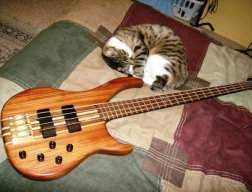
Hi guys ! I just posted my latest project in the classified. Milli 5 in case you're wondering.
For Sale - Peavey Millennium USA 5 string MM/J, Aguilar pre/pups, Custom wrap, Weighs 8.5 lbs !
For Sale - Peavey Millennium USA 5 string MM/J, Aguilar pre/pups, Custom wrap, Weighs 8.5 lbs !

Good day to you all!
Peavey Fury 19830Used – FairLocal Pickup
Edit: There's an interesting video in this listing about the TR design.
Cheers!
Whoa! That's very interesting! My 91 Foundation has that same ski jump problem and tends to have a lot of fret noise. Like he says in the video, I find lower tension to work better on that bass. Mine could use a leveling of the frets, and it's good to know that maybe I should really file down some of those higher frets to compensate.
[The listing has a video of a luthier who has taken the frets out of an 80s Fury neck, and he has delaminated the two-piece neck—which splits along the center line. You can see the cross section of the truss rod channel has a problematic bump around the 14th fret that seems like a terrible design that would wind up giving you a ski jump neck—which often happens.]
This is why I only buy if I can play first and also do not even look at abused basses. I've only had a mild ski jump on my Patriot which I didn't notice when I purchased. I was fortunate to get it back dead level with some progressive truss adjustments and lower tension strings. Now one of my lowest action basses. Very fortunate there.
Very informative video. I agree that the micro tilt should only be used in the most minor of ways, but didn't know that the truss rod channel was problematic to start. I have gotten around ski jump with upper fret filing and through a fix via warped neck.com. I don't run low tension strings, but so far so good. Guess I'm lucky..?
I don't run low tension either. The bass had been in storage for about 15 years fully tuned up with Fender flats which are quite high tension. I went to the GHS Pressure wounds which are not low tension, but lower than most flats. I feel lucky too. I don't really have a "bad neck" on any of my Peaveys. 100% with you on the micro tilt comment.Very informative video. I agree that the micro tilt should only be used in the most minor of ways, but didn't know that the truss rod channel was problematic to start. I have gotten around ski jump with upper fret filing and through a fix via warped neck.com. I don't run low tension strings, but so far so good. Guess I'm lucky..?

Are we sure that all the Peavey bass necks have truss rods like this one example?Good day to you all!
Peavey Fury 19830Used – FairLocal Pickup
Edit: There's an interesting video in this listing about the TR design.
Cheers!
That one could have been from a very bad day at the factory.
I'm guessing that Peavey did not make necks every day with truss rods that have a deliberate kink in them.
I have not had one Peavey neck with ski jump and I set neck relief at .009 and string height at the 15th fret at .060 which is pretty low. (and I run flats on most of them)
And I hate micro tilt systems too.

Are we sure that all the Peavey bass necks have truss rods like this one example?
That one could have been from a very bad day at the factory.
I'm guessing that Peavey did not make necks every day with truss rods that have a deliberate kink in them.
I have not had one Peavey neck with ski jump and I set neck relief at .009 and string height at the 15th fret at .060 which is pretty low. (and I run flats on most of them)
And I hate micro tilt systems too.
I was considering that. All my Peavey's are fine, mist are awesome!
Don't buy a car if it's built on Monday or Friday they say...
Peavey Bass guitar body Peavey Bass guitar body | Brown Eyed Girls Resale | Reverb
A couple bass bodies on reverb. Millennium or Cirrus? I don't know.
Cheers
A couple bass bodies on reverb. Millennium or Cirrus? I don't know.
Cheers
Peavey Bass guitar body Peavey Bass guitar body | Brown Eyed Girls Resale | Reverb
A couple bass bodies on reverb. Millennium or Cirrus? I don't know.
Cheers
Millennium import bodies.

Does anyone know where I can get neck bolts for my new G Bass project?


Very informative video. I agree that the micro tilt should only be used in the most minor of ways, but didn't know that the truss rod channel was problematic to start. I have gotten around ski jump with upper fret filing and through a fix via warped neck.com. I don't run low tension strings, but so far so good. Guess I'm lucky..?
I'm no expert, but I'm not sure I buy into that dude's theory on what causes ski jumps. The truss rod channel where the "kink" is, looks to be located where the neck is securely fastened dead flat against the neck pocket surface by the neck screws. My tech buddy of 40 years calls it "Fenderitis" because it happens to bolt-on necks, in general. The neck area that's screwed to the body can't move, while the rest of the neck can bow forward. He claims it's a case of the neck wood being inherently weak when the issue happens. Over time, a jump appears on a weak neck. Luck of the draw, but there are sometimes clues that a neck may be weak, just by looking at the grain. A good stiff piece of neck wood to begin with avoids the problem. I've brought basses to him with severely forward bowed necks with max'd out truss rods. At which point he'd always say "it's not a truss rod problem, it's a 'wood' problem". Which makes perfect sense to me. Hence, the addition of stiffening rods, six-bolt neck joints, and in the case of Brubaker and others, a deeper neck joint altogether. All in an effort to avoid neck issues, including the infamous ski jump. Abusing the micro-tilt feature throws a monkey wrench into the equation.
The Peavey truss channel shape may not have been optimal, but it doesn't seem to be the root cause for ski jumps. Again, the area that the video dude says is "rising up" because of the kinked channel and rod, physically can't (without some help from abusing the micro-tilt feature). The rest of the neck is moving but the neck butt is clamped down flat, or at least it should be. Does this make sense? If not, please explain.

Only up to a point, but this is not probably the best venue to discuss this. Some very reputable individuals that work in the field have tried to address this problem on this very same forum. See for example: Getting the Facts about Ski JumpsI'm no expert, but I'm not sure I buy into that dude's theory on what causes ski jumps. The truss rod channel where the "kink" is, looks to be located where the neck is securely fastened dead flat against the neck pocket surface by the neck screws. My tech buddy of 40 years calls it "Fenderitis" because it happens to bolt-on necks, in general. The neck area that's screwed to the body can't move, while the rest of the neck can bow forward. He claims it's a case of the neck wood being inherently weak when the issue happens. Over time, a jump appears on a weak neck. Luck of the draw, but there are sometimes clues that a neck may be weak, just by looking at the grain. A good stiff piece of neck wood to begin with avoids the problem. I've brought basses to him with severely forward bowed necks with max'd out truss rods. At which point he'd always say "it's not a truss rod problem, it's a 'wood' problem". Which makes perfect sense to me. Hence, the addition of stiffening rods, six-bolt neck joints, and in the case of Brubaker and others, a deeper neck joint altogether. All in an effort to avoid neck issues, including the infamous ski jump. Abusing the micro-tilt feature throws a monkey wrench into the equation.
The Peavey truss channel shape may not have been optimal, but it doesn't seem to be the root cause for ski jumps. Again, the area that the video dude says is "rising up" because of the kinked channel and rod, physically can't (without some help from abusing the micro-tilt feature). The rest of the neck is moving but the neck butt is clamped down flat, or at least it should be. Does this make sense? If not, please explain.
In particular, as the deformation normally happens outside of the neck pocket, it is difficult to consider shims, microtilts, the number of bolts as the main causes for the problem. Similarly, stiffening rods that do not run over the portion of the neck where the deformation is most likely to happen (the transition between the bolted part and the "free" part) are not likely the most effective solution.
I think lots of basses are bought new and never get set up correctly (or at all) and the person gives up on playing after six weeks and the instrument sits there under string tension with the truss rod completely loose and the neck bowed like crazy until finally they sell it 5-10 years later, by then the neck has a problem if it is not a very good neck. New owner gets the instrument and tightens the truss rod which is now fighting not only string tension but a piece of wood that has been bent forward for a long time as well.
I don't think shimming a neck or micro tilt systems create ski jump (as StewMac says they do to help sell their full pocket shims), I just think micro tilt systems suck because they are a waste of manufacturing expense when a shim costs nothing and works better.
I'm still not sure that Peavey made all their truss rod channels in the shape that one example in the video has.
I do think wood selection is a factor, good luthiers are pretty picky about the pieces they make necks out of.
I think there are a lot of thicker P necks that held up better than thinner necks.
It seems that bi-laminated necks and multi-laminated necks also help make them stiff and stable.
I don't think shimming a neck or micro tilt systems create ski jump (as StewMac says they do to help sell their full pocket shims), I just think micro tilt systems suck because they are a waste of manufacturing expense when a shim costs nothing and works better.
I'm still not sure that Peavey made all their truss rod channels in the shape that one example in the video has.
I do think wood selection is a factor, good luthiers are pretty picky about the pieces they make necks out of.
I think there are a lot of thicker P necks that held up better than thinner necks.
It seems that bi-laminated necks and multi-laminated necks also help make them stiff and stable.
CNC doesn't have a very bad day at the factory.Are we sure that all the Peavey bass necks have truss rods like this one example?
That one could have been from a very bad day at the factory.
I'm guessing that Peavey did not make necks every day with truss rods that have a deliberate kink in them.
I have not had one Peavey neck with ski jump and I set neck relief at .009 and string height at the 15th fret at .060 which is pretty low. (and I run flats on most of them)
And I hate micro tilt systems too.
How many of us here know exactly what was done by CNC and what was not, and what work gets done after the CNC work?CNC doesn't have a very bad day at the factory.
So, you're sure that Peavey made all their basses with a kinked steel rod?
I definitely have Peavey basses that were more cleanly made than others....by a lot.
The neck heel to neck pocket fit varies from one Peavey (and Fender) bass to another ...is that the CNC cut pocket tolerances or the CNC cut neck heel tolerances?
My mahogany Patriot is made much cleaner/tighter all around than any other Peavey (or Fender) bass I've had here.
The cut-out in the headstock for truss rod nut access is all over the place with 80's Peavey basses, the truss rod covers are often way off center to cover the cut.
All my current and past Peavey basses respond well to truss rod adjustments, and are as stable as my Yamahas, MusicMan, Squiers, and Guild.
Last edited:

CNC doesn't have a very bad day at the factory.
I would assume there are factors that would make for some variation in the quality of the CNC produced parts. Blade/bit sharpness being one, but also the density/grain of the wood (and type of wood), temperature of the cutting blade/bit, function of the CNC system itself (how well the mechanisms move, etc), and probably a bunch more that I'm not thinking of - all minor but still there.
All the parts produced would be within tolerances, but combining some drift in adjoining parts (say neck and pocket) I would expect some overall quality variation to happen.


