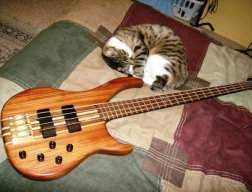
Just FYI, I lowered the price on my Milli 5 significantly in the classified.

TalkBass has been independent since 1998. Add your voice.
Create a free account to reply to discussions, view embedded media, and browse with fewer display ads.
Join free Log in
Want zero display ads or expanded classifieds tools? Compare plans.

Only up to a point, but this is not probably the best venue to discuss this. Some very reputable individuals that work in the field have tried to address this problem on this very same forum. See for example: Getting the Facts about Ski Jumps
In particular, as the deformation normally happens outside of the neck pocket, it is difficult to consider shims, microtilts, the number of bolts as the main causes for the problem. Similarly, stiffening rods that do not run over the portion of the neck where the deformation is most likely to happen (the transition between the bolted part and the "free" part) are not likely the most effective solution.


Your answers, all your answers, can be found here: Invalid Link RemovedHey all, I have a couple general questions about my '89 Rudy Sarzo Sigs. They are a couple of my top tier basses permanently embedded in my herd. Look as I might I could not find this info.
1- what is the wood used for the body wings?
2- is it the same wood for both with only finish change?
3- what are the neck stringers?
These are two of the best basses I ever played (and I have a boatload) that feel like they were custom made for me. Me and Rudy must have "identical" hands"!
Thanks up front.
View attachment 4624446

Ash body wings. I have a husk that the neck was messed up. Gonna try and route a neck pocket for it and put a USA Grind neck on it.Hey all, I have a couple general questions about my '89 Rudy Sarzo Sigs. They are a couple of my top tier basses permanently embedded in my herd. Look as I might I could not find this info.
1- what is the wood used for the body wings?
2- is it the same wood for both with only finish change?
3- what are the neck stringers?
These are two of the best basses I ever played (and I have a boatload) that feel like they were custom made for me. Me and Rudy must have "identical" hands"!
Thanks up front.
View attachment 4624446

Nice! I was tempted to do that but with my g bass neckAsh body wings. I have a husk that the neck was messed up. Gonna try and route a neck pocket for it and put a USA Grind neck on it. View attachment 4625375
Personally a black trans would be the way I goAsh body wings. I have a husk that the neck was messed up. Gonna try and route a neck pocket for it and put a USA Grind neck on it. View attachment 4625375
I bet it will be 100x better when it's done and feel like a new bass. Kind of like getting a new Peavey GV for $200 (Canadian) bucks !Finnaly took my GV to get setup by my dads buddy
looks like it has a ramp..


I think lots of basses are bought new and never get set up correctly (or at all) and the person gives up on playing after six weeks and the instrument sits there under string tension with the truss rod completely loose and the neck bowed like crazy until finally they sell it 5-10 years later, by then the neck has a problem if it is not a very good neck. New owner gets the instrument and tightens the truss rod which is now fighting not only string tension but a piece of wood that has been bent forward for a long time as well.
I don't think shimming a neck or micro tilt systems create ski jump (as StewMac says they do to help sell their full pocket shims), I just think micro tilt systems suck because they are a waste of manufacturing expense when a shim costs nothing and works better.
I'm still not sure that Peavey made all their truss rod channels in the shape that one example in the video has.
I do think wood selection is a factor, good luthiers are pretty picky about the pieces they make necks out of.
I think there are a lot of thicker P necks that held up better than thinner necks.
It seems that bi-laminated necks and multi-laminated necks also help make them stiff and stable.
That's what I thought I read somewhere. Thanks for that.Ash body wings.
I got these decals and they are great. One bass has decals and one was factory. Can you tell which was which ?Side note.. I’d love snake eye inlays if anyone can tell me where I can find some
Except how do you center it lol!I got these decals and they are great. One bass has decals and one was factory. Can you tell which was which ?
Oval MOP WHITE SHELL Fretboard Markers Vinyl Inlays Sticker Decals for ANY BASS | eBay
View attachment 4627119

Except how do you center it lol!
I got these decals and they are great. One bass has decals and one was factory. Can you tell which was which ?
Oval MOP WHITE SHELL Fretboard Markers Vinyl Inlays Sticker Decals for ANY BASS | eBay
View attachment 4627119
Yes, you're correct, probably because I got anxious and impatient on the LAST one, so it was on a little off center.I'll play! The one on the right...?