
Enjoy the benefits of a premium membership!
Upgrade Account
-
TalkBass has been independent since 1998. Add your voice.
Create a free account to reply to discussions, view embedded media, and browse with fewer display ads.
Join free Log in
Want zero display ads or expanded classifieds tools? Compare plans.
You are using an out of date browser. It may not display this or other websites correctly.
You should upgrade or use an alternative browser.
You should upgrade or use an alternative browser.
U.S. Peavey Club
- Thread starter Soundchaser11460
- Start date
-
- Tags
- club
More options
Who Replied?

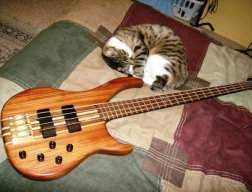
A question about the Koa Unity basses. I played one a friend had some years back and it is the reason I have my Dyna Unity now. The sound and feel had me hooked in an instant. However, the Koa was extremely light weight.....and beautiful..... and my back would love it but, it really had "neck dive" problems. Is this an issue with all the Koa Unitys and how do you compensate for it? Yeah, I want one of these too. Thanks!
I'm gonna chime in and say the Koa Unity I just got also has no neck dive issues. I also use a wide strap, and coupled with the lightweight of the bass it is very easy to control

Here's mine... appears my bass was built sometime after 01/24/89.
SN on headstock is 04494962
I LOVE how this stuff is SO normal to us ... I love gear geeks !!!!
I mean, c'mon, how many segments of the population compare circuit boards ... On their basses, no less !!! That RULES !!!!
I mean, c'mon, how many segments of the population compare circuit boards ... On their basses, no less !!! That RULES !!!!
 . Bassists seem to be the geeks of the band and I'm totally cool with that, lol.
Thanks bassclef! I appreciate the the additional affirmation. I thought I was through buying basses for a while! Now I have to find a Koa! I really need a light weight bass.
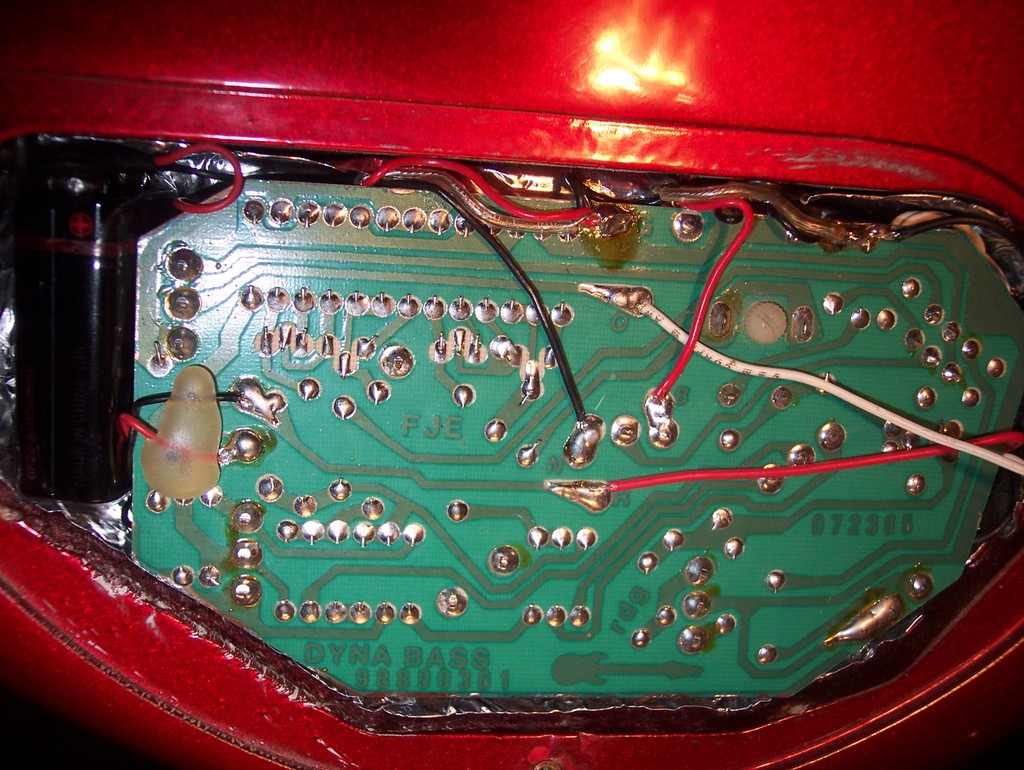
Just for fun facts...rdg is the preamp engineer, FJE is the circuit board designer, DYNA BASS the product name, 98890361 the raw circuit board part number and 072385 (July 23, 1985) the date code for when the circuit board artwork was finished (for this revision). The artwork for the circuit board pictured was laid out by hand. There's at least one later version that was computer generated with a date code of 020588 and PCB designer initials WM from the time Peavey transitioned to computer circuit board design. There's no real difference between the different versions.
Just for reference - I just opened up my '89 Sarzo and the board info reads:
DYNA BASS
RCB Pt #988907060A - Handwritten next to that is T3588
Date Code: 012489
Initials: WM
I am getting the same reading from both the neck and bridge pickups on my volt meter. But google says I need to check the other 2 wires (green and white) that are joined and shrink wrapped together. I don't think that's necessary.... input???? Can't find how to check the pan pot to see if its working.

I am getting the same reading from both the neck and bridge pickups on my volt meter. But google says I need to check the other 2 wires (green and white) that are joined and shrink wrapped together. I don't think that's necessary.... input???? Can't find how to check the pan pot to see if its working.
If the pickups read the same with the PUs un-soldered from the PCB, then the bridge pickup should be good. Best way to check a pickup is to wire it to a separate jack and go into an amp.
If the pickup is good, a cold solder joint on the pcb. You can electrically check the pan pot with the PUs un-soldered. After that, pull the PCB and check the pan pot for physical damage.
mech
edit: If you look at the solder joints on the pan pot on the PCB I posted., the one for the wiper and the one to it's right don't look great. I reflowed the solder on those two joints and several others. Can't remember what the problem was but reflowing the solder cured it.
Yeah, I'm gonna solder that pickup to a jack and double check it, then solder everything back up, including re-soldering the pan pot.
I was just looking at my classic MIJ bass with active / passive. The preamp board, as far as I can see, does not have a trim pot to balance the volume between active and passive. The active is 80% louder than the passive.
The Dyna board does.
Another reason just to show that classic USA Peavey is the BEST. Peavey had/has DEEP pockets and they can and do hire the best technicians out there.
The Dyna board does.
Another reason just to show that classic USA Peavey is the BEST. Peavey had/has DEEP pockets and they can and do hire the best technicians out there.

Scott in Dallas
Commercial User
- Aug 16, 2005
- 2,084
- 27
- 55
- Disclosures
- Builder and Owner: DJ Ash Guitars
Peavey just thought things out better than most other people. They worked with musicians to develop things and needed to do them better in order to survive. Fender sells instruments regardless of quality, and always has a legion of people to make excuses for the company.

I'm tired of my Fury. What's the next Peavey for me? Looking for something with a little more balls, with more of a growl/low end.

I'm tired of my Fury. What's the next Peavey for me? Looking for something with a little more balls, with more of a growl/low end.
Just curious as to what year your Fury is? My Fury has WAY more balls than my Fender Jazz bass. Maybe you need to go with something active?
I'm tired of my Fury. What's the next Peavey for me? Looking for something with a little more balls, with more of a growl/low end.
You could replace the pickup for a change in tone. Maybe a SDQP?
Peavey just thought things out better than most other people. They worked with musicians to develop things and needed to do them better in order to survive. Fender sells instruments regardless of quality, and always has a legion of people to make excuses for the company.
Ain't that the truth !!!
Just curious as to what year your Fury is? My Fury has WAY more balls than my Fender Jazz bass. Maybe you need to go with something active?
88 with Dimarzio's in it.

You could replace the pickup for a change in tone. Maybe a SDQP?
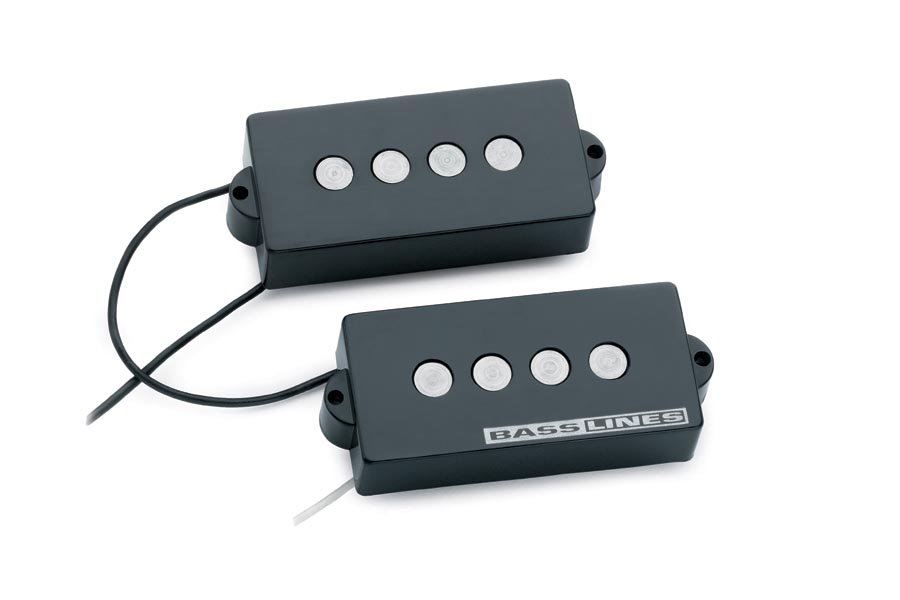
I tried the Basslines SPB-3 in my Fury and couldn't tell much difference, if any at all. Swapped the original back in. Put the SPB-3 and a SJB-3 in my B-Ninety and they made a big difference for the better.
mech


