• TalkBass has been independent since 1998. Add your voice.
    Create a free account to reply to discussions, view embedded media, and browse with fewer display ads.
    Join freeLog in
    Want zero display ads or expanded classifieds tools? Compare plans.

U.S. Peavey Club

what is a 25kl?

trying to learn

this looks like this to me

volume with a push pull for single/humbucker

and a separate tone control for each

?

CW stands for clockwise rotation of the pot shaft and the arrow indicates that rotation and which of the outside legs of the pot whatever needs to be soldered to it.

One side one the "neck" pickup is always grounded (the upside down tree symbol). The other side of the neck pickup is connected to the "bridge" pickup. The other side of the "bridge" pickup is the output and connects to the volume and tone controls. The 25KL is used as a variable resistor to ground at the connection between the two pickups. As it's shaft is turned clockwise from 0 to 10 it gradually grounds the connection between the two pickups. This reduces the output of the "neck" PU until it reaches 0 and only the "bridge" works as a single coil. When the 25KL is on 10 the pickups act as a series humbucker pair.
 
CW stands for clockwise rotation of the pot shaft and the arrow indicates that rotation and which of the outside legs of the pot whatever needs to be soldered to it.

One side one the "neck" pickup is always grounded (the upside down tree symbol). The other side of the neck pickup is connected to the "bridge" pickup. The other side of the "bridge" pickup is the output and connects to the volume and tone controls. The 25KL is used as a variable resistor to ground at the connection between the two pickups. As it's shaft is turned clockwise from 0 to 10 it gradually grounds the connection between the two pickups. This reduces the output of the "neck" PU until it reaches 0 and only the "bridge" works as a single coil. When the 25KL is on 10 the pickups act as a series humbucker pair.
Mech, i have Centralab AFS5 - 251U pots, are these useable? What are these exactly?
 
CW stands for clockwise rotation of the pot shaft and the arrow indicates that rotation and which of the outside legs of the pot whatever needs to be soldered to it.

One side one the "neck" pickup is always grounded (the upside down tree symbol). The other side of the neck pickup is connected to the "bridge" pickup. The other side of the "bridge" pickup is the output and connects to the volume and tone controls. The 25KL is used as a variable resistor to ground at the connection between the two pickups. As it's shaft is turned clockwise from 0 to 10 it gradually grounds the connection between the two pickups. This reduces the output of the "neck" PU until it reaches 0 and only the "bridge" works as a single coil. When the 25KL is on 10 the pickups act as a series humbucker pair.


thanks mech you are awesome

so would this setup be essentially vvt?
 
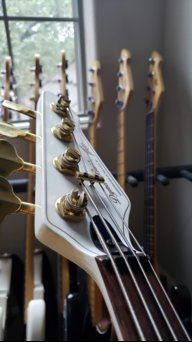
My new-to-me Peavey GV bass arrived! Very sparkly holo-flake finish which I find suitably amusing. The colours really don't show up in the photos, but it's phantasmagorical. Terrific workmanship overall with this instrument. Very pretty pau ferro fingerboard (a favourite of mine), easy-access wheel for truss rod adjustment, and the big string retainer bar which makes mounting the B-string harder than it needs be. There's an early ABM-type bridge: a serious hunk of metal with the saddle lock set screws for each string in a genuinely PITA location on the front of each support block; however, tightening them makes a striking difference to the sound of the instrument. (It's not nearly as elegant a solution as the G&L system.) It has a 35" scale and relatively flat-through neck which is comfortable although a bit of a reach for a C on the B-string given the way the instrument sits. Weight's very nice, on the light side. Neck tilt system with 5 bolts works well. After getting the pickup heights sorted out, there is a wide tone palette via the blend control. The EQ is surprisingly effective. Overall the sound of the bass can range from warm plus/minus some bite all the way to a distinctly middy punch. The J-bass type cancellation at mid-blend is striking and another voice altogether. When I opened up the control cavity I was disappointed to find the 1996 version of the Cirrus preamp with the control pots soldered directly to the printed circuit board and a half-effort at conducting paint on the walls. While I can see the manufacturing advantage during assembly, it's a darned nuisance to fix just about anything or even get a squirt of contact cleaner in there. I had the same thing in my Cirrus 6 and was delighted to haul it out and put an Audere preamp in. I'm not going to be so fast to do that here. The pre seems to work well in this instrument, although I'll need to get it into a live situation to be sure. I got this for a very nice price and in a pleasant exchange with an academic colleague out in Calgary. Overall, this is a very nice acquisition: my 7th US Peavey bass.
[Edited to remove reference to Modulus necks, see below.]

[N.B. Put my first set of GHS Balanced Nickel strings on this bass and am suitably impressed.]

Peavey GV Bass Oct 20, 2018 - 1.jpg
Peavey GV Bass Oct 20, 2018 - 2.jpg
Peavey GV Bass Oct 20, 2018 - 3.jpg
Peavey GV Bass Oct 20, 2018 - 6.jpg
Peavey GV Bass Oct 20, 2018 - 5.jpg
Peavey GV Bass Oct 20, 2018 - 9.jpg
Peavey GV Bass Oct 20, 2018 - 7.jpg
Peavey GV Bass Oct 20, 2018 - 8.jpg
 
Last edited:
Modulus made necks for only the B Quad Peavey basses. The necks for the G and GV were made by Bell and Carlson which is a gun stock company. I verified this information with Geoff Gould and one of the folks who used to work at Peavey.

Some of the necks showed the cool pattern and some were solid black. Who knows why? My G bass has the cool pattern on the neck.

Congratulations on the GV. It looks sweet.

I have 3 Cirrus basses, a G Bass and a Millennium and all have the preamp with the pots mounted to the PC board. It is a bit more trouble to service but makes great sense from a manufacturing standpoint. The Cirrus preamp seems fine to me but the Millennium pre takes a bit of getting use to. It is voiced differently.
 
  • Like
Reactions: jmlee and armybass
Modulus made necks for only the B Quad Peavey basses. The necks for the G and GV were made by Bell and Carlson which is a gun stock company. I verified this information with Geoff Gould and one of the folks who used to work at Peavey.

I sit corrected and edited my post. @mech can you confirm that Modulus never made G series necks?
 
My new-to-me Peavey GV bass arrived! Very sparkly holo-flake finish which I find suitably amusing. The colours really don't show up in the photos, but it's phantasmagorical. Terrific workmanship overall with this instrument. Very pretty pau ferro fingerboard (a favourite of mine), easy-access wheel for truss rod adjustment, and the big string retainer bar which makes mounting the B-string harder than it needs be. There's an early ABM-type bridge: a serious hunk of metal with the saddle lock set screws for each string in a genuinely PITA location on the front of each support block; however, tightening them makes a striking difference to the sound of the instrument. (It's not nearly as elegant a solution as the G&L system.) It has a 35" scale and relatively flat-through neck which is comfortable although a bit of a reach for a C on the B-string given the way the instrument sits. Weight's very nice, on the light side. Neck tilt system with 5 bolts works well. After getting the pickup heights sorted out, there is a wide tone palette via the blend control. The EQ is surprisingly effective. Overall the sound of the bass can range from warm plus/minus some bite all the way to a distinctly middy punch. The J-bass type cancellation at mid-blend is striking and another voice altogether. When I opened up the control cavity I was disappointed to find the 1996 version of the Cirrus preamp with the control pots soldered directly to the printed circuit board and a half-effort at conducting paint on the walls. While I can see the manufacturing advantage during assembly, it's a darned nuisance to fix just about anything or even get a squirt of contact cleaner in there. I had the same thing in my Cirrus 6 and was delighted to haul it out and put an Audere preamp in. I'm not going to be so fast to do that here. The pre seems to work well in this instrument, although I'll need to get it into a live situation to be sure. I got this for a very nice price and in a pleasant exchange with an academic colleague out in Calgary. Overall, this is a very nice acquisition: my 7th US Peavey bass.
[Edited to remove reference to Modulus necks, see below.]

[N.B. Put my first set of GHS Balanced Nickel strings on this bass and am suitably impressed.]

View attachment 3186659 View attachment 3186660 View attachment 3186661 View attachment 3186662 View attachment 3186664 View attachment 3186665 View attachment 3186667 View attachment 3186668
Beauty!! I love the holoflake finish....very classy.
 
I sit corrected and edited my post. @mech can you confirm that Modulus never made G series necks?
I had 2 different people at Peavey confirm Modulus had nothing to do with the G-series. The "poor man's Modulus" came about from them being cheap for basses with graphite necks and confusion with the B-Quad.

"Modulus" is a registered trademark and gets credited in the B-Quad specs, that's not the case with the G series specs.

BTW nice to see a decent bridge on the GV, hardware on the G-bass is pretty low key import stuff.
 
  • Like
Reactions: jmlee
I think I might have an idea why they went to the opaque back on the GV necks. While this layout of the fabric doesn't change the rigidity of the neck, it doesn't look as pretty as it would if it were laid out more straight.
 

Attachments

  • DE777E50-AE26-417F-A3AC-562003148ED3.jpeg
    DE777E50-AE26-417F-A3AC-562003148ED3.jpeg
    153.1 KB · Views: 23
  • Like
Reactions: mech
I think I might have an idea why they went to the opaque back on the GV necks. While this layout of the fabric doesn't change the rigidity of the neck, it doesn't look as pretty as it would if it were laid out more straight.

Actually, the mechanics of composite materials tells you that the directional stiffness and (generally) the strength of a rigid matrix composite (say, a stiff epoxy matrix with carbon fibre reinforcement) depends strongly on the directional layup of the reinforcing fibres—assuming they are the stiffest phase in the material. In aircraft manufacture, for instance, one lays the fibres down in the direction of greatest principal stresses to get the greatest performance with the least weight of materials. I'd guess that the cross-play layup in the photo you showed (the next layer down would presumably be at 90° to the superficial layer) might yield the greatest compromise stiffness/strength against longitudinal bending of the neck (relief) and twisting of the structure.
 
Modulus made necks for only the B Quad Peavey basses. The necks for the G and GV were made by Bell and Carlson which is a gun stock company. I verified this information with Geoff Gould and one of the folks who used to work at Peavey.

Some of the necks showed the cool pattern and some were solid black. Who knows why? My G bass has the cool pattern on the neck.

Congratulations on the GV. It looks sweet.

I have 3 Cirrus basses, a G Bass and a Millennium and all have the preamp with the pots mounted to the PC board. It is a bit more trouble to service but makes great sense from a manufacturing standpoint. The Cirrus preamp seems fine to me but the Millennium pre takes a bit of getting use to. It is voiced differently.
Yes, the GV and G bass necks were not Modulus.
I verified this with a Peavey employee first and then I spoke with an employee at Bell & Carlson who confirmed they were the company that made the G bass and GV necks.
 
  • Like
Reactions: jmlee
Actually, the mechanics of composite materials tells you that the directional stiffness and (generally) the strength of a rigid matrix composite (say, a stiff epoxy matrix with carbon fibre reinforcement) depends strongly on the directional layup of the reinforcing fibres—assuming they are the stiffest phase in the material. In aircraft manufacture, for instance, one lays the fibres down in the direction of greatest principal stresses to get the greatest performance with the least weight of materials. I'd guess that the cross-play layup in the photo you showed (the next layer down would presumably be at 90° to the superficial layer) might yield the greatest compromise stiffness/strength against longitudinal bending of the neck (relief) and twisting of the structure.


Yes, but I was only talking about the fact that it's not laid out perfectly. It's got a bit of a distortion in the weave, for lack of a better term. THAT won't change the properties of the neck, and it's very easy to just cover up using opaque gel coat. I've worked with that carbon fiber cloth, and it's a real bear to get it to lay straight. That was trying to make a flat panel. I can't imagine trying to lay it in what is essentially a cone, and keep the weave from looking crooked. I've taken to buying pre-made sheets of the stuff for my iem use.
 

Attachments

  • AA567DEF-364F-4C33-A250-14E71FBFD3DB.jpeg
    AA567DEF-364F-4C33-A250-14E71FBFD3DB.jpeg
    1.3 MB · Views: 18
  • 8E119247-5695-4D15-A79D-FB6D273CE25C.jpeg
    8E119247-5695-4D15-A79D-FB6D273CE25C.jpeg
    1.3 MB · Views: 16
  • Like
Reactions: jmlee
Where did I see a Cirrus Custom Shop with solid redwood body wings around here somewhere? I don't even remember whether it was a 4, 5, or 6, but I wanted to show it to another TBer that's just discovering the higher end of the Peavey scale. I've searched this and the Cirrus club threads and came up blank. It was within the last couple of weeks. Can someone point me to it...
 
  • Like
Reactions: BassikLee