I'd like to have a better understanding of EQing bass guitar. I hear people use terms like "scooped" all the time but don't really know how to identify or replicate certain EQs. How would the bass tone in this song be described and achieved from an EQ perspective? I have a BOSS GE-7 pedal and the EQ settings on my Ampeg PF-20T to work with.

Enjoy the benefits of a premium membership!
Upgrade Account
-
TalkBass has been independent since 1998. Add your voice.
Create a free account to reply to discussions, view embedded media, and browse with fewer display ads.
Join free Log in
Want zero display ads or expanded classifieds tools? Compare plans.
You are using an out of date browser. It may not display this or other websites correctly.
You should upgrade or use an alternative browser.
You should upgrade or use an alternative browser.
Understanding EQ
- Thread starter runt
- Start date
More options
Who Replied?

here is a thread sticky from Amps and Cabs that has some very solid EQ info.
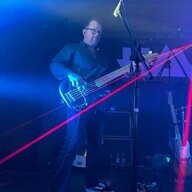
As far as the tone in the clip you posted, the bass tone is very difficult to really hear clearly. Given that the bass player is using a hollow body bass (Gibson ??) the instruments non-amplified voice is probably pretty mid/high heavy. In the recording they have made the bass very thuddy ... with lots of low end and not a ton of mid definition, and not a lot of highs, which is surprising since the bass player is using a pic which usually get you at least some definition.
If you were seeking that kind of tone, try turning up bass EQ in the 80-100hz range. Scoop mids (300-800hz), roll off highs (1k - 4k) Turn the tone down on your bass (depending on what bass you use).
FWIW, the original version of the song done by The Call has a ton of bass definition ... very clanky 80's rock tone (IMO/IME).
use your ears, good luck!

Clink on the links below to view threads on the most frequently asked questions and topics in the amps forum.
If you have threads or links to contribute to this section, please feel free to PM an AMP mod for inclusion!
Warning! Some of these topics are objective and to the point. Most are on much more subjective matters. The one thing you won't get in those threads is a single definitive answer. Like most subjective issues, you're going to get a lot of opinions, hopefully most of which are based upon real world experience. The point of having threads like this...
If you have threads or links to contribute to this section, please feel free to PM an AMP mod for inclusion!
Warning! Some of these topics are objective and to the point. Most are on much more subjective matters. The one thing you won't get in those threads is a single definitive answer. Like most subjective issues, you're going to get a lot of opinions, hopefully most of which are based upon real world experience. The point of having threads like this...
- IvanMike
- Replies: 2
- Forum: Amps and Cabs [BG]
As far as the tone in the clip you posted, the bass tone is very difficult to really hear clearly. Given that the bass player is using a hollow body bass (Gibson ??) the instruments non-amplified voice is probably pretty mid/high heavy. In the recording they have made the bass very thuddy ... with lots of low end and not a ton of mid definition, and not a lot of highs, which is surprising since the bass player is using a pic which usually get you at least some definition.
If you were seeking that kind of tone, try turning up bass EQ in the 80-100hz range. Scoop mids (300-800hz), roll off highs (1k - 4k) Turn the tone down on your bass (depending on what bass you use).
FWIW, the original version of the song done by The Call has a ton of bass definition ... very clanky 80's rock tone (IMO/IME).
use your ears, good luck!
Last edited:

I got tired of not knowing what each frequency center would do, so one day I sat down with headphones, a freebie 31 band graphic EQ plugin, and a recording of my bass with no EQ straight into an interface. Then I went through every single slider, going up, down and all around, and listened to the tonal changes, and I didn’t move to the next slider until I had the previous slider’s actions committed to memory.
Finally got a chance to listen, and on the 20t, I’d start with bass 2 o clock, mids 2 o clock, treble 10 o clock, maybe even 9, and turn your tweeter off if you have one. Got no idea what bass you’re using, but while he’s using an Epiphone EB2, your bass may require a different setting, but I always found that a good place to start on the PF heads with that style preamp for most basses. I’d leave off the Boss for now, too.
Also, he’s using flatwounds, which have less ringy attack, so if you’re using rounds, you won’t get an exact match but close enough unless BMRC needs you to fill in
Also, he’s using flatwounds, which have less ringy attack, so if you’re using rounds, you won’t get an exact match but close enough unless BMRC needs you to fill in

I'd like to have a better understanding of EQing bass guitar. I hear people use terms like "scooped" all the time but don't really know how to identify or replicate certain EQs. How would the bass tone in this song be described and achieved from an EQ perspective? I have a BOSS GE-7 pedal and the EQ settings on my Ampeg PF-20T to work with.
One of the challenges here is listening to a mixed and mastered track. First the bass gets recorded, and you might hear a blend of mic and DI signals, which are then manipulated via EQ, compression, clipping, etc. After that there will be additional layers of processing, including EQ and compression, which will make the finished sound you hear in the track different from what came out of the amp. That isn't to say the sound is wildly different, but it could be quite challenging to replicate the mixed & mastered sound in a live rig.
@JimmyM mentions a great point. Get an EQ plugin, narrow the Q, and boost and cut various ranges to hear what's going on. There are rules of thumb about what sounds good, but ultimately you need to have your own sense of direction.
A bass example with a pedal
Here's an example with guitar in a DAW.
here is a thread sticky from Amps and Cabs that has some very solid EQ info.
Clink on the links below to view threads on the most frequently asked questions and topics in the amps forum.
If you have threads or links to contribute to this section, please feel free to PM an AMP mod for inclusion!
Warning! Some of these topics are objective and to the point. Most are on much more subjective matters. The one thing you won't get in those threads is a single definitive answer. Like most subjective issues, you're going to get a lot of opinions, hopefully most of which are based upon real world experience. The point of having threads like this...
- IvanMike
- Replies: 2
- Forum: Amps and Cabs [BG]
As far as the tone in the clip you posted, the bass tone is very difficult to really hear clearly. Given that the bass player is using a hollow body bass (Gibson ??) the instruments non-amplified voice is probably pretty mid/high heavy. In the recording they have made the bass very thuddy ... with lots of low end and not a ton of mid definition, and not a lot of highs, which is surprising since the bass player is using a pic which usually get you at least some definition.
If you were seeking that kind of tone, try turning up bass EQ in the 80-100hz range. Scoop mids (300-800hz), roll off highs (1k - 4k) Turn the tone down on your bass (depending on what bass you use).
FWIW, the original version of the song done by The Call has a ton of bass definition ... very clanky 80's rock tone (IMO/IME).
use your ears, good luck!
Thanks! I am using the same bass that he's playing--an Epiphone Rivoli--and the humbucker pickup is very thuddy. I'll try those settings on the EQ pedal!
The bass player in BRMC is actually the bass player from The Call's son! They cover the song as a tribute to his father who was also very involved with their band and the making of their music.
Finally got a chance to listen, and on the 20t, I’d start with bass 2 o clock, mids 2 o clock, treble 10 o clock, maybe even 9, and turn your tweeter off if you have one. Got no idea what bass you’re using, but while he’s using an Epiphone EB2, your bass may require a different setting, but I always found that a good place to start on the PF heads with that style preamp for most basses. I’d leave off the Boss for now, too.
Also, he’s using flatwounds, which have less ringy attack, so if you’re using rounds, you won’t get an exact match but close enough unless BMRC needs you to fill in
That's almost exactly where I keep my PF20T set haha. The only difference is that I usually have the treble at around noon. I'm using it with the 1x12 cab and have wondered if I might have more luck with a 2x10...
Thank you!
One of the challenges here is listening to a mixed and mastered track. First the bass gets recorded, and you might hear a blend of mic and DI signals, which are then manipulated via EQ, compression, clipping, etc. After that there will be additional layers of processing, including EQ and compression, which will make the finished sound you hear in the track different from what came out of the amp. That isn't to say the sound is wildly different, but it could be quite challenging to replicate the mixed & mastered sound in a live rig.
@JimmyM mentions a great point. Get an EQ plugin, narrow the Q, and boost and cut various ranges to hear what's going on. There are rules of thumb about what sounds good, but ultimately you need to have your own sense of direction.
A bass example with a pedal
Here's an example with guitar in a DAW.
Thanks! Those are great videos!
112 vs 210 is immaterial to me. If I like the sound, I’ll use anything. I have one of those PF112’s and it’s sweet.That's almost exactly where I keep my PF20T set haha. The only difference is that I usually have the treble at around noon. I'm using it with the 1x12 cab and have wondered if I might have more luck with a 2x10...
Thank you!
So since you have a Rivoli with a mudbucker as well, that might be too much bass and not enough treble to use those settings. Not sure, though, since it’s been a couple decades since I played one.

I do the opposite. I make a frown.Scooped means the mid range is scooped out or lowered. On a graphic eq this looks like a smiley face.
Caveat: I’ve been playing for a few decades, but I am *not* an engineer or a physicist or even anywhere close to being a scientist.
With that caveat, here’s some of my theoretical understanding of EQ, versus some of the more practical/tactical knowledge shared in this thread. Hope it’s helpful for OP or someone else. Also I’m definitely open for correction!
When a lot of people say tone, they mean timbre.
The frequency of a note by itself is just a sine wave, like that tinnitus ringing in your ear sound. What gives an instrument its unique voice is the accumulation of harmonics that are also heard when a note is played or sung. Some of those harmonics will be naturally boosted or cut or sustained or dampened depending on resonance. That gives an instrument its timbre, and what makes your spoken voice different from mine.
(I’m using the term harmonic here, but some of those additional frequencies are also disharmonic. Ignore that for now.)
When you make EQ changes, it’s important to understand that the change affects primarily that frequency, eg. 50 Hz. In addition to that frequency, there are nearby frequencies - 40, 43, 52, etc - that also get affected. This range is the width, literally the band width. If you boost, imagine you’re building a mountain with the peak being that frequency the slider is set for. The width of the base of the mountain is the bandwidth. Similarly, if you cut, you’re making a depression, and the width of the top of that depression is the bandwidth.
Imagine an X-Y axis, where Y is amplitude of signal and X is frequency of signal. Y is what you’re controlling when you make a change with the slider, and X is the slider itself.
So given that each note played or sung is a package containing the fundamental frequency as well as an assortment of harmonic frequencies, when you boost or cut in a given band you are only affecting the frequencies in that given band. This is why when you cut at 40 Hz you’ll still hear the low E, but what you’re primarily hearing is the package of harmonics that exist at higher frequencies, and they inform your brain that a low E is being played. It also means that if you have a high frequency band boosted, you’ll still hear finger on string noise or fret buzz when playing those low notes. Boosting a band will not affect the amplitude of frequencies outside of that band, but may result in them being “shouted down,” lost in the relative amplitude of that band.
Many of these extra frequencies live in the mid range, so making changes to he mids can have a big impact on your tone. A scooped setting (lowered mids) can sound more “pure” when played without other instruments in the mix, and we hear that as good and musical, whereas boosted mids can sound honky and nasal when played solo.
In a mix however, those midrange bands are where the bulk of your “tone” (timbre) actually reside. And given that a guitar is typically an octave higher than a bass, their harmonic packages per note will be other than yours, so boosting the mids in a mix allows you to cut through more, be more audible in the mix. Some of those frequencies are washed over or played with more amplitude by other instruments, so what you tend to get more with a mids boost in a mix is much closer to the timbre of your instrument, versus that honky nasal quality.
Overdrive/distortion/fuzz basically add more harmonic content and/or drive higher the amplitude of ranges of harmonic content. Putting an EQ before any of these or before a preamp and boosting a given band will overdrive that band going into the pedal/preamp circuit, so can give you more of that white noise around that that band than you otherwise would have had. Having an EQ before or after one of these pedals will have different effects.
It’s important to understand that settings for one combo of bass+pedals+amp may be very different when used with another bass or pedal or amp.
Compression typically affects a note in both amplitude and sustain of harmonic/fundamental frequencies, raising the amplitude of the quieter ones and lowering the amplitude of the louder ones. When you first attack a note, with your finger, your pick, your thumb, etc, that initial note attack has a higher amplitude of many of those frequencies, and then they decay (lose sustain) over differing periods of time, depending on the structure of your bass and the natural EQ of your signal chain. Sustain basically means they maintain a given amplitude longer. Playing around with a compressor, you can lessen or increase that attack, add sustain, or reduce sustain. Having an EQ before or after a compressor will also have different effects.
So where an EQ is in your signal chain is important. The one on your amp is post-preamp, one in your effects loop will come after the amp’s EQ, and you can place one at the very start of your signal chain, right out of your bass. Playing around with an EQ pedal’s location is also important to spend some time with.
With that caveat, here’s some of my theoretical understanding of EQ, versus some of the more practical/tactical knowledge shared in this thread. Hope it’s helpful for OP or someone else. Also I’m definitely open for correction!
When a lot of people say tone, they mean timbre.
The frequency of a note by itself is just a sine wave, like that tinnitus ringing in your ear sound. What gives an instrument its unique voice is the accumulation of harmonics that are also heard when a note is played or sung. Some of those harmonics will be naturally boosted or cut or sustained or dampened depending on resonance. That gives an instrument its timbre, and what makes your spoken voice different from mine.
(I’m using the term harmonic here, but some of those additional frequencies are also disharmonic. Ignore that for now.)
When you make EQ changes, it’s important to understand that the change affects primarily that frequency, eg. 50 Hz. In addition to that frequency, there are nearby frequencies - 40, 43, 52, etc - that also get affected. This range is the width, literally the band width. If you boost, imagine you’re building a mountain with the peak being that frequency the slider is set for. The width of the base of the mountain is the bandwidth. Similarly, if you cut, you’re making a depression, and the width of the top of that depression is the bandwidth.
Imagine an X-Y axis, where Y is amplitude of signal and X is frequency of signal. Y is what you’re controlling when you make a change with the slider, and X is the slider itself.
So given that each note played or sung is a package containing the fundamental frequency as well as an assortment of harmonic frequencies, when you boost or cut in a given band you are only affecting the frequencies in that given band. This is why when you cut at 40 Hz you’ll still hear the low E, but what you’re primarily hearing is the package of harmonics that exist at higher frequencies, and they inform your brain that a low E is being played. It also means that if you have a high frequency band boosted, you’ll still hear finger on string noise or fret buzz when playing those low notes. Boosting a band will not affect the amplitude of frequencies outside of that band, but may result in them being “shouted down,” lost in the relative amplitude of that band.
Many of these extra frequencies live in the mid range, so making changes to he mids can have a big impact on your tone. A scooped setting (lowered mids) can sound more “pure” when played without other instruments in the mix, and we hear that as good and musical, whereas boosted mids can sound honky and nasal when played solo.
In a mix however, those midrange bands are where the bulk of your “tone” (timbre) actually reside. And given that a guitar is typically an octave higher than a bass, their harmonic packages per note will be other than yours, so boosting the mids in a mix allows you to cut through more, be more audible in the mix. Some of those frequencies are washed over or played with more amplitude by other instruments, so what you tend to get more with a mids boost in a mix is much closer to the timbre of your instrument, versus that honky nasal quality.
Overdrive/distortion/fuzz basically add more harmonic content and/or drive higher the amplitude of ranges of harmonic content. Putting an EQ before any of these or before a preamp and boosting a given band will overdrive that band going into the pedal/preamp circuit, so can give you more of that white noise around that that band than you otherwise would have had. Having an EQ before or after one of these pedals will have different effects.
It’s important to understand that settings for one combo of bass+pedals+amp may be very different when used with another bass or pedal or amp.
Compression typically affects a note in both amplitude and sustain of harmonic/fundamental frequencies, raising the amplitude of the quieter ones and lowering the amplitude of the louder ones. When you first attack a note, with your finger, your pick, your thumb, etc, that initial note attack has a higher amplitude of many of those frequencies, and then they decay (lose sustain) over differing periods of time, depending on the structure of your bass and the natural EQ of your signal chain. Sustain basically means they maintain a given amplitude longer. Playing around with a compressor, you can lessen or increase that attack, add sustain, or reduce sustain. Having an EQ before or after a compressor will also have different effects.
So where an EQ is in your signal chain is important. The one on your amp is post-preamp, one in your effects loop will come after the amp’s EQ, and you can place one at the very start of your signal chain, right out of your bass. Playing around with an EQ pedal’s location is also important to spend some time with.
Caveat: I’ve been playing for a few decades, but I am *not* an engineer or a physicist or even anywhere close to being a scientist.
With that caveat, here’s some of my theoretical understanding of EQ, versus some of the more practical/tactical knowledge shared in this thread. Hope it’s helpful for OP or someone else. Also I’m definitely open for correction!
When a lot of people say tone, they mean timbre.
The frequency of a note by itself is just a sine wave, like that tinnitus ringing in your ear sound. What gives an instrument its unique voice is the accumulation of harmonics that are also heard when a note is played or sung. Some of those harmonics will be naturally boosted or cut or sustained or dampened depending on resonance. That gives an instrument its timbre, and what makes your spoken voice different from mine.
(I’m using the term harmonic here, but some of those additional frequencies are also disharmonic. Ignore that for now.)
When you make EQ changes, it’s important to understand that the change affects primarily that frequency, eg. 50 Hz. In addition to that frequency, there are nearby frequencies - 40, 43, 52, etc - that also get affected. This range is the width, literally the band width. If you boost, imagine you’re building a mountain with the peak being that frequency the slider is set for. The width of the base of the mountain is the bandwidth. Similarly, if you cut, you’re making a depression, and the width of the top of that depression is the bandwidth.
Imagine an X-Y axis, where Y is amplitude of signal and X is frequency of signal. Y is what you’re controlling when you make a change with the slider, and X is the slider itself.
So given that each note played or sung is a package containing the fundamental frequency as well as an assortment of harmonic frequencies, when you boost or cut in a given band you are only affecting the frequencies in that given band. This is why when you cut at 40 Hz you’ll still hear the low E, but what you’re primarily hearing is the package of harmonics that exist at higher frequencies, and they inform your brain that a low E is being played. It also means that if you have a high frequency band boosted, you’ll still hear finger on string noise or fret buzz when playing those low notes. Boosting a band will not affect the amplitude of frequencies outside of that band, but may result in them being “shouted down,” lost in the relative amplitude of that band.
Many of these extra frequencies live in the mid range, so making changes to he mids can have a big impact on your tone. A scooped setting (lowered mids) can sound more “pure” when played without other instruments in the mix, and we hear that as good and musical, whereas boosted mids can sound honky and nasal when played solo.
In a mix however, those midrange bands are where the bulk of your “tone” (timbre) actually reside. And given that a guitar is typically an octave higher than a bass, their harmonic packages per note will be other than yours, so boosting the mids in a mix allows you to cut through more, be more audible in the mix. Some of those frequencies are washed over or played with more amplitude by other instruments, so what you tend to get more with a mids boost in a mix is much closer to the timbre of your instrument, versus that honky nasal quality.
Overdrive/distortion/fuzz basically add more harmonic content and/or drive higher the amplitude of ranges of harmonic content. Putting an EQ before any of these or before a preamp and boosting a given band will overdrive that band going into the pedal/preamp circuit, so can give you more of that white noise around that that band than you otherwise would have had. Having an EQ before or after one of these pedals will have different effects.
It’s important to understand that settings for one combo of bass+pedals+amp may be very different when used with another bass or pedal or amp.
Compression typically affects a note in both amplitude and sustain of harmonic/fundamental frequencies, raising the amplitude of the quieter ones and lowering the amplitude of the louder ones. When you first attack a note, with your finger, your pick, your thumb, etc, that initial note attack has a higher amplitude of many of those frequencies, and then they decay (lose sustain) over differing periods of time, depending on the structure of your bass and the natural EQ of your signal chain. Sustain basically means they maintain a given amplitude longer. Playing around with a compressor, you can lessen or increase that attack, add sustain, or reduce sustain. Having an EQ before or after a compressor will also have different effects.
So where an EQ is in your signal chain is important. The one on your amp is post-preamp, one in your effects loop will come after the amp’s EQ, and you can place one at the very start of your signal chain, right out of your bass. Playing around with an EQ pedal’s location is also important to spend some time with.
Thanks a lot! Very helpful!
Yw, I should also add that if you’re not looking for adding distortion or overdrive, you should be looking at primarily cutting frequencies instead of boosting.Thanks a lot! Very helpful!
Also, a really great way to make your amp completely impotent and nearly inaudible is to boost lows. Those lower frequencies literally need more electricity (wattage) to be made louder; higher frequencies need less. That’s why bass amps tend to be 500 watts versus 30-50 watt guitar amps.
Here's an online 1/3 octave frequency training game you can set for different levels of skill and you can limit the bandpass frequency range to suit the speakers your listening to.
Audio Frequency Trainer
Audio Frequency Trainer
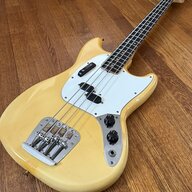
Lots of great info for you about EQ so far in the thread. I’ll throw in some things to think about that are related to the Rivoli you are playing. I played a Gibson EB2 with flats, Gibson’s version of the Riv, in a band not unlike BRMC, and got a similar sound. It’s a short scale bass so you’re going to get more meat, clarity, and punch by playing higher up on the neck. Meaning if the song is in B, I’ll play my bassline centered around the B on the E string 7th fret and not the B on the A string 2nd fret. This is where a short scale / mudbucker combo shines. Mids are super important to the sound you’re after, so cutting or scooping mids will kill your ability to cut through. It’s better to cut some lows to uncover the mids, instead of boosting anything. Also, open sounding ported cabinets tended to work better than sealed which will sometimes over accentuate the thuddyness. I found a ported 2x15 Sunn 200s cab sounded way better than a sealed 8x10 SVT cab with that particular bass. Conversely, a mid forward bass like a Precision tends to sound better with the sealed 8x10 SVT to my ears. Anyway, good luck in your tone quest.
Lots of great info for you about EQ so far in the thread. I’ll throw in some things to think about that are related to the Rivoli you are playing. I played a Gibson EB2 with flats, Gibson’s version of the Riv, in a band not unlike BRMC, and got a similar sound. It’s a short scale bass so you’re going to get more meat, clarity, and punch by playing higher up on the neck. Meaning if the song is in B, I’ll play my bassline centered around the B on the E string 7th fret and not the B on the A string 2nd fret. This is where a short scale / mudbucker combo shines. Mids are super important to the sound you’re after, so cutting or scooping mids will kill your ability to cut through. It’s better to cut some lows to uncover the mids, instead of boosting anything. Also, open sounding ported cabinets tended to work better than sealed which will sometimes over accentuate the thuddyness. I found a ported 2x15 Sunn 200s cab sounded way better than a sealed 8x10 SVT cab with that particular bass. Conversely, a mid forward bass like a Precision tends to sound better with the sealed 8x10 SVT to my ears. Anyway, good luck in your tone quest.
Thank you! This is very helpful!
You’re so right about the sound being different depending on where you play on the neck. The difference in clarity is really stark.
So you would say the BRMC bass sound (specifically in the video) is very mids-focused?
Thank you! This is very helpful!
You’re so right about the sound being different depending on where you play on the neck. The difference in clarity is really stark.
So you would say the BRMC bass sound (specifically in the video) is very mids-focused?
Not necessarily mids focused, but they are definitely present, especially low mids around 4-500Hz. There’s likely a bit of a low roll off going on which allows the mids to be heard as opposed to a mid boost. Also sounds like he’s running a subtle effect. I can hear the tail of maybe a light reverb or delay on the fill he plays at 3:40. Listening to the track again with headphones, it sounds like he’s running an SVT so I guess forget what I said about ported cabs, lol. It has that Ampeg thud.
Not necessarily mids focused, but they are definitely present, especially low mids around 4-500Hz. There’s likely a bit of a low roll off going on which allows the mids to be heard as opposed to a mid boost. Also sounds like he’s running a subtle effect. I can hear the tail of maybe a light reverb or delay on the fill he plays at 3:40. Listening to the track again with headphones, it sounds like he’s running an SVT so I guess forget what I said about ported cabs, lol. It has that Ampeg thud.
Got it. Thanks! I too think I hear some delay in parts. He’s running an SVT II head but I can’t see the cab he’s running through. He normally uses 8x10s, so likely one of those.
Yep sounds like an SVT and 8x10Got it. Thanks! I too think I hear some delay in parts. He’s running an SVT II head but I can’t see the cab he’s running through. He normally uses 8x10s, so likely one of those.


