
I would agree with you on Eddie and Ron, but do you ever check out symphonic players ? They play in tune essentially all the time.Nobody plays in tune all the time. Even not the greatest upright or fretless players. Players like Eddie Gomez or Ron Carter don't have the best intonation but they make that up with their enormous creativity.

Enjoy the benefits of a premium membership!
Upgrade Account
-
TalkBass has been independent since 1998. Add your voice.
Create a free account to reply to discussions, view embedded media, and browse with fewer display ads.
Join free Log in
Want zero display ads or expanded classifieds tools? Compare plans.
You are using an out of date browser. It may not display this or other websites correctly.
You should upgrade or use an alternative browser.
You should upgrade or use an alternative browser.
Unlined or Lined: Irrelevant?
- Thread starter Dr. Cheese
- Start date
More options
Who Replied?
I would agree with you on Eddie and Ron, but do you ever check out symphonic players ? They play in tune essentially all the time.
I think the structure of a conductor, the orchestra tuning to a common pitch, a bass section in which players will match each other plus the fact orchestras play written music with no improvisation all help with intonation, IMO.

You can't see the lines when you're playing anyway. I like the Fender fretless scheme of dots on the note at 1, 3, 5, 7 etc. If I had lines i would probably start to try to look at them while I play. I started on an early fretless P and have never understood why people would want lines.
So does a rigorous training program that starts in elementary school for some.its a very competitive situation to get a symphonic position similar to getting into an Ivy League school. One of my DB instructors was very proud of the number of students he got into top ranked schools and then went on to symphonies. There is a very intense focus on the technique staying highly intonated and using a bow. It is its own universe. Patitucci and Stanley Clarke started out on that assembly line, but got sidetracked.I think the structure of a conductor, the orchestra tuning to a common pitch, a bass section in which players will match each other plus the fact orchestras play written music with no improvisation all help with intonation, IMO.
I have profound respect for the classically trained db players. They may not be able to improvise ("we dont do that") but they will always execute whats on the sheet in tune.
So does a rigorous training program that starts in elementary school for some.its a very competitive situation to get a symphonic position similar to getting into an Ivy League school. One of my DB instructors was very proud of the number of students he got into top ranked schools and then went on to symphonies. There is a very intense focus on the technique staying highly intonated and using a bow. It is its own universe. Patitucci and Stanley Clarke started out on that assembly line, but got sidetracked.
I have profound respect for the classically trained db players. They may not be able to improvise ("we dont do that") but they will always execute whats on the sheet in tune.
If that what it takes to consistently be in tune, markers of any kind, on a fretless bass guitar should be a non-issue.


Where the neck joins the body is the big deal for upright. Plus, someone auditioning for a major college will stick with one bass for 6 months or more .If that what it takes to consistently be in tune, markers of any kind, on a fretless bass guitar should be a non-issue.
Where the neck joins the body is the big deal for upright. Plus, someone auditioning for a major college will stick with one bass for 6 months or more .
If basses are standard scale, changing instruments should be manageable. At the point when kids are learning, many do not own the instruments they use.

It's just aesthetics, play what works best for you.


I would agree with you on Eddie and Ron, but do you ever check out symphonic players ? They play in tune essentially all the time.
I have played upright in orchestras and I can assure you they don't play in tune all the time. Even the top players don't.
I don't mind that, I love players like Eberhard Weber's playing but it drives some people nuts.[/QUOTE]Pino doesn't. Steve does not have the best intonation.
Yes he is another example. I love his playing but it's not always in tune. Now if he had a lined board.....


Do you think that every lined fretless is bought from a store?You can't see the lines when you're playing anyway. I like the Fender fretless scheme of dots on the note at 1, 3, 5, 7 etc. If I had lines i would probably start to try to look at them while I play. I started on an early fretless P and have never understood why people would want lines.
Many have to have the bass of their choice defretted.
Unless you have an unlined fingerboard applied,that usually means inlays are put in.
Last edited:

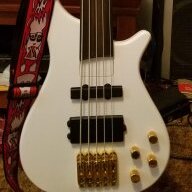
This bass, goes by the name of Fred, and Fred's slinky nylon raiment, gave me a proper start. Got the jazz juices flowing 'n' all 
My first bass, way back, had nylon flats onboard. We may just go again, on the strength of that. My Fred though will be lined. And her name's Elle — Elle for lined So, slung slinky like that, what's the bet she gives ol' Fred a run for his money.
I've always balked on the restringing, up until now — the rounds serve very nicely, if it ain't broke, etc. — but that woodiness Fred's fueling may have pushed me over the edge.
My first bass, way back, had nylon flats onboard. We may just go again, on the strength of that. My Fred though will be lined. And her name's Elle — Elle for lined
So, slung slinky like that, what's the bet she gives ol' Fred a run for his money.I've always balked on the restringing, up until now — the rounds serve very nicely, if it ain't broke, etc. — but that woodiness Fred's fueling may have pushed me over the edge.

I recently bought my second fretless. My first was a Carvin AC50 without lines about five years ago. I didn’t get very far with it. Because I play a lot of instruments I just didn’t have the time to commit to learning it well.
Fast forward to last week. I bought an Ibanez SRH505f with lines - mainly because I have a gig where the BL prefers that sound.
I found that the lines (and especially where it matters where they come over the edge of the fretboard) are so dark I can barely see them. Since I want that sound, don’t have a lot of time to spend getting up to par, and can’t see the lines well enough, I plan to cut out the dark fretlines and fill them in with glow in the dark powder, and reposition the side dots in between the frets with glow in the dark powder as well. All told - $35 in parts and a fun little project.
I get that unlined looks cool. I definitely get that lines are like training wheels. But I also understand that for a gig, sometimes you have to do what you need to get through. Hopefully over time I can develop my fretless playing and move to unlined, but if I never do I’m fine keeping the lines.
Fast forward to last week. I bought an Ibanez SRH505f with lines - mainly because I have a gig where the BL prefers that sound.
I found that the lines (and especially where it matters where they come over the edge of the fretboard) are so dark I can barely see them. Since I want that sound, don’t have a lot of time to spend getting up to par, and can’t see the lines well enough, I plan to cut out the dark fretlines and fill them in with glow in the dark powder, and reposition the side dots in between the frets with glow in the dark powder as well. All told - $35 in parts and a fun little project.
I get that unlined looks cool. I definitely get that lines are like training wheels. But I also understand that for a gig, sometimes you have to do what you need to get through. Hopefully over time I can develop my fretless playing and move to unlined, but if I never do I’m fine keeping the lines.
I don't mind that, I love players like Eberhard Weber's playing but it drives some people nuts.
Yes he is another example. I love his playing but it's not always in tune. Now if he had a lined board.....
If he had a lined board, he'd know where the frets were supposed to be. However, their location is a compromise*, and even a perfectly intonated fretted bass/guitar is not in tune throughout the fretboard.
So he'd still be out of tune unless he used his ear and muscle memory to locate the correct spot for each individual note.
*Unless you have the Buzz Feiten Tuning System®, True Temperament Fretting System or another one like it installed on your instrument.
If he had a lined board, he'd know where the frets were supposed to be. However, their location is a compromise*, and even a perfectly intonated fretted bass/guitar is not in tune throughout the fretboard.
So he'd still be out of tune unless he used his ear and muscle memory to locate the correct spot for each individual note.
*Unless you have the Buzz Feiten Tuning System®, True Temperament Fretting System or another one like it installed on your instrument.
A perfectly intonated fretted bass should be in tune 'enough' all over the fret board so that it doesn't annoy you or other people or stand in the way of making music. Thousands of bass player and guitar players have proven that along the way. Same goes for lined boards. That's not really an issue for most people. (yes I know about equal temperament fretting systems, but I don't need them
).(yes I know about equal temperament fretting systems, but I don't need them
Much the same as I and many others don't need lines on a fretless.


Much the same as I and many others don't need lines on a fretless.
That's what you think...


