• TalkBass has been independent since 1998. Add your voice.
    Create a free account to reply to discussions, view embedded media, and browse with fewer display ads.
    Join freeLog in
    Want zero display ads or expanded classifieds tools? Compare plans.

Unusual Rock Trivia?

Peter Baker was born in Lewisham, South London; he was nicknamed "Ginger" for his shock of flaming red hair.
View attachment 4897676

Baker also holds a record for releasing the first double album to be registered as platinum-selling. One thing that really got on Baker’s nerves was doing interviews, and he wasn’t afraid to speak his mind. On many occasions, Baker was outright abusive towards interviewers, unconcerned about looking brutish in front of audiences.

One of the consequences of being a part of Cream, according to Baker himself, was a serious hearing issue. By the end of his life, Baker was virtually deaf.
According to Baker himself, he relied on improvisation to get him through live shows, and almost never practiced beforehand. This resulted in songs that often lasted 20 minutes!
This is all you need to learn what a crank he was…
Beware of Mr. Baker (2012) - IMDb
I encountered him in the waiting room of a chiropractor once, around the time of his involvement with Masters Of Reality. He was about 52 then, but looked 20 years older.
 
Last edited:
The artist behind one of the greatest prog rock album covers was not a professional artist. Barry Godber was an art-school friend of King Crimson lyricist Pete Sinfield and was then working as a computer programmer. Recruited by Sinfield to create a cover for their 1969 album, In the Court of the Crimson King, Godber got knocked off his feet by “21st Century Schizoid Man,” and painted exactly what he saw. Robert Fripp in particular loved the dramatic nature of the painting. It was Fripp’s idea to put no artist or title on the front or back cover, a radical idea at the time (and a risky one for a debut). Sadly, Godber had a fatal heart attack soon after its release; the painting is now owned by Fripp.
59474E4B-00F0-43F8-BC2C-C04709DA9B83.jpeg
 
The artist behind one of the greatest prog rock album covers was not a professional artist. Barry Godber was an art-school friend of King Crimson lyricist Pete Sinfield and was then working as a computer programmer. Recruited by Sinfield to create a cover for their 1969 album, In the Court of the Crimson King, Godber got knocked off his feet by “21st Century Schizoid Man,” and painted exactly what he saw. Robert Fripp in particular loved the dramatic nature of the painting. It was Fripp’s idea to put no artist or title on the front or back cover, a radical idea at the time (and a risky one for a debut). Sadly, Godber had a fatal heart attack soon after its release; the painting is now owned by Fripp.
View attachment 4899831
In honor of my favorite album cover, and a favorite album.
20200828_095158.jpg
 
View attachment 4898794
Fender necks that have been sawn down the middle to show the truss rod curve, the top is a '50s/one piece maple neck and the bottom a later '70s neck with bullet truss rod adjusted from the headstock end. The truss rod is a 3/16" steel rod set in a curved channel. Look how thin the wood is on the back of the neck!

By modern standards this is considered one of the more basic designs, tightening the rod forces it to straighten and hence give the neck a back bow. If the neck develops a natural back bow there's nothing you can do about it. More modern dual action truss rods can bend the neck both ways.
I'm pretty sure that the backs of those necks have also been sawed off. Notice that they're not rounded as one would expect. Still, the curved truss channel is interesting!
 
Rick Wakeman’s album covers would get bigger and splashier as his concept albums did, but the cover of his 1973 solo debut The Six Wives of Henry VIII was more subtle. With a photograph of a serious-looking Wakeman walking among the figures of Henry VII and his wives at Madame Tussaud’s wax museum, it underlined the historical nature of the album. Everything about the cover was quintessentially English. Except of course for Richard Nixon, who’s there in the background if you look closely; the Tussaud’s folks had failed to move his figure all the way out of range.

2513B5EB-0DA3-47E8-8BEE-9228CB7BC01A.jpeg
 
Longtime designer Hugh Syme was right in tune with Rush’s cerebral sense of humor, which found its finest expression on one of their best-loved albums, Moving Pictures. The 1981 cover makes a triple visual pun on the title, with a crew moving paintings out of a museum, teary onlookers being moved by the scene, and a movie crew filming it. There are subtler jokes too: How many museums would have a chilling painting of Joan of Arc’s death right next to one of dogs playing poker? (There’s an infinite loop here too: Joan is played by the cover’s photographer Deborah Samuel). Friends of the band are in the crowd, including Crowbar lead singer Kelly Jay as one of the movers; and it was shot at the three-arched Ontario Legislative Building in Toronto. And this beloved cover almost didn’t happen: The label felt that Rush’s concept would cost too much, so the band shelled out the expenses itself.

9D6019D0-E3DE-4DC1-8087-92C71057C575.jpeg
 
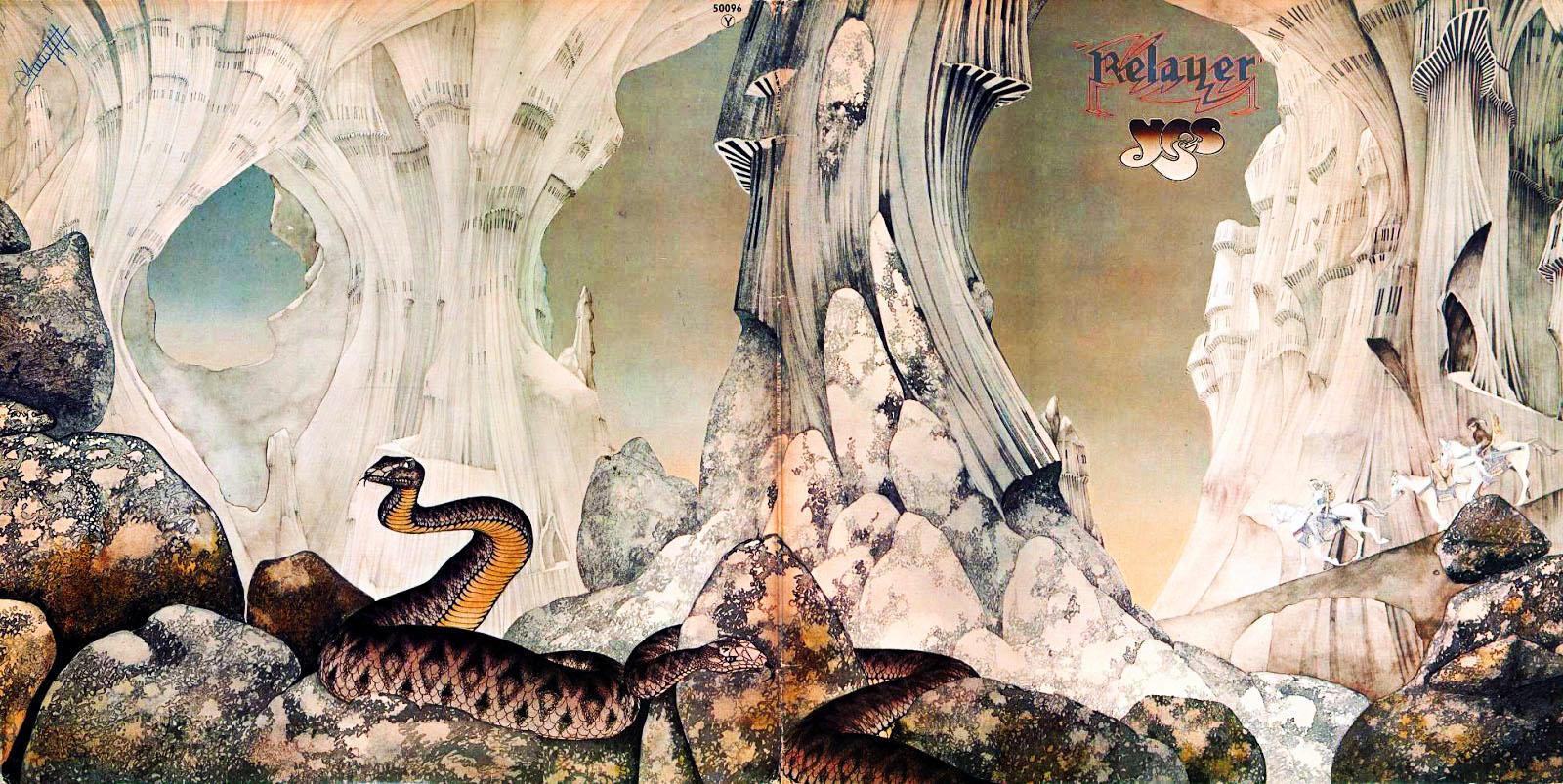
Though Roger Dean did the artwork for dozens of bands, he’s most closely aligned with Yes, whose logo he also created. And the link between Yes’ musical and Dean’s visual imagery is no coincidence. “I felt that if the band was making an effort to reinvent music, that there was an obligation to have this product look like it came from the place where the music allegedly came from,” he explained. His most striking Yes cover, 1974’s Relayer, may be the one most closely keyed to the music. The war-and-peace themed album is Yes’ most dramatic, and Dean departed from his usual splashes of color to create a forbidding wintry landscape with marching soldiers and a guard snake (Dean was working off the album’s original title, The Gates of Delirium). The cover also has a hidden secret: It forms a continuous scene when you put its front cover to the left of the back cover of Yes’ previous album, Tales From Topographic Oceans.

D753EE00-5F49-48A1-95D9-C0A56A8AB1A4.jpeg
 
The cover also has a hidden secret: It forms a continuous scene when you put its front cover to the left of the back cover of Yes’ previous album, Tales From Topographic Oceans.

I'm amazed, as both a diehard Yes fan during the 1970s, and as the sort of 1970s-era teenager who spent countless hours staring at LP gatefolds, that ^^^this never occurred to me.

I no longer have either album on vinyl, and my CD collection is currently 2,500 miles away from me; need to see if there's a picture online of the two jackets juxtaposed!


Edit: I found this...which is Relayer's back cover next to TFTO's front cover:
[Invalid or Expired Link Removed]
 
I'm amazed, as both a diehard Yes fan during the 1970s, and as the sort of 1970s-era teenager who spent countless hours staring at LP gatefolds, that ^^^this never occurred to me.

I no longer have either album on vinyl, and my CD collection is currently 2,500 miles away from me; need to see if there's a picture online of the two jackets juxtaposed!


Edit: I found this...which is Relayer's back cover next to TFTO's front cover:
[Invalid or Expired Link Removed]
Thanks! I was too lazy to do to put it all together. :roflmao: Thanks for doing it!
 
  • Like
Reactions: SubHuman
The first female roadie..Tana Douglas

A snippet from an interview.

Even though she served in the trenches of rock, Tana Douglas’s memoir, LOUD: A Life in Rock’n’Roll by the World’s First Female Roadie, could easily serve the same purpose – a kind of Gaffer Tape Your Life.

As a young woman barely out of boarding school in Toowoomba when she landed her first crew gigs, Douglas stuck steadfastly to the rule: “Never let them see a sign of weakness.” She even gave that one for free to a crying Sharon Osbourne, having a moment in a hotel lobby bathroom during Ozzy Osbourne’s 1980 Blizzard of Ozz tour.

Even though she served in the trenches of rock, Tana Douglas’s memoir, LOUD: A Life in Rock’n’Roll by the World’s First Female Roadie, could easily serve the same purpose – a kind of Gaffer Tape Your Life.

But it was as the backline roadie for AC/DC that she found her calling, with manager Michael Browning moving her into a sharehouse with the band. What’s striking about her memoir is just how young band and crews tended to be – often still teenagers. Douglas recalls Bon Scott fretting that he was too old for the game, being relatively ancient in his late 20s.

Here’s the whole interview.
From sharehousing with AC/DC to comforting Sharon Osbourne: life as the world’s first female roadie

A8FF2E2F-7F00-4C45-B916-E6CC3216F500.jpeg
F242B534-6B61-4660-A68D-7B1F66D69C02.jpeg
363ABD1A-4496-4B97-ADAE-BBCEE7A8D84D.png
 
The main lyrics of the Jimi Hendrix song Fire ("let me stand next to your fire") came from a time when the band had just finished a gig in the cold around Christmas, 1966. They went to bass player Noel Redding's mother's house in Folkestone, England, and when they got there, Jimi asked Redding's mother Margaret if he could "stand next to her fire" to warm up. The family dog, a German Shepherd, lay by the fire, which inspired the line, "Move over Rover, and let Jimi take over."


This lyrical lightning bolt was a breakthrough for Hendrix, who had just started writing songs at the request of his manager Chas Chandler. Writing riffs was easy for him, and it turned out he had a talent for crafting lyrics as well, as he was able to turn a simple line into a fiery tale of lustful passion.

Link Removed
 
Tom Kriss was the original bassist for the James Gang, but wanted to leave after the Yer Album. Jim Fox relates this and how Dale Peters came in. DP btw, was originally a drummer himself.

Tom just spilled his guts," Fox tells UCR's [Invalid or Expired Link Removed] of a band meeting called after he and Joe Walsh realized Kriss "hadn’t said sh** in six months." Fox remembers Kriss saying: "'I hate this band. I hate the music we’re making. I don’t think I can play it anymore.' Joe and I were blindsided. You know, it was like, he was, I thought, a very fine player. 'Tom, aren’t you somewhat equally responsible for the music we’re making? What do you want to do?' 'Well, I don’t know, but I can’t take this anymore.'"

Fortunately, Fox knew just who to call: Dale Peters, who had replaced him in a college band at Ohio State University a few years before. Peters was drumming at the time, but he'd since picked up the bass — and Fox happened to know he was at loose ends with his own group, the Case of E.T. Hooley.

"I said, 'What are you doing? I know the band is not doing well.' He said, 'Yeah, we’ve kind of split up. I was thinking of going back to school,'" Fox recalls. "I said, 'Well, there’s a situation here. We have an unhappy bass player, who I think we’re going to have to replace. Why don’t you come down tonight after the gig and we’ll play for a while?' And he did and it was magic. It was instantaneously an upgrade, which we never expected. It was like, 'Well, Tom’s got his wish.' The next day, we sat Tom down and we said, 'Tom, you know, we talked to Dale Peters, another bass player, and you’re free to go.' He goes, 'Wow, thanks man, that’s a load off my mind.' Literally, the following night, Dale was in the slot and we never looked back."
 

Latest posts