

Enjoy the benefits of a premium membership!
Upgrade Account
-
TalkBass has been independent since 1998. Add your voice.
Create a free account to reply to discussions, view embedded media, and browse with fewer display ads.
Join free Log in
Want zero display ads or expanded classifieds tools? Compare plans.
You are using an out of date browser. It may not display this or other websites correctly.
You should upgrade or use an alternative browser.
You should upgrade or use an alternative browser.
Updating Recording set up
- Thread starter peterpalmieri
- Start date
More options
Who Replied?
I’m also doing upgrade and expansion to my home production studio... and had an older IMac with memory upgraded from 8 to 12 gb. It wasn’t enough (I use a lot of plugins, Slate, Wave, etc.) running GarageBand. Finally, my computer crashed and I had to get a new iMac a month or so ago. I upgraded to 16gb memory and the results have been terrific!
I’m not sure where I’m going with a new audio interface yet (currently Focusrite Scarlett 2i4) but I can say that for both a pre/DI for bass and vocals, the BAE 1073DMP has been giving me terrific results.
I’m not sure where I’m going with a new audio interface yet (currently Focusrite Scarlett 2i4) but I can say that for both a pre/DI for bass and vocals, the BAE 1073DMP has been giving me terrific results.

Apogee stuff is definitely high quality that offers unmatched integration with Logic, but you can read over on my thread about the problems I had with my pair of Element 88 interfaces. I’m glad they’re gone and what’s replaced them (MOTU 16A, Line Audio 8MP, Audient Nero) sounds noticeably better and actually works as advertised.
For a high end two channel interface I’d look at Metric Halo. If you need four channels I’d look at MOTU, RME, Lynx, etc. and something like a Vintage Audio M12.
For a high end two channel interface I’d look at Metric Halo. If you need four channels I’d look at MOTU, RME, Lynx, etc. and something like a Vintage Audio M12.
Apogee stuff is definitely high quality that offers unmatched integration with Logic, but you can read over on my thread about the problems I had with my pair of Element 88 interfaces. I’m glad they’re gone and what’s replaced them (MOTU 16A, Line Audio 8MP, Audient Nero) sounds noticeably better and actually works as advertised.
For a high end two channel interface I’d look at Metric Halo. If you need four channels I’d look at MOTU, RME, Lynx, etc. and something like a Vintage Audio M12.
thanks I read all about your problems, really sucks. It is hard for me to think I’d run into the same problems as you. I wouldn’t mind 4 mic Pres but I can live with two most of the time and I want the best quality converters I can afford and great mic Pres. At this price point the symphony Desktop checks all the boxes, o body is using these units yet so I don’t want to be the guinea pig either.
Will start reading over some of the other options you’ve mentioned.
I’m also doing upgrade and expansion to my home production studio... and had an older IMac with memory upgraded from 8 to 12 gb. It wasn’t enough (I use a lot of plugins, Slate, Wave, etc.) running GarageBand. Finally, my computer crashed and I had to get a new iMac a month or so ago. I upgraded to 16gb memory and the results have been terrific!
I’m not sure where I’m going with a new audio interface yet (currently Focusrite Scarlett 2i4) but I can say that for both a pre/DI for bass and vocals, the BAE 1073DMP has been giving me terrific results.
i haven’t had any computer issues, although my memory is still upgradable. I probably won’t look at adding any additional plug ins beyond what comes with symphony desktop and what I have in logic.
Having and loving my Monique I am very happy with my bass DI solution. But I do recognize that my converters are the weak link in the chain.
I can live with two quality inputs as I’m doing mostly my own tracks and individual players coming in. I’ve done a lot of experimenting with two mic drum recordings which is fun. 4 would be nice but I have a Roland kit and a drummer friend with a pretty high end studio that will put tracks together and send them to me.
My understanding is that the desktop uses the original Symphony converters, not the current ones. I believe these are the same converters used in the current Ensemble line. If high quality conversion is your main focus I’d look at a Metric Halo ULN-2, or Lynx and pair it with an external preamp. If you want super duper high level conversion than Burl is about as good as it gets, but Cranesong isn’t far behind.I want the best quality converters I can afford


You had me a bit nervous about that. The additional research had me dig a little deeper. No worries.all good
My understanding is that the desktop uses the original Symphony converters, not the current ones. I believe these are the same converters used in the current Ensemble line. If high quality conversion is your main focus I’d look at a Metric Halo ULN-2, or Lynx and pair it with an external preamp. If you want super duper high level conversion than Burl is about as good as it gets, but Cranesong isn’t far behind.
what I’m shooting for is an entire quality package below the $1500 price mark.
Great mic pre
Great AD conversion
Separate engineer and performer routable headphone outputs
Simple Logic integration
it is hard for me to understand what will be good enough when looking at the AD/DA conversion, although I know using the ZED10 isn’t high enough.
I'll second this recommendation. I have the Babyface Pro FS sitting on my desk right now, and it's been rock solid, plus has plenty of expansion options for me to grow more into it later.For that money, I'd be looking at the RME Babyface. They've been making world class digital interfaces since the '80s.

Had a Garageband question and issue. Been trying to get a handle on it during this lockdown.
My equipment used: MacBook, Garageband, Apogee Duet, non-active Jazz bass
Two of my bandmates (guitarist and keys) sent me an mp3 which I created as a track on iTunes. Pulled to GB as a separate track. I laid separate bass track. Levels seemed to be ok. I then "shared" it back with iTunes. Problem is that they sound good, but the bass sounds overdriven. I tried many angles to fix this. (re-recorded at lower levels, sending to iTunes at lower levels, exporting my bass track as an mp3 to my computer then re-introducing to GarageBand as new track. No luck. Anybody else had this issue? If so, any solutions?
My equipment used: MacBook, Garageband, Apogee Duet, non-active Jazz bass
Two of my bandmates (guitarist and keys) sent me an mp3 which I created as a track on iTunes. Pulled to GB as a separate track. I laid separate bass track. Levels seemed to be ok. I then "shared" it back with iTunes. Problem is that they sound good, but the bass sounds overdriven. I tried many angles to fix this. (re-recorded at lower levels, sending to iTunes at lower levels, exporting my bass track as an mp3 to my computer then re-introducing to GarageBand as new track. No luck. Anybody else had this issue? If so, any solutions?
I’d really like to have to independent head phone outputs so I can have a separate mixer for the performer and engineer when tracking vocal or anything with an open mic.I'll second this recommendation. I have the Babyface Pro FS sitting on my desk right now, and it's been rock solid, plus has plenty of expansion options for me to grow more into it later.
I did a little experiment last night and hooked up my XR18, which I normally only use live with an ipad, to my Mac to record and playback tracks.
not to test the audio quality but just to get my hands on feel of using hardware that uses its own routing software. In addition it’s a hardware device that I can’t quickly grab a Physical knob to switch between headphone and monitors.
I’m even more convinced that I want a solution that is integrated into logic and allows me to switch between headphones and monitors on my desk top. As well as get my input volume, switch on phantom power and set up playback and control live out of the box signal monitoring vs latency through software issues.
As a side note I prefer using a Soundcraft UI mixer when I’m playing with a band, the routing is much simpler and way easier to make adjustments when you’ve only got one bar of rest to make adjustments. The XR18 is a way more flexible and better sounding device but is a bit complicated to use while playing.
not to test the audio quality but just to get my hands on feel of using hardware that uses its own routing software. In addition it’s a hardware device that I can’t quickly grab a Physical knob to switch between headphone and monitors.
I’m even more convinced that I want a solution that is integrated into logic and allows me to switch between headphones and monitors on my desk top. As well as get my input volume, switch on phantom power and set up playback and control live out of the box signal monitoring vs latency through software issues.
As a side note I prefer using a Soundcraft UI mixer when I’m playing with a band, the routing is much simpler and way easier to make adjustments when you’ve only got one bar of rest to make adjustments. The XR18 is a way more flexible and better sounding device but is a bit complicated to use while playing.
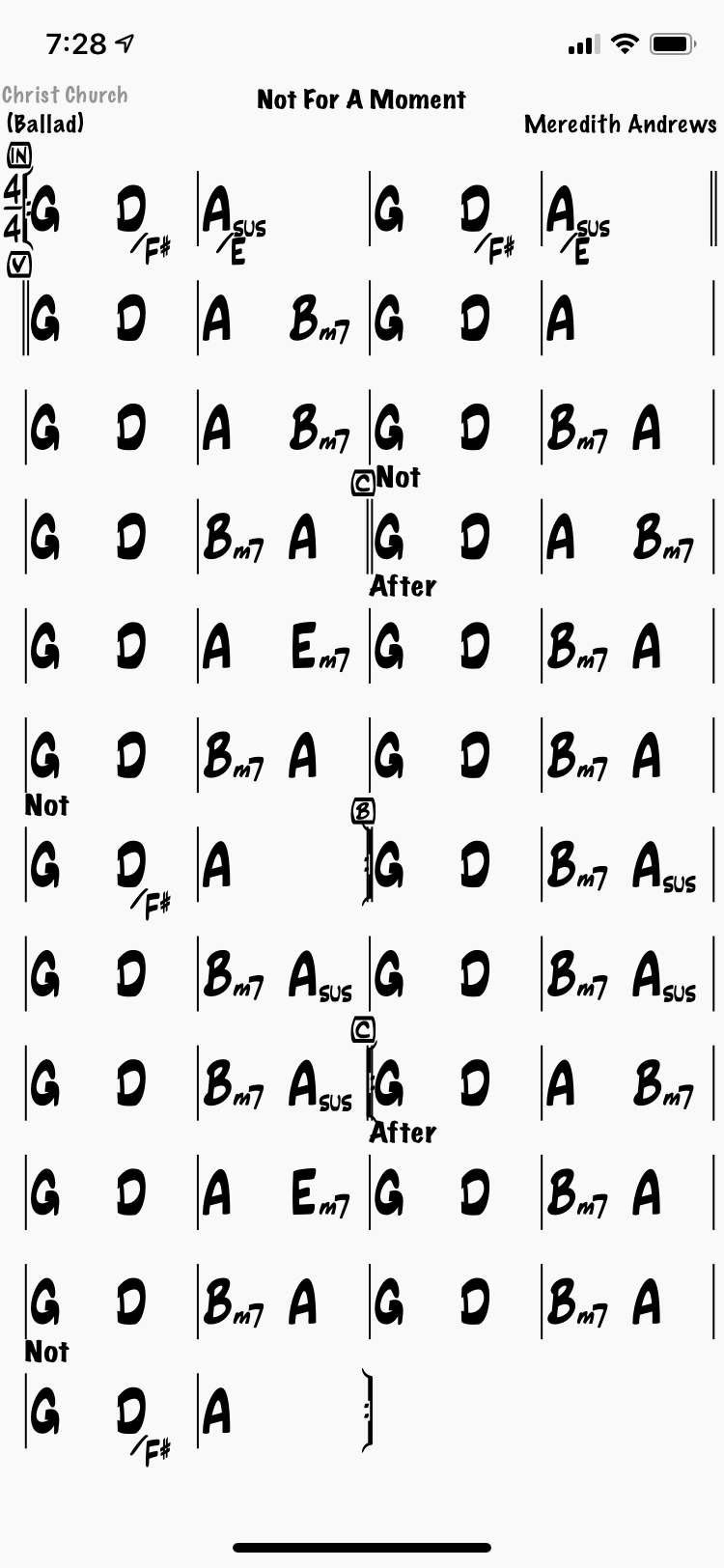
Here are the kinds of things I’ve been working on at home. These are pretty raw tracks, I did all the instrumentation including my terrible guitar playing on an awful acoustic. My wife recorded the vocal, she’s not a singer just my guinea pig but she does play along to keep me sane.
I can shoot this out in various forms for other folks in church to record their parts and send back to me.
Just learning to use flex pitch and other more advanced features in logic.
414 on the vocal, c1000 on the acoustic and bass is DI through Monique. I think I need to move the vocal mic further back, and maybe add the 414 further away as a second mic for the guitar but really the shortcomings are my performance not my mic skills. But none the less I will keep working at it.
About 4 hours of work including writing out the chord chart, creating the midi and laying out the arrangement


I can shoot this out in various forms for other folks in church to record their parts and send back to me.
Just learning to use flex pitch and other more advanced features in logic.
414 on the vocal, c1000 on the acoustic and bass is DI through Monique. I think I need to move the vocal mic further back, and maybe add the 414 further away as a second mic for the guitar but really the shortcomings are my performance not my mic skills. But none the less I will keep working at it.
About 4 hours of work including writing out the chord chart, creating the midi and laying out the arrangement
Last edited:
I’ve been using IReal Pro to write out chord charts for the groups I play with for years. To come up with keyboard parts I import the midi file into logic and then cut it up and alter it. There is probably an easier way but it works for me.

The more you look into the idea of updating your home studio the more things you want cost money. a Good DAW like logic is a good choice although I use a different one. Good interfaces can be bought for 500.00 or less. The better ones like RME are going to cost you. I think head phone should be or one of the priorities especially if you are not using speakers or using cheap speakers in a room that is not treated.
The more you look into the idea of updating your home studio the more things you want cost money. a Good DAW like logic is a good choice although I use a different one. Good interfaces can be bought for 500.00 or less. The better ones like RME are going to cost you. I think head phone should be or one of the priorities especially if you are not using speakers or using cheap speakers in a room that is not treated.
I have a pretty decent room, it pretty funny of all the things you mentioned headphones, I do have 2 K141s and 2 senn HD280s. Speakers could be better, KRK rockit 5.
At this point I’m waiting on the Symphony Desktop to start shipping and will likely wait for some reviews to make sure any bugs get worked out.
I do really need a couple decent guitars for laying down scratch tracks but I really don’t have interest in playing guitar other then when I need to. So I will probably hold off
Last edited:
I've been doing some petty intense research in regards to own upgrades. Narrowed it down to three 2 channel interfaces: RME Babyface, Apollo Twin X Duo, and Desktop Symphony. I think the Desktop Symphony has won out. Mainly because of the converter and DSP. I see Apogee has a really nice 6 band EQ and Compressor/Limiter plugin. Will be great for mixing and mastering I think. They look a bit like the Fabfilter stuff.
I just bought a new Adam Audio A3x and Sub7 speakers. Haven't hooked them up yet, still waiting for the cables. Will be getting a second Sub7, so I'll have three way speakers either side. The Sub7 goes down to 32hz.
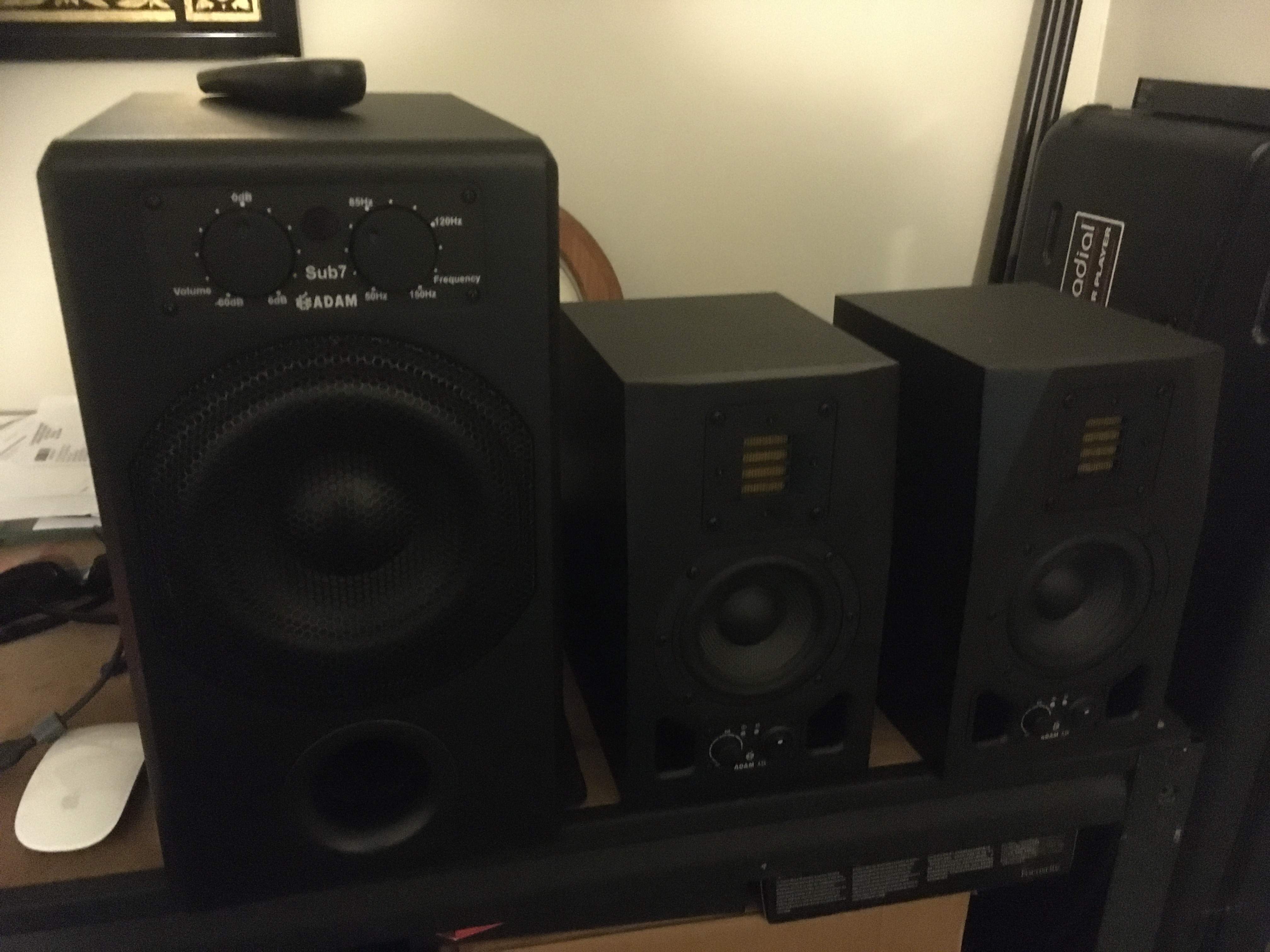
I just bought a new Adam Audio A3x and Sub7 speakers. Haven't hooked them up yet, still waiting for the cables. Will be getting a second Sub7, so I'll have three way speakers either side. The Sub7 goes down to 32hz.
You'll get better low end performance and less cancellation if you cluster your subs rather than spreading them out in a stereo arrangement. To further improvement the performance they should be clustered as close to one of the nearfields as possible. It looks weird compared to a symmetrical setup with subs on each side, but it really does work better for a number of reasons. It becomes a question of studio acoustics versus studio aesthetics and performance.Will be getting a second Sub7, so I'll have three way speakers either side.
Good tip, thanks
You'll get better low end performance and less cancellation if you cluster your subs rather than spreading them out in a stereo arrangement. To further improvement the performance they should be clustered as close to one of the nearfields as possible. It looks weird compared to a symmetrical setup with subs on each side, but it really does work better for a number of reasons. It becomes a question of studio acoustics versus studio aesthetics and performance.


