• TalkBass has been independent since 1998. Add your voice.
    Create a free account to reply to discussions, view embedded media, and browse with fewer display ads.
    Join freeLog in
    Want zero display ads or expanded classifieds tools? Compare plans.

Double Bass upright bass physically hard to play!

PeaveyPlayer

Supporting Member
Jul 15, 2014
5,327
4,876
Winnipeg, Manitoba
I have this upright bass i rent through my school to play and it is unbearably hard to play physically


I have taken it in twice now for a set up and they had addressed a separating fretboard and put a new adjustable bridge on

i have it as low as it can go and I still cant play it


anything I can do myself to make it playable/?
 
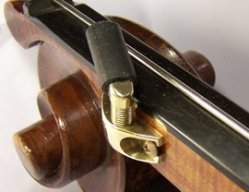
IMG_5769.JPG
IMG_5770.JPG
IMG_5771.JPG
 
You are not allowed to change anything on a rented bass. Doing something wrong can result in a much more expensive repair bill than if the change was done correctly by a luthier.

The strings are some flavor of D'Addario Helicore Hybrid (except the D which might be a Helicore Pizzicato).

What you can do is measure the distance between underside of the string and the fingerboard at the end of the fingerboard and the length of the open vibrating string. And you can make another photo of the silk ends in the peg box, so we can find out which flavor (light, medium or heavy and size) is used on your bass.

If you can give us this information, we can tell you weather the lowest possible string action is too high or you are not used to the greater physical challenge of a double bass. It's hard to tell that from the pictures.

Don't try to change the string height yourself, since a lower action might result in buzzes, so the fingerboard needs to be dressed to get rid of the buzzes. And that's definitely not a task for yourself to do at home, even if you might get permission to do that. You could easily ruin the fingerboard and a new one including dressing can get rather expensive.

When I got my own bass new the action of my adjustable bridge was too high, but I was warned by the luthier that the bridge might settle lower over time and that I should play it that way for some time. I changed it myself more than 10 years later (it would have be possible to do that after one of two years) but on my own instrument, my own risk and a lot more knowledge than before and the fingerboard needs some dressing after that.
 
  • Like
Reactions: Lee Moses
First thing to check is the nut height. If you can freely slide a Popsicle stick under the strings at the nut, then it is way too high. Second is fingerboard scoop. Press the lowest Eb on the D string, and at the same time press the highest note on the D string. Now look at the string height midway between these two points. Opinions vary here, but if it's more than 3mm then you have too much scoop. Lowering the bridge will help in thumb position, but won't do much in the lower register.
 
Last edited:
There are several threads on setup here on TB, but as it's not your instrument you can't really change much.

Possibly your nut might be a bit high, and your board might have a bit much scoop, but those are things that the luthier would have addressed in the set-up, and they are beyond what you may do anyway. The strings do not seem excessively high though, but maybe I don't see it right (giving some info might help). The one thing you might be able to do is mount lighter strings (not sure you may; check first), and beyond that: work on your technique.
 
There have been many good suggestions here, but what is it that makes it unplayable for you? Are you getting fatigue or pain in one arm or the other? Is this a problem with one hand or both? Is it a shoulder? See where I'm going here with this?

It could be setup, technique, or both. We need more information.

Something as simple as setting the end pin too high can even cause major fatigue.
 
Last edited:
  • Like
Reactions: Ortsom and PauFerro
Upright bass and Trumpet are the two most demanding instruments to play physically. ... Heavy orchestra strings would make pizz playing difficult. ... But, you haven't stated whether it's you right or left hand that's the biggest problem.
 
  • Like
Reactions: Ortsom
I have a really low action and just started playing upright 2 weeks ago. Like you, I found it a bear to play the thing at first. To the point I got a 1/4 size upright (35" from the bridge to the nut). And even with the shorter scale, that made me feel like I was recovering from a stroke and having to relearn how to do basic things all over again -- things I could do without thinking on electric bass.

At the nut, the strings are about the thickness of a business card on the G, D, and A strings above the fingerboard, and the a bit less than the thickness of a credit card on the E string nut area. The strings go from about 6 mm to 11 mm from the top of the fingerboard at the bridge end of the fingerboard.

But guess what -- at two-three hours a day of playing for two weeks, it's gotten way easier. So you need to give it some time and let the muscle groups in your hands, shoulders, and arms develop. My forearm and hands were fatigued and I could feel the muscle strain (like you do when you engage in healthy exercise). At one point I felt like my hands were the size of anvils as the muscles were developing. But today I woke up with no sense that my muscles are hurting and I just played for 45 minutes with no problems at all with my hands a few minutes ago. It is getting easier.

So, I suggest you give it time. Make sure the bass is at the right height. That you are standing properly with it, and that you are using the appropriate fingering for the size of the instrument. Which normally means 1-2-4 fingering and using all available fingers to press down the strings. My teacher also told me to use an full left arm and hand "pulling" motion to press down the strings. So, its not just the muscles in your hands, it's arm muscles too. I find that helps when I start fatiguing on certain notes (like F on the low E).

Good luck. I see why many of the experienced people here kept saying there was a chance I wouldn't make it on upright because the learning curve at first is tough. Your body rejects the instrument, sadly, at first. But I am finding it is getting way easier the more I stick it out.
 
Also try playing seated on a stool, with the instrument positioned stable between your legs (as Mr. Fitzgerald demonstrates in his videos). The stable instrument position with good access may also help.

That said, if you can be specific about them, it is well possible that the owner can relief set-up issues for you, via a luthier. To see if there are issues, please measure the hight of each string above the fingerboard at 3 places: right at the nut, in the middle right above the heel (half-way of the fingerboard), and at the end of the fingerboard. Measure without pushing the string up or down. Use a tape measure, and measure the distance between the strings and the fingerboard, perpendicular to the fingerboard; for the nut use the mentioned business card (or how many fit easily between). And indeed, show the top end of the strings & measure the scale, and let us know if your issues are left or right hand, or shoulder, ... .

Thanks.
 
Also try playing seated on a stool, with the instrument positioned stable between your legs (as Mr. Fitzgerald demonstrates in his videos). The stable instrument position with good access may also help.
Thanks.

So to disagree but, I believe this is the worse thing you can do while playing the upright bass. ... The instrument should be played standing up with your knees slight bent to relax the muscles in your back. Think of how a batter or golfer swings. The back has to be kept loose or you're in for a world of pain. ... The bass should lean into you so you're balancing it and not holding it up. ... The upright can be very hard on the upper body and the reason it's so physically demanding to play. ... If you need to sit down you're tired, so go to bed.
 
My new favorite saying is something I picked up here just recently: "There is nothing convenient or easy about the double bass." This includes playing it, transporting it, amplifying it, working on it ... You get the idea.

I started playing the upright just about a year ago, and it is still "difficult", though a lot easier than when I started. The first gigs I played my hands cramped up and I had to push through. It takes time to develop strength, and you need a lot with this instrument. Heck, just playing with your arms in the wrong positions can cause tendonitis.

Good luck! Keep playing.
 
It's my left hand
It's just hard to fret
Left hand technique most likely. It's hard to describe correctly, but attempt to get the note fingered without squeezing your hand with too much force... The force should come from your whole left side basically from shoulder to fingers, but make sure the force isn't more than needed to get a clean pitch, try to find the lightest touch you need to get a clean tone. Basically, let the weight and physics of how you are holding the large instrument help you....
 
Let me guess -- you're wrapping your thumb around the neck and/or playing with a collapsed hand. Yes?

What you should do is plant your thumb in the middle of the back of the neck and make your hand into what we call "the claw," a C-shape with the palm and fingers like you're going to claw somebody's face. Stop notes with the pads of your fingers.

This maximizes transfer of force and minimizes the strain on your hand and wrist while also maximizing reach. There should be an imaginary straight line through the palm, through your straightened wrist all the way to the elbow.

Forget your ring finger exists. It is there only to provide extra strength when the pinkie is stopping a note.

This DB stuff is more involved than it looks. No go find a teacher! Take at least a few lessons.
 
When I started I went through like 3 or 4 different high school & university basses that were each horrible and very discouraging to play. Once I got my first decent Kay ply - the setup was low with lighter strings - I didn't have to fight it near as much to get on with learning the damn thing properly!
My school has 5 basses

One is playable and I keep that at school all the time


I have to have one at home but its un playable

Going to the other bass feels like a huge relief on my left hand