• TalkBass has been independent since 1998. Add your voice.
    Create a free account to reply to discussions, view embedded media, and browse with fewer display ads.
    Join freeLog in
    Want zero display ads or expanded classifieds tools? Compare plans.

Usable Triple-Double J Build?

I've had this idea kicking around in my head for over a year now. I didn't want 3 splittable humbuckers, I wanted coils that could stand on their own individually and I wanted them all.over.the.place.

Part of the challenge is to make it not overly complicated to select which coils to activate. Originally I was thinking pairing them and using a 3-way switch to select either coil or join them in either series or parallel or maybe a 4-way blade so I didn't have to omit one of the four options. But then I'd have to merge the 3 resultant signals and that seemed a headache:
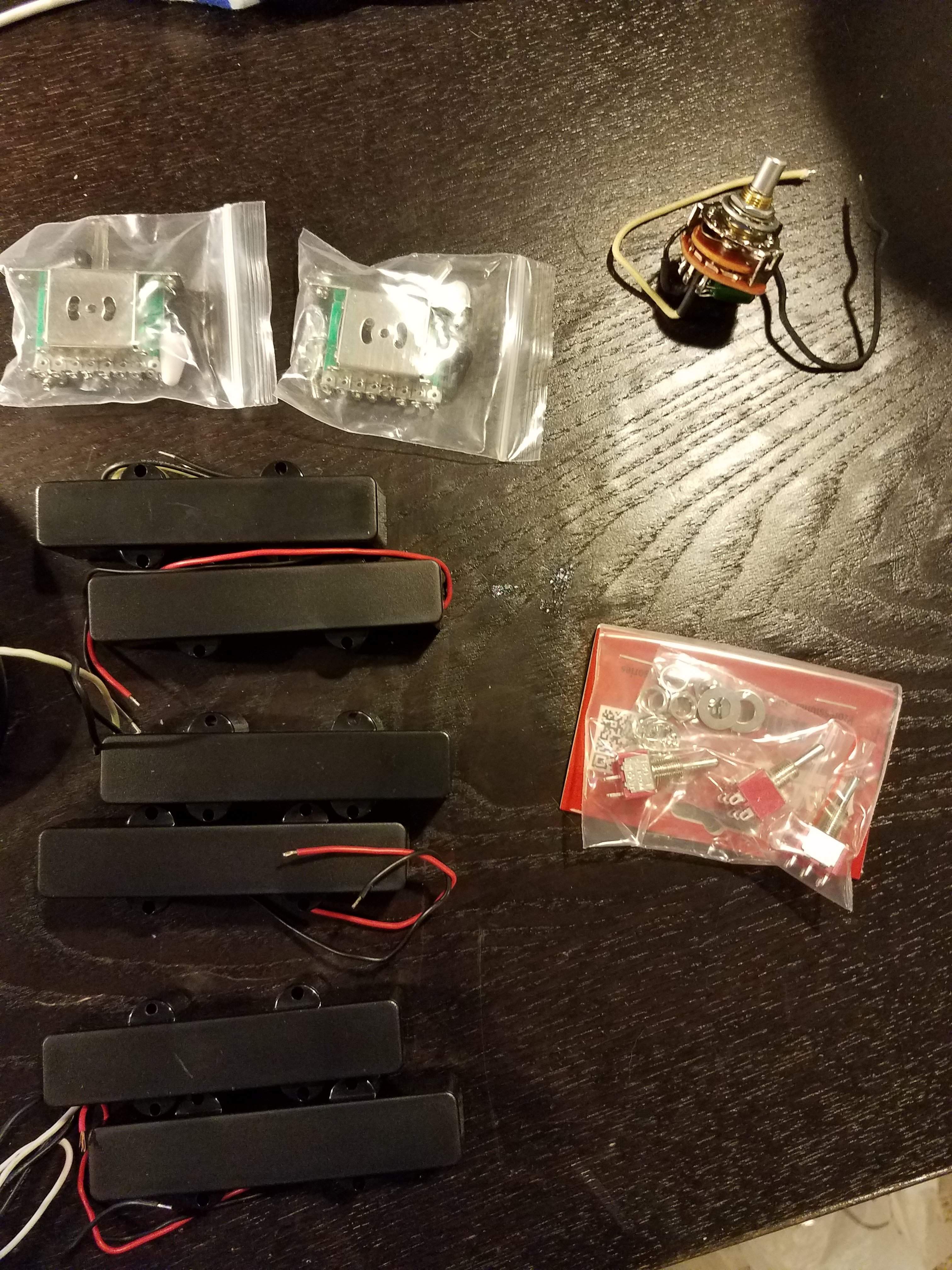
Components.jpg


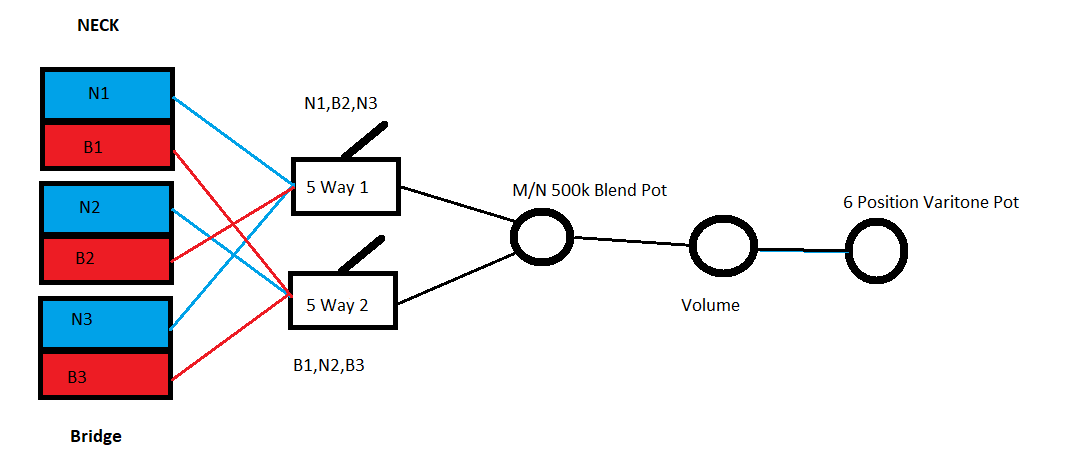
I think I've decided though... I will wire the pickups like a Strat but doubled. I'll use 2 x 5 way switches with either one operating like a humcancelling Strat and then use a 500k M/N blend pot to merge the signals as (very roughly) diagrammed here:
Circuit 1.png


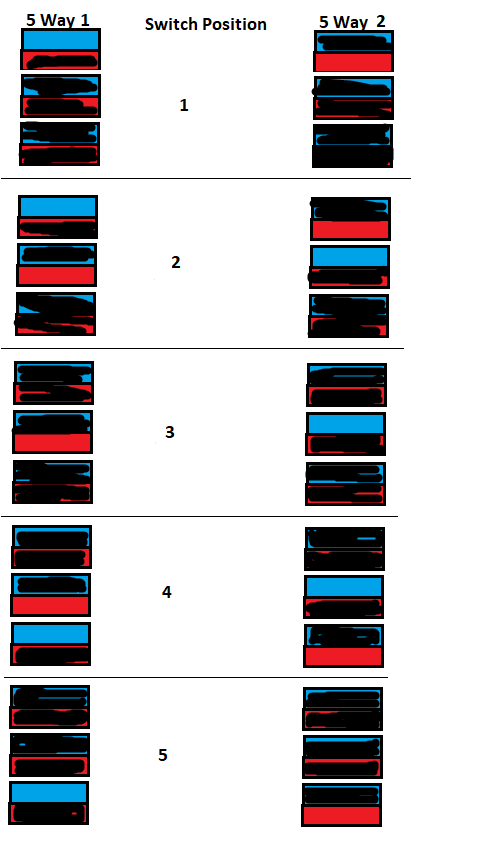
This may not allow for every possible coil config but it will cover quite a few! The diagram below shows how each 5 way would work and then just consider with the Blend, to combine into many combinations. By using a blend and not a 3 way switch, I should also be able to balance them so that if if one side is notable louder I could tweak it easily...
Circuit 2.png


Yeah I'm not the best technical diagrammer...

Hopefully that will be all the bad art I will be subjecting you to. I am just waiting for word on the bass that will be sacrificed for this endeavor... :D
 
I've had this idea kicking around in my head for over a year now. I didn't want 3 splittable humbuckers, I wanted coils that could stand on their own individually and I wanted them all.over.the.place.

Part of the challenge is to make it not overly complicated to select which coils to activate. Originally I was thinking pairing them and using a 3-way switch to select either coil or join them in either series or parallel or maybe a 4-way blade so I didn't have to omit one of the four options. But then I'd have to merge the 3 resultant signals and that seemed a headache:

View attachment 3954028

I think I've decided though... I will wire the pickups like a Strat but doubled. I'll use 2 x 5 way switches with either one operating like a humcancelling Strat and then use a 500k M/N blend pot to merge the signals as (very roughly) diagrammed here:

View attachment 3954030

This may not allow for every possible coil config but it will cover quite a few! The diagram below shows how each 5 way would work and then just consider with the Blend, to combine into many combinations. By using a blend and not a 3 way switch, I should also be able to balance them so that if if one side is notable louder I could tweak it easily...

View attachment 3954031

Yeah I'm not the best technical diagrammer...

Hopefully that will be all the bad art I will be subjecting you to. I am just waiting for word on the bass that will be sacrificed for this endeavor... :D

If you want every option, 3 4 way rotary switches into 2 4 way switches (N/M -> B) into a volume will allow every combination of series/single/parallel. No blending though.
 
Hmmm this wiring may be even more intuitive since it essentially splits the pickups into a Neck set and a Bridge set... Its too early for me to ponder if this gives the same or different coil configs, but it makes the balance knob actually behave like a conventional balance as oppose to interleaving the selected coils in v1...

Circuit 3.png
 
Pure armchair musing (or distilling the wisdom of others I've read) - that's a whole lot of magnetic damping (regardless of what's switched on at a given moment pickup-wise, the magnets are always in play.)

I suspect that one reason some folks love a basic P is that it's got as little of that as an electric bass can have, short of pure piezo or those lightwave pickup things.

But an interesting experiment, and non-armchair results may be different than armchair musings predict. Or it may produce the results you want regardless. Fun project in any case.
 
Pure armchair musing (or distilling the wisdom of others I've read) - that's a whole lot of magnetic damping (regardless of what's switched on at a given moment pickup-wise, the magnets are always in play.)

I suspect that one reason some folks love a basic P is that it's got as little of that as an electric bass can have, short of pure piezo or those lightwave pickup things.

But an interesting experiment, and non-armchair results may be different than armchair musings predict. Or it may produce the results you want regardless. Fun project in any case.

I'm currently seeing if the "subject" of this experimement can be had for no cost other than free advertising which would make this exercise significantly cheaper. The pups ran ~$33 total for 3 matched sets. The most expensive thing by far was the 6 way varitone pot at $50.

So yeah, I would love for this to have real world use, but it is definitely an fun project.
 
This is gonna be diagram heavy so bear with me...

I've been pondering the two strat wiring schemes. I've dubbed my original (well original to me) schematic "Interleaved"
upload_2020-8-23_21-13-54.png


And the newer idea "Stacked"
upload_2020-8-23_21-14-33.png


So I've tried to matrix these out to see if the options offered by one or the other are more desirable. While these are all combined (balance pot is not at either extreme, I think some of these are not necessary a even 50/50 balance.

First, the the matrices and then the one that interest me...
So in the following pictures you'll see "Pos _ #,#" The "_" is for (I)nterleaved or (S)tacked and the "#,#" are the first and second 5 way switch positions respectively. Clear as mud? Lets get into it!

upload_2020-8-23_21-21-33.png

upload_2020-8-23_21-22-17.png

upload_2020-8-23_21-22-59.png


Now for the Stacked configs:
upload_2020-8-23_21-24-2.png

upload_2020-8-23_21-24-46.png

upload_2020-8-23_21-25-29.png


Okay let that sink in... :D

Now that I had the possible pickup configurations I wanted to see if one or the other had more "interesting" or better said, usable options. I avoided the ones where would have been just two of the same pup so double the 60 cycle hum, but I kept some where there was one more of a type than another as a little hum might be allowable:

upload_2020-8-23_21-27-22.png


Maybe I was just getting tire but I found more combinations in the Stacked configuration I thought might work...

upload_2020-8-23_21-30-48.png


13 vs 20 out of 25 combinations each. I'm probably a nerd to find this all interesting.

The Pro of the Interleaved is that I could throw the balance pot all the way to one side and still get the 4th position to be a Jazz bass, but the big Pro for the Stacked config is I can very easily think of one switch controlling my "Neck" sound and the other my "Bridge"...

While I may have to setup the wiring so that I can switch between the two schemes, I'm definitely leaning towards the Stacked wiring at this moment.
 
Not saying this as a luthier, just a player, but I'm picturing two rows of toggle switches. The first row would simply be on/off toggle for each pair of pickups (like on a Jaguar guitar), and the second would be a series of four-way switches that are series/parallel/"north" pickup/"south" pickup (kinda like a G&L L2K K-mod with one extra position).

Again, I'm not a luthier, so this might be incredibly complicated to wire; however, as a player, it seems like it would be much more straightforward to control than two set of interleaved switches.
 
Not saying this as a luthier, just a player, but I'm picturing two rows of toggle switches. The first row would simply be on/off toggle for each pair of pickups (like on a Jaguar guitar), and the second would be a series of four-way switches that are series/parallel/"north" pickup/"south" pickup (kinda like a G&L L2K K-mod with one extra position).

Again, I'm not a luthier, so this might be incredibly complicated to wire; however, as a player, it seems like it would be much more straightforward to control than two set of interleaved switches.

That's the idea I started but with 3way DPDT switches instead of 4 way blades. While you are absolutely right that your wiring approach would provide the maximum # of options (unless you want to dabble in phase switching? Yeah, me neither! lol), I can see myself doing better flipping a couple of 5 ways and then tweak balance to taste to get from and config A to config B rather than trying to fiddle with 3x 4way blades and 3x on/offs...

...again that could totally be me... :D

The other idea I like of going with my "stacked" strat config is just the understanding that if I want the current sound a little bassier or sharper, it may be just a matter of turning the balance knob towards the neck or bridge.

I am trying to balance the options with usability, both in the context of usable sounds, but also accessibility.

Also, for some crazy reason 4-way blades were way more expensive that 5-way, perhaps due to the # of strat modders/builders out there?
 
My counterpoint to that would be that with a control system that complex, it’s going to take you ages to remember what each setting actually does.

What about this modification to your stacked idea: two five way toggles, where one controls the north pickup and the other controls the south pickup, then two S1 type push pull to activate the bridge pickups? That would let you activate pretty much any combination of pickup on the bass. Then you could add a three way dip switch that acts as a sort-of kill switch: middle are all pickups, up is a kill switch for the south pickups, down is a kill switch for the north pickups. I think that would actually give you access to all possible pickup combinations, assuming I’m calculating it correctly. You would not have access to series mode, though. Maybe you could use your Varitone to simulate series? I’ve never used one before so I don’t know what it’s capable of.
 
My counterpoint to that would be that with a control system that complex, it’s going to take you ages to remember what each setting actually does.

What about this modification to your stacked idea: two five way toggles, where one controls the north pickup and the other controls the south pickup, then two S1 type push pull to activate the bridge pickups? That would let you activate pretty much any combination of pickup on the bass. Then you could add a three way dip switch that acts as a sort-of kill switch: middle are all pickups, up is a kill switch for the south pickups, down is a kill switch for the north pickups. I think that would actually give you access to all possible pickup combinations, assuming I’m calculating it correctly. You would not have access to series mode, though. Maybe you could use your Varitone to simulate series? I’ve never used one before so I don’t know what it’s capable of.

Maybe thats why I like P bass no switching around pickups when you only have 1
 
it’s going to take you ages to remember what each setting actually does

Ultimately I'm not sure that matters though, does it? If the player knows that position(s) X and Y give them the tone they want for a certain song, should they care if they know exactly what X and Y are?

Just thinking out loud. The whole subject of planning out switch configurations like this really interests me and I find it really hard to make decisions on my own projects sometimes. There's the sort of logical draw-it-on-paper ideal of planning things out and then you have to balance against the practical aspect of "when I'm playing, what am I actually going to use, and how am I going to use it?"
 
Maybe thats why I like P bass no switching around pickups when you only have 1

And I have absolutely *nothing* against the P bass! That's the reason I'm approaching this as not only a sonic experiment, but a usability experiment. The P bass is tried-n-true and people will argue till the day they die that its all you ever need, and for some that's very true (no snark at all, they can get the sounds they need from it).

This is experimenting for personal enrichment here, I'm curious what I can pull off. It may have been done before but I'll try to document my process/logic so it can be picked apart.
 
  • Like
Reactions: EdBo
Ultimately I'm not sure that matters though, does it? If the player knows that position(s) X and Y give them the tone they want for a certain song, should they care if they know exactly what X and Y are?

Just thinking out loud. The whole subject of planning out switch configurations like this really interests me and I find it really hard to make decisions on my own projects sometimes. There's the sort of logical draw-it-on-paper ideal of planning things out and then you have to balance against the practical aspect of "when I'm playing, what am I actually going to use, and how am I going to use it?"

Right, I'm trying to present the controls in a manner that allows the player the ability to get from config A to config B in a second or less. I feel like, for me, 2 blades switches and a Balance would fit that bill, once familiarity sets in.

As far as the wiring, I feel like the "stacked" approach would be more logical and easy to approach, especially in those moments when you have to be a bit off-script because you aren't sitting in the mix how you'd like. If its too bassy, balance out the Neck stack or pull switch back away from the neck to go with mid coil instead of neck. To nasally? The reverse with the bridge coil blade.