• TalkBass has been independent since 1998. Add your voice.
    Create a free account to reply to discussions, view embedded media, and browse with fewer display ads.
    Join freeLog in
    Want zero display ads or expanded classifieds tools? Compare plans.

Useful gear ideas

A powerful (500 watt), loud, light weight (20lb 1x12") combo with built in wireless for my bass and blue tooth for practice. It should have gain and master controls plus decent EQ so i can dial in clean to dirty and scooped to classic tone. The speaker should be flat enough to make the aux in sound good and the bass sound good. Oh yeah and a built in tuner.......and a 9volt output to power pedals.
 
Last edited:
  • Like
Reactions: Raenil
What I would like to see is a multifunction belt-worn or instrument installed preamp, a modern successor to the Scholz Rockman, both bass and guitar versions. Bought one (arm, leg, firstborn) in 1984, and still have it for headphone practice. Idea would be LiIon rechargeable, long runtime, wireless connection to a plug-in receiver. With surface mount microelectronics could be the size if a cellphone and have more FX. The Rockman sounded great, but with the Rockadapter to power it, or 8 AA batteries that would last 1 show, was trailing 2 cords and it was kludgy, awkward controls, big and heavy. Did eq, stereo chorus, compression, distortion, outputted in stereo directly to a power amp. (the Dunlop Bass Ace copied all of the bad attributes of the original and few of the good ones)
 
The Ampeg clear plexiglass guitars / basses from the early 70s. Could pop a pickup out and replace with another one of different voicing - they had banana plugs making the connections.
Cool, i like the banana plug idea.
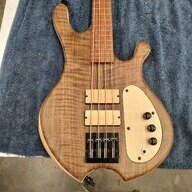
I did this one so i can take the guess work out of placing pickups in my mod projects.
A little hot glue to place a flat lego piece on the pickups and then I can stack more flat ones for height. Move them around for placement. Its not super precise but close enough.
It plays pretty good too!
 
  • Like
Reactions: JRA
BEST IDEA HERE: A locking device that lets you keep your strap onto guitar without falling off the strap....OH wait they did this UGH!!!! LOL
 
We live in an age where players usually employ more than one pedal.

I'd really like it if pedal manufacturers started providing 3.5mm jacks wired in parallel with each 1/4 inch phono jack on their pedals. The option to use significantly smaller interconnecting patch cords would make wiring up a pedalboard so much easier, less expensive, and save some space. Much less of a hassle to anchor them down too.
 
Last edited:
We live in an age where players usually employ more than one pedal.

I'd really like it if pedal manufacturers started providing 3.5mm eurorack type jacks wired in parallel with each 1/4 inch phono jack on their pedals. The option to use significantly smaller interconnecting patch cords would make wiring up a pedalboard so much easier, less expensive, and save some space. Much less of a hassle to anchor them down too.
3.5mm connectors are nowhere near robust enough for this application IME.
 
  • Like
Reactions: Passinwind and WRM
To me, a useful gear idea would be like Legos, with components that quickly lock in place, and can be disconnected just as easily.

Possible applications might include:

Attaching lightweight amps to cab tops so they don't move while playing.

Connecting pedal board elements to a pedal board; bonus points if audio signals and power connections are provided in each "Lego."

Temporarily affixing something to a bass amp - like a tuner, effect, or pedal.

Quick-connect "Lego"-based pick-ups; snap and play.


Brain droppings from an old man...
Glue some Lego baseplate to your cab and some bricks or plates to whatever gear you wanna stick to it. They're more than strong enough for typical flat/horizontal or even slightly inclined surfaces.
 
  • Like
Reactions: Jazzdogg
I always wonder why the vast majority of pickup-equipped acoustic guitars have built-in electronic tuners but are completely absent on solid-body instruments.
I assume it's partly because the controls on acoustic guitars face the player, but on solid bodies face the audience.
I don't recall the brand (I think is started a W - not Warwick, some boutique brand) that did have a small tuner inlayed into the edge of the fingerboard at the body; it was a linear array of LEDs. There was a review of it in Bass Player in the '90s, IIRC.
 
3.5mm connectors are nowhere near robust enough for this application IME.

Out of curiosity, why not? Most boards aren't constantly plugging and unplugging pedals. I've also helped a friend build a 3.5mm patch panel he's using in his home studio. It's had almost two years of active use so far and it's still going strong with zero issues.
 
I always thought it would be cool to have an XLR instrument cable with the ability to provide phantom power to active electronics. No idea if this is feasible or not, guessing not, since as Aged Horse pointed out: if it doesn't exist there's probably a reason.

Relatively straightforward, engineering wise, even within the grasp of a decent little hobbyist hacker..

I will say that this is not a product we're likely to see a ton of demand for, for a couple reasons…

it necessitates that you always have phantom available, so if there's no PA or phantom isn't available, you have to have your own phantom module, or a preamp that provides phantom… not only does that kind of remove the convenience generally, but having to include a preamp largely removes most of the appeal of an onboard preamp..

The other workaround is having an alternative power supply like an onboard battery just as a back up… Which again is going to remove much of the convenience, or at least make it kind of silly and redundant..

so I think if you see this, it will be a bespoke labor of love from somebody, convinced that this is the interface, they need.

ask somebody who has built some elaborate things to solve an imaginary problem for many years, this one doesn't even make my list.


I do kind of like the idea of something like Anthony Jackson's setup- if I remember correctly, his pick up is wired directly to an XLR with no knobs on board, with his preference to be for the pick up to connect directly to a transformer (paraphrasing, but I believe he says that specifically.)

in that specific case, I would argue it may indeed make more sense to have some sort of hi-fi preamp onboard as close as possible to the pick ups, and for somebody who has committed to the XLR life, certainly having phantom power this reinvented hifi active bass is a no-brainer.


Have you seen some of the bases overseas with chargeable batteries and a USB-c port to charge them?
 
  • Like
Reactions: jutty17
Out of curiosity, why not? Most boards aren't constantly plugging and unplugging pedals. I've also helped a friend build a 3.5mm patch panel he's using in his home studio. It's had almost two years of active use so far and it's still going strong with zero issues.
Because in the general population, they don't hold up well.

If the product is only designed for a 3 year lifespan, that would probably work, but I suspect that most folks buying quality gear will be expecting more than that.
 
  • Like
Reactions: Bassdirty and WRM
I've also helped a friend build a 3.5mm patch panel he's using in his home studio. It's had almost two years of active use so far and it's still going strong with zero issues.
Was this by any chance an actual professional 3.5mm patch bay? If so, the jacks contained in the jack field are considerably more robust than the regular, single 3.5mm jacks made for individual mounting. The jacks in a professional, studio-type patch bay are also slightly different and plugs on the patch cords designed to be used in these jack fields are also just slightly differently shaped. Both elements, the jack and plugs are purpose designed to be plugged and unplugged numerous times without failure or causing much wear. They are actually different connectors than the normal 'mini-stereo' plug such as one would find on a set of headphones, even though they are the same diameter and have some degree of interchangeability. (This is also true for .250" patch bays -- the plugs are not truly interchangeable between the two types.)

In any case, terminating cables with 3.5mm connectors is considerably more difficult to do, and as pointed out, they are not nearly as robust. Don't believe that? Have you ever stepped on one?
 
Is that rare? My MarkBass 8x10 has that feature.

I'm sure I'd never use it, tho... :)
Jimmy will call me out if I'm wrong, but I'm fairly sure it's non standard. Same for the ole Mesa 215PH cabinets, the rare one has individual jacks. I can see using the top half in rehearsal studio and the full 810 to gig.
While we're at it with good ideas, how about something that sounds like an 810 at 1/2 the size/weight. Wishing the Berg NV series was still a thing...
 
  • Like
Reactions: Marko 1
Was this by any chance an actual professional 3.5mm patch bay?

It was made by the two of us. He handled the sheet metalwork. I did the wiring and soldering. I'm assuming that makes it unprofessional by your standards. And by ours too since neither one of us considers ourselves electronics professionals either.

I'm sure a real pro could have done it better than ours .But our homebrew has performed very reliably despite that. It just works, so go figure. :)

In any case, terminating cables with 3.5mm connectors is considerably more difficult to do, and as pointed out, they are not nearly as robust. Don't believe that? Have you ever stepped on one?

I didn't find it all that challenging to cut strip, and solder to them. But I have a lot of experience dealing with connectors and cable assemblies and doing field repairs on them from my IT days. I'm also quite good at soldering.

And no. I never stepped on one. But I also never stepped on this particular rack mounted patch panel, nor the cables between two pedals on a pedalboard either. Be quite a feat if I could! :laugh:

I also wasn't suggesting earlier that 3.5mm jacks and plugs be used for everything. Just the patching cables between effects pedals mounted on a pedalboard. Which is a specific rather than general use case.
 
Last edited:
I didn't find it all that challenging to cut strip, and solder to them. But I have a lot of experience dealing with connectors and cable assemblies and doing field repairs on them from my IT days. I'm also quite good at soldering.
I've only ever terminated a couple of dozen 3.5mm connectors -- maybe after I've done several hundred, like I have with 1/4" connectors, I'll have better chops.
 
  • Like
Reactions: agedhorse and 40Hz
I've only ever terminated a couple of dozen 3.5mm connectors -- maybe after I've done several hundred, like I have with 1/4" connectors, I'll have better chops.

I only did 36 for him. Not the most exciting project I ever let myself get roped into by a friend. But it wasn't all that bad since I broke it up into a couple of work sessions. It also wasn't my first rodeo with mini jacks. I do a lot with eurorack synth modules and kits these days. (We all have our weird little retirement hobbies right?) In the eurorack world 3.5mm is the standard for connectors.
 
Last edited:
In any case, terminating cables with 3.5mm connectors is considerably more difficult to do, and as pointed out, they are not nearly as robust. Don't believe that? Have you ever stepped on one?
Depends on the connector? Rean and Neutrik make some 3.5mm connectors that are more or less just miniaturized versions of their 6.5mm units, including the metal barrels. Easier to build with than some XLR plugs in my experience.
 
  • Like
Reactions: 40Hz
For those of you still using rack rigs with Furman power conditioners in the top slot, stick a nightlight into one of the rear power ports. Being able to see the inside of the rack when it is illuminated saved me many times on a dark stage.

Agree. Sure beats trying to find that little flashlight that always tries to stay hidden whenever it's in your gig bag. :thumbsup:
 
  • Like
Reactions: BasturdBlaster