
Enjoy the benefits of a premium membership!
Upgrade Account
-
TalkBass has been independent since 1998. Add your voice.
Create a free account to reply to discussions, view embedded media, and browse with fewer display ads.
Join free Log in
Want zero display ads or expanded classifieds tools? Compare plans.
You are using an out of date browser. It may not display this or other websites correctly.
You should upgrade or use an alternative browser.
You should upgrade or use an alternative browser.
Using Send and Return for FX pedals.
- Thread starter FenderB
- Start date
More options
Who Replied?

So you don't use the send/return option?
You can but that leaves the preamp in the signal chain.
If you just want to put effects in the effects loop, most times it’s only modulation effects or a HPF (IMO) that works well in that part of the chain. Everything else is usually better in front of the preamp.
Another issue is how the effects loop is configured by the manufacturer. If it’s a series loop, then it sits between the preamp and power amp stage. So by plugging directly into just the return jack on a series loop you’ve disconnected your amplifier’s preamp and EQ section and are going straight to the power amp. However, if it’s a parallel loop, the effects chain (think of it as a second channel on a mixer) runs alongside the preamp stage and both get summed somewhere along the way before they go into the power amp stage of your amp.
I was just getting ready to post the same thing. Everything I've read says modulation type effects work best in the loop.Pedals like compression, envelope filters, distortion, and overdrive tend to work better going into the amp’s input. Modulation effects like chorus and flange etc., along with delay and reverb tend to work better in the loop. However, there are no rules, and it really comes down to personal preference through trial and error.

You can but that leaves the preamp in the signal chain.
If you just want to put effects in the effects loop, most times it’s only modulation effects or a HPF (IMO) that works well in that part of the chain. Everything else is usually better in front of the preamp.
Another issue is how the effects loop is configured by the manufacturer. If it’s a series loop, then it sits between the preamp and power amp stage. So by plugging directly into just the return jack on a series loop you’ve disconnected your amplifier’s preamp and EQ section and are going straight to the power amp. However, if it’s a parallel loop, the effects chain (think of it as a second channel on a mixer) runs alongside the preamp stage and both get summed somewhere along the way before they go into the power amp stage of your amp.
I was just getting ready to post the same thing. Everything I've read says modulation type effects work best in the loop.
Pedals like compression, envelope filters, distortion, and overdrive tend to work better going into the amp’s input. Modulation effects like chorus and flange etc., along with delay and reverb tend to work better in the loop. However, there are no rules, and it really comes down to personal preference through trial and error.
I think that advice is outdated. The purpose of the effects loop (on a bass amp, at least) is to be able to give your rackmount modulation/delay/reverb units a line level signal that matches what those units were built for. If we're talking about effects pedals there's no reason to put them in an effects loop because the higher signal level will clip them. Of course there are exceptions but probably 99% of pedals out there can't handle the line level signal of a typical effects loop.

I was just getting ready to post the same thing. Everything I've read says modulation type effects work best in the loop.
That's only relevant when you're using the preamp section of the head for distortion.
You almost always want your time and modulation effects after your distortion, rather than before, wherever it is in the chain.
That isn't necessarily true either. Depends. The classic '60s tones came from plugging the guitar into a spring reverb tank and the tank into a distorted amp. That gives the reverb a bigger sound. Lots of guitarists also prefer chorus before distortion rather than the other way around. The Binson Echorec was designed to go before your distorted amp, not in the loop, and so on.That's only relevant when you're using the preamp section of the head for distortion.
You almost always want your time and modulation effects after your distortion, rather than before, wherever it is in the chain.
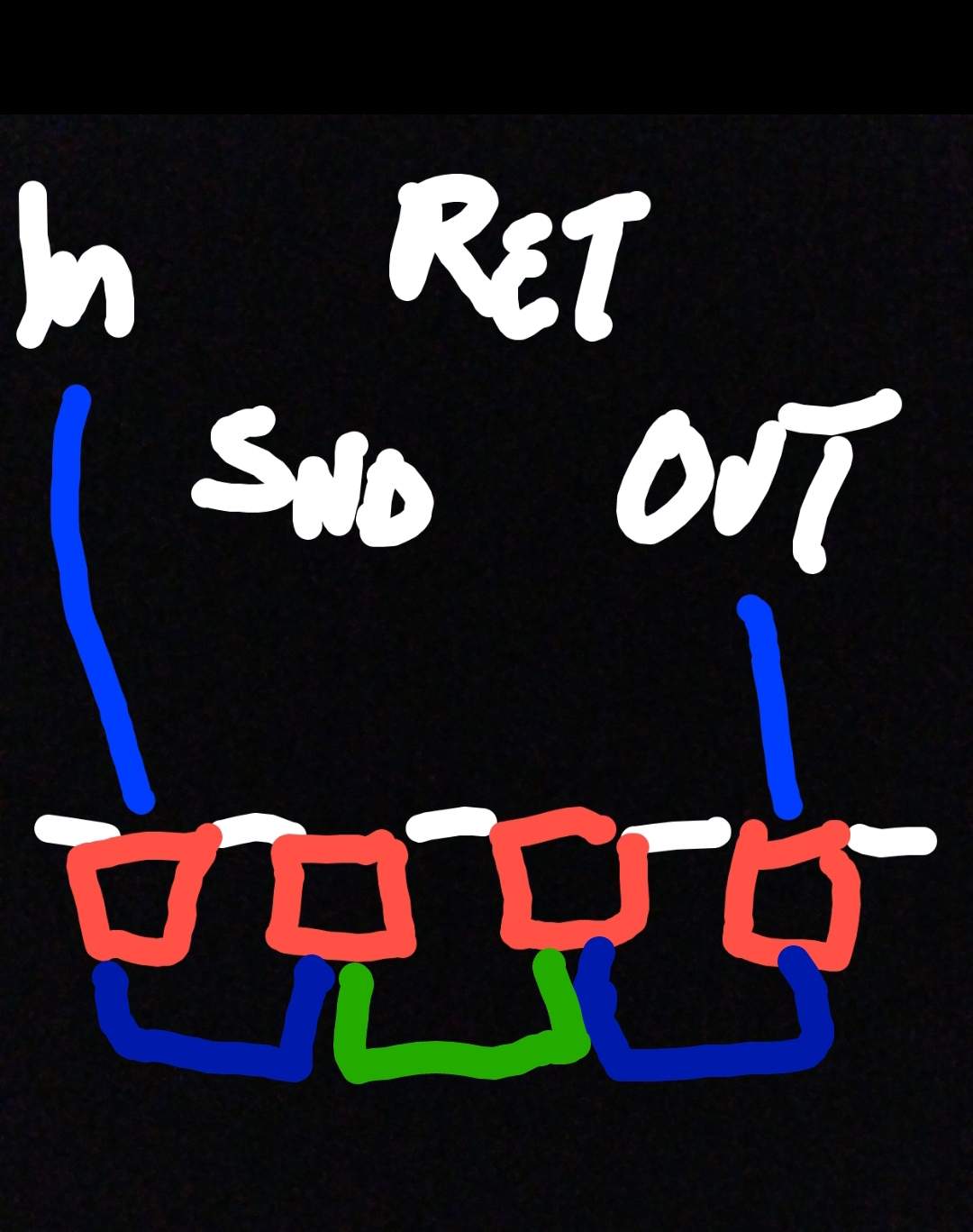
This is how the amp is routed when you don't use the send and return. Send and return are connected internally.
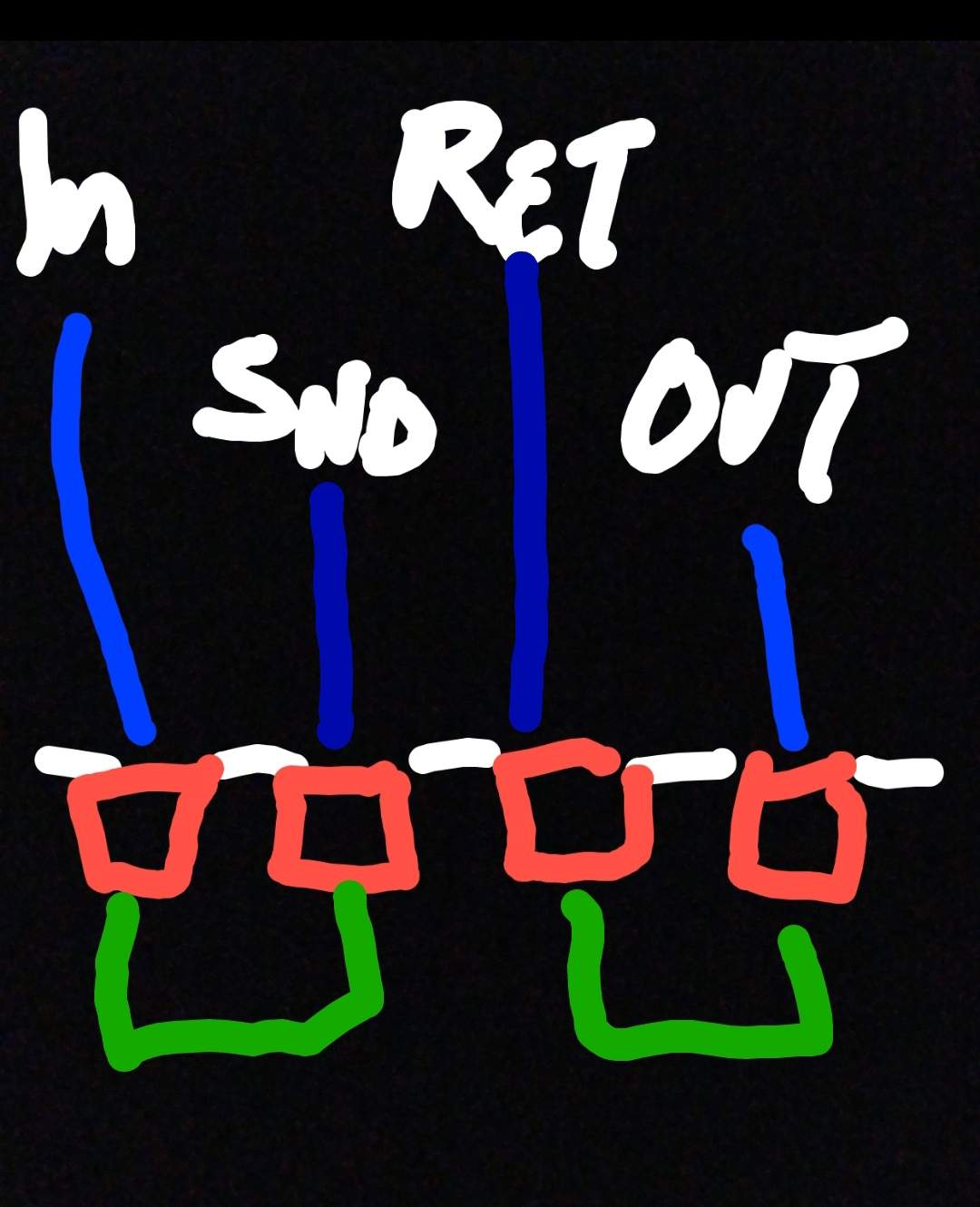
This is how it's wired when you put effects in the loop. The preamp is on the green line between the input and send. The way the jacks are wired opens the circuit between send and return. The send goes to the effect in and return to the effect out.
This is how you avoid the preamp all together.

This is how it's wired when you put effects in the loop. The preamp is on the green line between the input and send. The way the jacks are wired opens the circuit between send and return. The send goes to the effect in and return to the effect out.
This is how you avoid the preamp all together.

I'm the exception to the rule, apparently. I use my preamps effects loop. I'm trying to have as clean a signal as I can going into the preamp. I do run my compressor and my light drive into the front of my preamp, but everything else goes through the effects loop. In fact, my other pedals go through a loop switcher, into the effects loop. It looks like this...
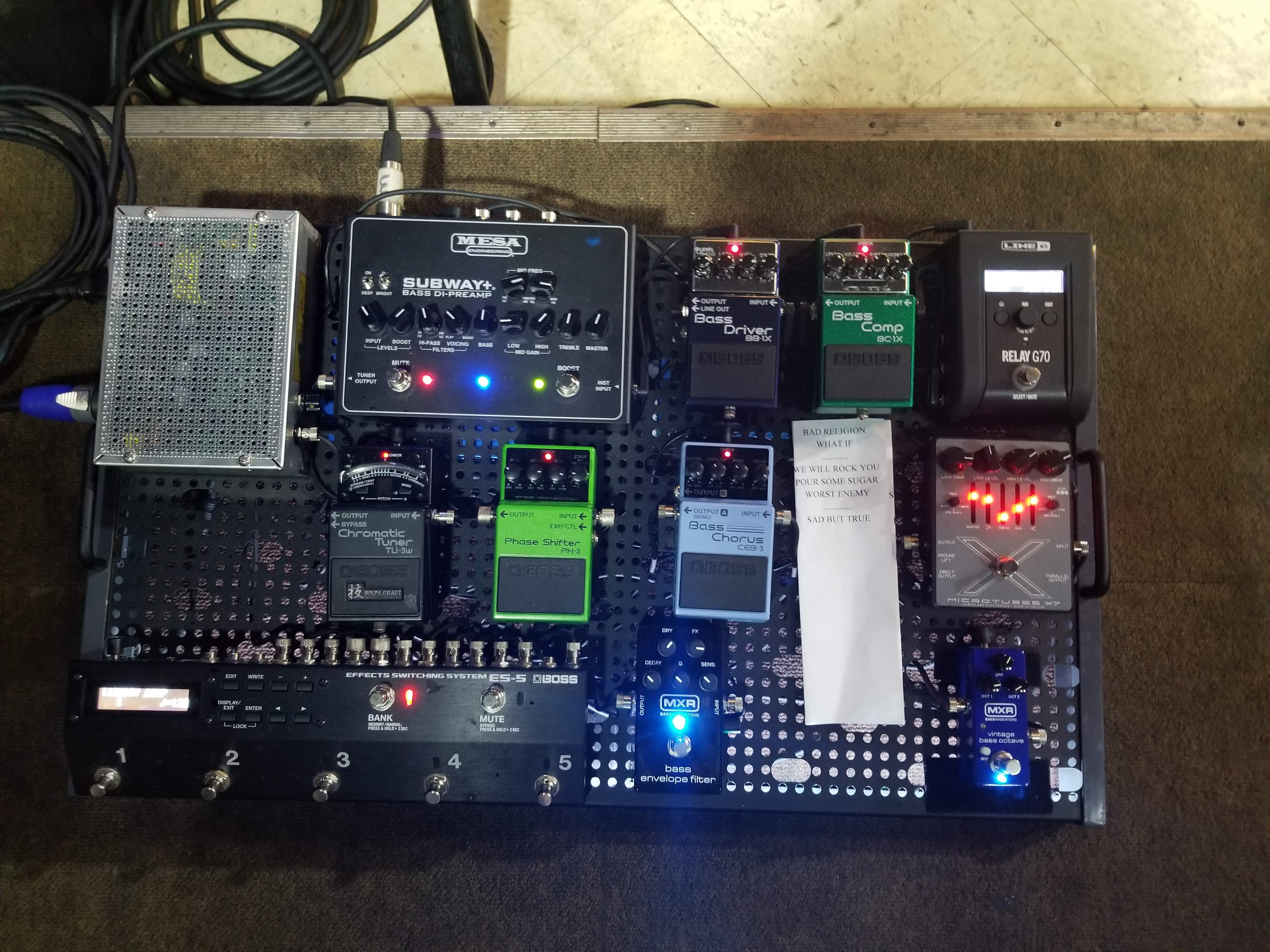
G70->BC-1X->BB-1X(or VT Bass)->Subway+ input.
Subway FX Send->Boss ES-5 input
Loop 1-MXR VBO
Loop 2-DG X7
Loop 3-Boss CEB-3
Loop 4-Boss PH-3
Loop 5-MXR BEF
Boss ES-5 output->Subway FX Return
If I don't want anything, I can just click off the BC-1X and the BB-1X. My signal is just going thru 2 pedals instead of 7 or 8. Even if every pedal was true-bypass, I feel like you still leave a little tone behind. Also with the ES-5, if I want to completely reorder the pedals going thru it, I can go into the menu and move everything, without unplugging anything. The Boss loop switchers are legit!
It sounds pretty massive, I dig it. I'm a weirdo...;-)
G70->BC-1X->BB-1X(or VT Bass)->Subway+ input.
Subway FX Send->Boss ES-5 input
Loop 1-MXR VBO
Loop 2-DG X7
Loop 3-Boss CEB-3
Loop 4-Boss PH-3
Loop 5-MXR BEF
Boss ES-5 output->Subway FX Return
If I don't want anything, I can just click off the BC-1X and the BB-1X. My signal is just going thru 2 pedals instead of 7 or 8. Even if every pedal was true-bypass, I feel like you still leave a little tone behind. Also with the ES-5, if I want to completely reorder the pedals going thru it, I can go into the menu and move everything, without unplugging anything. The Boss loop switchers are legit!
It sounds pretty massive, I dig it. I'm a weirdo...;-)

This issue varies by configuration. I play a few instruments, guitar among them (as many others here do). What follows is just my opinion.... it works for me.
With discrete effects, some sound better before the instrument input on the amp.... and some sound better in the effects loop. For my guitar rig, I have these pedals before the input (and in this order):
vibe > synth > compressor > wah > phaser/envelope > pitch shift > distortion > drive > flanger > chorus.
From the amp’s effect send, I have:
chorus(2) > tremolo > rotary > delay > reverb.
If the phaser did not also include the envelope follower, it would perhaps be in the effects loop.
But if you are using a multieffects unit, you usually need to put it into the instrument input - and rely on it, rather than the amp, for any above-threshold drive effects. You could also opt to ignore the amp’s instrument input entirely and plug the effect unit directly into the effect return on the amp - but then you tend to lose the character of the amp, and might as well just get a neutral inexpensive power amp of some sort. I have a multieffect, and am putting that into a mini mixer which allows me to balance dry and effect into the amp’s instrument input.
With discrete effects, some sound better before the instrument input on the amp.... and some sound better in the effects loop. For my guitar rig, I have these pedals before the input (and in this order):
vibe > synth > compressor > wah > phaser/envelope > pitch shift > distortion > drive > flanger > chorus.
From the amp’s effect send, I have:
chorus(2) > tremolo > rotary > delay > reverb.
If the phaser did not also include the envelope follower, it would perhaps be in the effects loop.
But if you are using a multieffects unit, you usually need to put it into the instrument input - and rely on it, rather than the amp, for any above-threshold drive effects. You could also opt to ignore the amp’s instrument input entirely and plug the effect unit directly into the effect return on the amp - but then you tend to lose the character of the amp, and might as well just get a neutral inexpensive power amp of some sort. I have a multieffect, and am putting that into a mini mixer which allows me to balance dry and effect into the amp’s instrument input.
You can but that leaves the preamp in the signal chain.
If you just want to put effects in the effects loop, most times it’s only modulation effects or a HPF (IMO) that works well in that part of the chain. Everything else is usually better in front of the preamp.
Another issue is how the effects loop is configured by the manufacturer. If it’s a series loop, then it sits between the preamp and power amp stage. So by plugging directly into just the return jack on a series loop you’ve disconnected your amplifier’s preamp and EQ section and are going straight to the power amp. However, if it’s a parallel loop, the effects chain (think of it as a second channel on a mixer) runs alongside the preamp stage and both get summed somewhere along the way before they go into the power amp stage of your amp.
Well this changed my mind, thanks 40Hz, It'll give me something to tinker with.
it really comes down to personal preference through trial and error.
And therein lies the problem with playing around with effects, amps etc. What sounds good in the loungeroom/bedroom/garage often sounds very different at stage volumes in a room full of people.
And therein lies the problem with playing around with effects, amps etc. What sounds good in the loungeroom/bedroom/garage often sounds very different at stage volumes in a room full of people.
Well... I’ve never heard a reverb that sounds good being fed into a distorted preamp. Either in a garage or onstage.

I've always made a habit of putting my reverb/chorus/delay etc. after drive, but i've been using an ampeg scrdi lately, and if i want to DI, but still have chorus for example, it has to be before the scrambler. To be honest i got grumpy and put all my pedals in a "less than ideal" order (tuner-hipass-chorus-reverb/delay-comp-scrdi) and it actually sounds just fine to me. Yes i appreciate how the scrambler will distort the modulation effects, but it's still a pretty interesting and different effect. We'll see about the long term...
One thing, the scrambler DI pedal does not work well in the effects loop. It does not have a very high output, and limited my overall volume.
One thing, the scrambler DI pedal does not work well in the effects loop. It does not have a very high output, and limited my overall volume.
I admit I don't know what is typical for bass amp loop levels, but with guitar amps there is no "typical". Some guitar amp effects loops run line level, some run instrument level, a fair few have a toggle switch to allow either level; my 90s Rivera tube amp actually had separate effects send and return level knobs for maximum flexibility.Typically the Effects Loop runs at line level while the pedals run at instrument level. You will have to try it and see if what you have is campatible with the loop.
Few guitarists would do that today though, because running reverb in front of more modern, higher gain distortion tones sounds pretty bad to most people, it just turns to mud. (Of course there will always be exceptions.)The classic '60s tones came from plugging the guitar into a spring reverb tank and the tank into a distorted amp. That gives the reverb a bigger sound.
I admit I don't know what is typical for bass amp loop levels, but with guitar amps there is no "typical". Some guitar amp effects loops run line level, some run instrument level, a fair few have a toggle switch to allow either level; my 90s Rivera tube amp actually had separate effects send and return level knobs for maximum flexibility.
Few guitarists would do that today though, because running reverb in front of more modern, higher gain distortion tones sounds pretty bad to most people, it just turns to mud. (Of course there will always be exceptions.)
Plenty of guitarists do that now. Most of the indie bands out there are going for '60s sounds and use vintage type amps. The guitarists using "modern" high gain amps might be the minority.
FWIW, if you get a nice preamp pedal you can go straight from the preamp into the effects return, bypassing the amps internal preamp. I do this with my Noble on my Forte and Magellan 800. Sounds great
Of course there are exceptions but probably 99% of pedals out there can't handle the line level signal of a typical effects loop.
Depends on the amp and the design of the effects loop. I’m not familiar with any relatively modern amp where that’s an issue. I know many players besides myself who happily plug a variety of pedal type effects into the loop with no problems. I also don’t know too many players running rack modulation gear. Or why you’d be including an effects loop in a non-rackmount amp if that loop were primarily intended to be used only with rackmount gear. That doesn’t make much sense. Especially considering how rackmount gear for instrument players has gone so much out of vogue these days.
Well... I’ve never heard a reverb that sounds good being fed into a distorted preamp. Either in a garage or onstage.
Listen to any surf rock from the '60s or music from the spaghetti Western movies. That's the sound of a reverb tank through an overdriven amp.
Depends on the amp and the design of the effects loop. I’m not familiar with any relatively modern amp where that’s an issue. I know many players besides myself who happily plug a variety of pedal type effects into the loop with no problems. I also don’t know too many players running rack modulation gear. Or why you’d be including an effects loop in a non-rackmount amp if that loop were primarily intended to be used only with rackmount gear. That doesn’t make much sense. Especially considering how rackmount gear for instrument players has gone so much out of vogue these days.
Agedhorse actually touched on this the other day. Players like having preamp out and power amp in jacks. That's the main function of the fx loop nowadays.
Plenty of indie bands have awful guitar tones. I think it's a point of pride with them.Plenty of guitarists do that now. Most of the indie bands out there are going for '60s sounds and use vintage type amps. The guitarists using "modern" high gain amps might be the minority.


