• TalkBass has been independent since 1998. Add your voice.
    Create a free account to reply to discussions, view embedded media, and browse with fewer display ads.
    Join freeLog in
    Want zero display ads or expanded classifieds tools? Compare plans.

Victor Wooten: There are 30 keys

From a Twitter handle called "Threatening Musical Notation", modulating from A major to C# major to Db major:

View attachment 4556707
The change of key signature from C# major to Db major (enharmonic keys) is not a modulation (modulation is about the music).
One would need a compelling reason for this to be useful (and not pure sadism). One possible valid reason would if the music modulates further towards the "sharp" side, for example to Ab major.
 
The change of key signature from C# major to Db major (enharmonic keys) is not a modulation (modulation is about the music).
One would need a compelling reason for this to be useful (and not pure sadism). One possible valid reason would if the music modulates further towards the "sharp" side, for example to Ab major.

It's just silly. That's all.
 
Victor is correct. F# major is different from Gb major. The two keys actually sound different as well. Those who took classical piano lessons can easily tell.
OMG.. The entire “practicing in all keys is important, Can anyone tell me how many that is..??” Comes from T. Browns “Tracker school” & The Wilderness Awareness program founded by John Young. Where instructors are taught to “Coyote train” students (Essentially Socratic Method, Fostering curiosity and giving answers in the form of questions, trickery & mischievous guidance. To make you think..

I actually ended up here trying to figure out if Adam Nitti kept up his “Atlanta Bass/Music Dojo” online instruction, Or if it’s now defunct.. My thought was the Vic Wooten Bass Nature folks would likely have the inside scoop on Nitti’s current projects/schedule..?? I’ve been out of the B.N. Camp/Tracker school instructor orbit for a good while! I was curious if he’s still doing private instruction via video chat etc.. And what kinda $$ rates to expect??
 
Last edited:
Can anyone tell me how many that is..??”

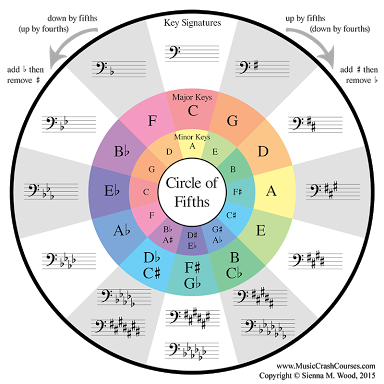
On paper 15 Major and 15 Minor. In sound 12 Major and 12 Minor.
65fc10d073d8a6fd485a70f3c180a4a5.png
 
On paper 15 Major and 15 Minor. In sound 12 Major and 12 Minor.
65fc10d073d8a6fd485a70f3c180a4a5.png
With the caveat that A-sharp minor, D-sharp minor, and G-sharp minor are very rarely used because the leading tone (the natural seventh from the parallel major scale), while not reflected in the key signature, is a double sharp and since the natural seventh is used quite often in minor keys when following the conventions of tonal harmony, most composers/arrangers will avoid having a double sharp in the home key. Double sharps and flats are kind of a "break glass in case of emergency" notation, usually reserved for moments of modal interchange (where a chord from outside the home key is used, but it's not tonicizing or modulating to a different key) or in highly chromatic passages.
 
  • Like
Reactions: Wasnex
This sums it all up. But how often do you encounter C# major or Cb major or A# minor in a score?

Bach’s prelude 3 from the Well Tempered Clavier is in C# major, but I think most composers will write Dd major instead.

You certainly do if you are a horn player. Example: guitar player demands that a song is played in E because his hero did so on an album and because of his “tones”. Trumpet and tenor saxophone get to play in F# while the alto saxophone gets to play in C#.

Non “C” instruments even get to play in keys with double accidentals from time to time. I’ve been there and done that.
 
  • Like
Reactions: Les Fret