• TalkBass has been independent since 1998. Add your voice.
    Create a free account to reply to discussions, view embedded media, and browse with fewer display ads.
    Join freeLog in
    Want zero display ads or expanded classifieds tools? Compare plans.

Vintage Old Fender - I don't get it.

For the record I was summing the impression I got from a quick read of the thread. I wasn't directing my comments at anyone in particular.

While I'm no one to say what's good or bad, I think we agree that there are good things with broad appeal and good things with niche appeal, and then there are basses that only a mother could love.

Ah, I see :) Yes, we are broadly in agreeance.

 
I confess, I just don't get it...

Why are the old Fenders worth so much? Their necks are not as well built as many of today's basses (single action truss rod, no other reinforcement), they exhibited neck dive (heavy tuners), cheap bridges, non-angled headstock required a string hold-down button, 3-bolt necks.

Why would someone pay big money for an inferior instrument with damaged finished and half warn-out frets?

Is there really nothing else that sounds as good? Nothing else have that old-school mojo?

Yea, I just don't get it. Please enlighten me.

Not trying to start "something", just trying to get some answers to Q's that have been nagging me.

- Keith -

Unless someone is a collector, I don't get it either. Old Fender necks were prone to twisting, ski-jump-ramping, poor truss rod performance, etc etc.

Fender American Standard/Deluxe is in an entirely different league structurally speaking, tone wise, playability. And Fender's only authorized replacement parts, Warmoth also has the double stiffening bars. These newer necks are almost bullet proof in comparison. Leave the 62 Jazz in a humidity controlled room / studio.
 
Unless someone is a collector, I don't get it either. Old Fender necks were prone to twisting, ski-jump-ramping, poor truss rod performance, etc etc.

Fender American Standard/Deluxe is in an entirely different league structurally speaking, tone wise, playability. And Fender's only authorized replacement parts, Warmoth also has the double stiffening bars. These newer necks are almost bullet proof in comparison. Leave the 62 Jazz in a humidity controlled room / studio.
ive had way more instances of ski jumps and necks with uncorrectable forward bow on modern era fender necks than any of the old basses ive owned.
 
  • Like
Reactions: The Bass Clef
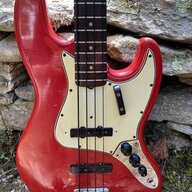
Thorough detailed documentation of the bass by a Fender Gold Level, Custom Shop Luthier.
Neck stamp.
Pots were '63 code, but that was normal because they bought them by the thousands.

Yeah, I thought it might be from the neck stamp due to the date.

When using the neck stamp to date the bass (probably 7 May 64 A in this case) The 7 in the neck stamp is the model code for a Jazz bass and not the date the bass was made. All that can be determined from that neck stamp is that the neck was stamped sometime in May of 1964. Other model codes are a 5 for the P bass and 23 for the Telecaster Bass.

The J neck shown below was stamped in December 1964

[Invalid or Expired Link Removed]
 
Last edited:
Saying that something is a matter of opinion creates false equivalency. We don't live in a world where every bass is equally good or bad.

True. Some instruments are crap regardless of make, model or supposed "mojo". If a bass has wonky frets with a twisted neck and crappy pickups, but the owner loves the bass and thinks it sounds great, it doesn't negate the fact that it's a piece of crap. Beauty my be in the eye of the beholder, but that beholder may be oblivious as to what a truly well made instrument is...or just be in plain old denial that they are the proud owner of something 95% of bass players wouldn't use for kindling. This goes for both certain "bargain" basses, and over priced "vintage" pieces. Nothing will change the fact that it's a piece of crap.
 
It does stand to reason that the population of old Fender basses, for example, has largely been culled of the clunkers, at least among the ones that are being played. Not all the good ones made it - see Bass of Doom; they weren't all rescued. As for the vintage "wall hangers" held by collectors, I consider those akin to a higher end version of what's hanging on the wall at GC - some good, some not so much.
 
A lot of people mistake the first digit of the neck stamp for the day of manufacture. You're neck stamp is no doubt "7 May 64 A". But the "7" doesn't mean the 7th of May, 7 is just the code for a Jazz Bass neck. There is no way to know the exact day ANY vintage Fender left the factory. You can usually narrow it down to a year by taking the sum of all the original parts together.

Can't argue. It is the sum of all details combined.
May '64 with clay dots told the luthier it was an early '64.
The electronics had never been touched, all original solder joints, all correct codes.
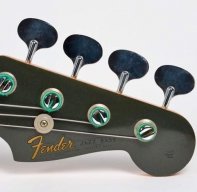
We had to document the bass in order to restore the headstock finish with period correct, Fender issued replacement logo.
The body finish was all original. Original frets in pretty good shape.
Because it had so many positive points on original integrity, he was very confident estimating replacement value for that color, Dakota Red, in that condition at $22,000.00

I paid $250.00 for the bass when I bought it in'73
The headstock restoration cost more than I paid for the bass.
 
Last edited:
Can't argue. It is the sum of all details combined.
May '64 with clay dots told the luthier it was an early '64.
The electronics had never been touched, all original solder joints, all correct codes.
We had to document the bass in order to restore the headstock finish with period correct, Fender issued replacement logo.
The body finish was all original. Original frets in pretty good shape.
Because it had so many positive points on original integrity, he was very confident estimating replacement value for that color in that condition at $22,000.00

I paid $250.00 for the bass when I bought it in'73
The headstock restoration cost more than I paid for the bass.

Nice! That estimate must have been pre-'08, yes? I think with the ecomony not fully rebounded yet, and "replacement value" always being much higher than what you could actually sell it for, that's still a very, very high estimate.. even if the headstock finish was original. I've seen a few custom color '61 stack knobs sell in the $22-25K range lately. Regardless, it's still a very valuable bass, and a crazy cool bass to own!
 
Nice! That estimate must have been pre-'08, yes? I think with the ecomony not fully rebounded yet, and "replacement value" always being much higher than what you could actually sell it for, that's still a very, very high estimate.. even if the headstock finish was original. I've seen a few custom color '61 stack knobs sell in the $22-25K range lately. Regardless, it's still a very valuable bass, and a crazy cool bass to own!

Nope just had the headstock restored this past spring.
 
It all goes back to how one views instruments... If you view it as a commodity or as collectible, then I don't know why one would have anything other than the big names (Fender, Gibson, Martin etc.) However if you look at them as tools to complete a job, then I don;t see the point in buying a vintage instrument. I'm sure there are exceptions, but for me personally, I view my instruments as tools, so I go with Lakland mostly because I like the Fender designs, but think the Lakland to be a superior tool to do the job.