• TalkBass has been independent since 1998. Add your voice.
    Create a free account to reply to discussions, view embedded media, and browse with fewer display ads.
    Join freeLog in
    Want zero display ads or expanded classifieds tools? Compare plans.

Vintage vs new.

Interesting questions, responses in bold...

May we get that train back on tracks?

What creates good tone?

- The old dry wood that vintage instruments have?

All wood used in instrument construction is dried. The wood in vintage instruments was relatively new when the classic recordings they're known for were made.


- The fact that the instrument has been played for a long time?

Instruments with little playing time also have good tone.


-Hand-wound vintage pickups and the effect of time on them?

Available today in scatter wound and "aged" pickups (with weaker magnets). My favorite aged pickup is the SD Antiquity and I prefer them to the vintage pickups I have.

- The quality of the manufacturing/workmanship?

Workmanship today in many cases is better than on many vintage instruments particularly those from the 70's.

- The quality and variety of wood used?

Same as used in the mass production of instruments today

- The strings?

Other than the player, the strings are the generators of tone.

- The worn out feel of an old neck?

I see that more as a influence on the player rather than directly on the tone.

- Can a relic match vintage?

Tone wise, yes.

- Can franken instruments sound as good as instruments which have been whole for 40 years?

Yes, as long as the "franken" is assembled properly (I've worked on more than a few that weren't) . It's simply chance which parts are selected on the production line when building an instrument.

- Is it the combination of several factors listed above?

Definitely

- Could tone be a random thing?

It definitely is. The number of variables and their permutations pretty much guarantee it, especially the variables concerning the material comprising the primary structural components, that is, the wood.

- Is it all in the head of the musician playing the instrument?

Depends on the musician.
 
I have always felt, and I still believe - that the natural process of the wood aging over many, MANY years seasons it - in a sort of an indescribable way - and that aging is what creates the true magic.

I personally don't think the bass needs to look like it was dragged by a tow truck and played for a gazillion hours in order to be deemed "the holy grail". I think the organic and natural aging of the wood tells the tale.

Just my two cents.

BassHappy
www.innertainment.net

Agreed - The wear resulting from years of playing isn't a qualifier at all. Being an artist, I'm always drawn to the abused beauty of used/worn tools, including instruments. In my book, even a lowly key takes on a 'look' from years of use opening my front door. It still works and there's no reason to replace it. If I would have played the '66 and it had a warped neck or was in need of a fret-job, I would have been happy taking a picture of it and moving on. How anybody responds to an instrument visually is only subjective and to each their own. I am thankful to that very fact as the price I got it for was very reasonable.

IMG_6378_zps0bccbf2d.jpg
 
I have always felt, and I still believe - that the process of the wood aging over many, MANY years seasons it - in a sort of an indescribable way - and that the natural aging of the wood is what creates the true magic.

That's potentially testable first by analysing the structure at various scales of new and old wood over a sufficiently large number of samples of old and new instruments of the same wood type to determine if there is any systematic difference in structure. If there is no statistically significant difference in structure then the ageing will not matter.

This is not the same question as whether wood makes any difference to tone, but if there is no age-related difference in structure this cannot make any difference.

You could do the same for pickups too, by comparing the response to metal moving in their magnetic apeture for samples of pickups intended to be the same. E.g. select the same new materials, put on the same number of windings, and so on.
 
That's potentially testable first by analysing the structure at various scales of new and old wood over a sufficiently large number of samples of old and new instruments of the same wood type to determine if there is any systematic difference in structure. If there is no statistically significant difference in structure then the ageing will not matter.

This is not the same question as whether wood makes any difference to tone, but if there is no age-related difference in structure this cannot make any difference.

You could do the same for pickups too, by comparing the response to metal moving in their magnetic apeture for samples of pickups intended to be the same. E.g. select the same new materials, put on the same number of windings, and so on.

LOL, test away my friend, my ears are my ears and sorry - but they overrule any scientific test you might invent. I can play you tracks from 35 years ago with the same instrument, the same strings, the same electronic settings (direct through a limiter only with the EQ flat) from today and thirty years ago and there is no simply no question that the sound and depth of the instrument is markedly improved.

Not sure what else you might attribute it to other than the aging of the wood?

Oh, of course, if I dragged my pristine PRS #11 from 1978 behind a tow truck for a day or two, I am CERTAIN it would sound even better!

PRS%20SIde.png


At some point over the years it made the transition from a solid and sometimes pretty incredible sounding instrument - to pure magic.

Best,

BassHappy
www.innertainment.net
 
LOL, test away my friend, my ears are my ears and sorry - but they overrule any scientific test you might invent.

I made no statement about whether time changes wood structure or not or what tonal effect this might had, just suggested a method to quickly determine if such a difference occurs. The gold standard would be testing the same instrument twice or more over a period of 30 years but that takes, well, about 30 years.

If there is a difference in structure over two samples taken 30 years apart then it is possible that age can affect tone. If there is no difference it cannot. I have seen visible changes in resin in pine subjected to repeated stress, but the stress was relatively intense, but I am entirely open to the possibility of tonal changes.

With recordings there are lots of potential variables, so I am just thinking of how you'd tie it down to one variable at a time and test for it. It has relevance for the recent test they did of vioins, except they aren't likely to let people drill cores out of a Stradivarius.
 
How about the wood becoming a little drier every year and the vibration occurring while the instrument is played, could that have an impact on tone?

Some people say older instrument are lighter because they are drier? Is that a fact or a tale?
 
I made no statement about whether time changes wood structure or not or what tonal effect this might had, just suggested a method to quickly determine if such a difference occurs. The gold standard would be testing the same instrument twice or more over a period of 30 years but that takes, well, about 30 years.

If there is a difference in structure over two samples taken 30 years apart then it is possible that age can affect tone. If there is no difference it cannot. I have seen visible changes in resin in pine subjected to repeated stress, but the stress was relatively intense, but I am entirely open to the possibility of tonal changes.

With recordings there are lots of potential variables, so I am just thinking of how you'd tie it down to one variable at a time and test for it. It has relevance for the recent test they did of vioins, except they aren't likely to let people drill cores out of a Stradivarius.

Hey, this is my Stradivarius - no drilling for samples here either!

I have no idea why the sound has improved over the years, but it most certainly has....

:hyper::hyper::hyper::hyper:

BassHappy
www.innertainment.net
 
How about the wood becoming a little drier every year and the vibration occurring while the instrument is played, could that have an impact on tone?

Some people say older instrument are lighter because they are drier? Is that a fact or a tale?

Wood as mentioned prior is dried before construction (kiln or naturally). Some has been "aged" (stored over time before used) As wood is organic and was living it hardens over time after being cut. Light vintage instruments were probably light to begin with. To test that theory - a good number of heavy 70's Fender basses haven't gotten any lighter.

There are those devices made to send vibrations through an acoustic instrument to accelerate seasoned tone (or something). I've talked w/Luthiers and they don't put much stock in it. Maybe a copper bracelet keeps arthritis away… it seems to work for some people.
 
Or maybe just maybe your ears have changed.

LOL!

I am certainly no spring chicken so that is entirely possible! Although I had my ears tested on April 1st and all checked out good.

However, I think the ears around me are pretty solid and reliable in the unlikely case that mine are not - and I am sure they would tend to differ with you....

:bassist::bassist::bassist::bassist:

beautiful instrument

Thanks for the kind words.....

If you would like to hear it let me know.

BassHappy
www.innertainment.net
 
LOL!

I am certainly no spring chicken so that is entirely possible! Although I had my ears tested on April 1st and all checked out good.

However, I think the ears around me are pretty solid and reliable in the unlikely case that mine are not - and I am sure they would tend to differ with you....

:bassist::bassist::bassist::bassist:


Thanks for the kind words.....

If you would like to hear it let me know.

BassHappy
www.innertainment.net

Needless to ask! Yes - I'll wear my headphones as my little outboard speakers are barely sufficient to translate assessment of a quality instrument. By the way, is it Koa? I have a bass I made of Koa that looks very similar.
 
Needless to ask! Yes - I'll wear my headphones as my little outboard speakers are barely sufficient to translate assessment of a quality instrument. By the way, is it Koa? I have a bass I made of Koa that looks very similar.

Hello JIO

No, actually it is honduras mahogany, the same stuff at the time that they were making marimbas out of. Back in those pre-factory PRS days Paul would use honduras mahogany for both the set neck and the body. He felt at the time that the coupling and resonance of the neck vs. body was pretty critical to the final tone of the instrument - and wouldn't even consider building a bolt on. Anyways, right or wrong - he would suspend the mahogany from an eye hook by a wire suspended from the ceiling and strike it with a marimba mallet. If it didn't ring for about 15-20 seconds - he wouldn't use it for a guitar. That was his criteria for wood selection at the time. ALL PRS guitars and basses at that time were 100% honduras mahogany with brazilian rosewood boards.

You can go here for music: http://www.everythinghappytheman.com/music.html

The first record simply called "Happy the Man" was a Rick 4001 and "The Muse Awakens" was more recent and features my twin Roscoes. Everything else is the PRS. The PRS no longer leaves the house, so I had to replace it with the two midi Roscoes. There are some pretty cool fretless and upright sounds with the Roscoes though. The song Paul always raves about is "Steaming Pipes" where I get to do a little popping and snapping on the intro. Enjoy!

BassHappy
www.innertainment.net
 
Just a kind of side note:
I guess when the electric bass and the electric guitar were still "revolutionary" and the players of the upright bass and acoustic instruments saw their status in danger, the e-players pronounced the E in electric guitar and bass, while the conservatives and the defenders of the then "status quo" pronounced the acoustic qualities of their instruments. I remember an article in Bass Player as late as in the early 90's, where Ron Carter defended his position that the Fender Bass isn't a "real" instrument. He wasn't that aggressive and honoured the archievements and the serious musicianship of artists as James Jamerson, but he still hold his view on "the Fender bass".

I guess after the electric bass and guitar became mainstream and synthesizers or even worse :-) samplers and later record players became instruments to create music with, players of electric basses and guitars started to pronounce the acoustic qualities of their instruments: wood, age etc.
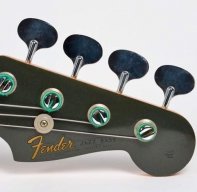
And then, when purely digital instruments became hit machines, analogue synthesizers and cheap samplers became "vintage". I guess some of you know what amount of money you have to pay today for the old Roland 303s and 808s. And the price you have to pay for a NOS Technics 1210.

Although I think that at least the last time I chequed the difference between analogue filters on synthesizers and their digital copies was far greater than the difference between any "vintage" Fender bass and a new one...

In german marketing we have a funny word "Alleinstellungsmerkmal" which can't be really translated, but in english it would be "unique selling point".

A lot of this talk about vintage, age, body woods etc. ppp. is a desperate attempt to find this quality in now "mainstream" instruments.

Dirk
 
Just a kind of side note:
I guess when the electric bass and the electric guitar were still "revolutionary" and the players of the upright bass and acoustic instruments saw their status in danger, the e-players pronounced the E in electric guitar and bass, while the conservatives and the defenders of the then "status quo" pronounced the acoustic qualities of their instruments. I remember an article in Bass Player as late as in the early 90's, where Ron Carter defended his position that the Fender Bass isn't a "real" instrument. He wasn't that aggressive and honoured the archievements and the serious musicianship of artists as James Jamerson, but he still hold his view on "the Fender bass".


I'd love to see what taklbass would do with Ron and that opinion.. especially if they didn't know it was Ron, lol! But yeah, sorry Ron. Love your genius upright abilities, but you couldn't be more wrong about the electric bass. I actually heard from a teacher once that Bach said the same thing to his son about the piano!
 
All I can gather from mongo's posts is that he recognizes the verifiable fact that vintage basses are only universally superior in price. Sound, feel, etc. supercede age and model. Many people think with all their might that Pre-CBS Fenders inherently sound better. Less, but still many, also think those in the 15 years afterward sound better.

But there's nothing about Pre-CBS that makes them any better other than subjective opinion. A blind test would be factual evidence that no one would be able to tell the difference between models spread across the spectrum of age and quality with regards to Fender. But of course, those tests would be dismissed.

I do not believe that the only criteria, or even the main criteria, considered when buying a vintage guitar/bass, is playability and sound. In large part, people are buying them for the same reasons people buy old comics, stamps, coins, etc., and those reasons are not solely based on utility. With the logic expressed in this thread, someone is being scammed when they buy a collectible stamp, because the face value is less than the price paid by the collector.
 
Btw, I just read the violin article from the first post, the one that putatively supports the argument that old basses sound just like new ones. First, the article is about violins and not Fender basses, and second, the conclusion from the article was not that the old and new violins sounded the same, but that blindfolded players preferred the newer ones over the older ones -- clearly they could tell a difference if they preferred the new ones!

This article does not support the premise by several in this thread that there is no tonal difference between old basses and new basses. Other than that, I stick by my main argument summarized above.

Now Mongo can come around and call me a bully or maybe a racist...
 
This is a bit of fanciful thinking.

naturally cured means grown in the wild, selected means the cheapest wood was chosen.

Do you knoiw that the escalade is built in the exact same factory as the gmc and chevy? ANd yes, by the exact same people. I know we're not talking suvs, but while we associate the excalade with a quality and craftsmansip, thruth is that that the same hands build all three vehicles. Ans the same QC applies to all of them.
 
LOL!
I am certainly no spring chicken so that is entirely possible! Although I had my ears tested on April 1st and all checked out good.

Preferences change, and that is part of the subjective part of the auditory system, and that's an added complexity. Tones I thought were
good for bass 20 years ago I hate now!

To match two recordings, even with the same bass over thirty years you would need to:

1. Ensure that loudness is the same to within about 0.5dB.
2. Ensure that the strings are the same. Manufacturers may make the same model of strings now, but they might vary slightly between now and 30 years ago
3. Ensure that the dynamics of the playing are pretty much the same as before (see 1)
4. Ensure that all the elements in the recording are the same (exactly the same equipment all measurable via test equipment to exactly to the same tolerances)
5. Ensure the playing is the same (same notes, etc).
6. Ensure that the 30 year old recording has not degraded in any way. I.e. it would need to have been digitised via very good A/D 30 years ago

If you have good ears (and I have no doubt you do) you are probably more sensitive than most to the issues from 1 to 7. Your good ears are probably a hindrance as you might be picking up on a difference in something in the recording chain that is not the bass. If the old recording has got ever so slightly muffled over the last 30 years you might prefer the new one. If there is a standard set of reference tones on the recording that could be adjusted for. There are so many possible variables in a recording that it would make it hard to pin down what might be causing a preference for one recording over another.

For just the audio side I think you'd need to create a bass playing robot and have it play a selection of old and new basses behind a curtain and do a large listening test of a hundred or so people (enough to have a good chance of statistical significance depending on the other test parameters). Even for new and old recordings of a bass it should be done double blind, ideally.