
• TalkBass has been independent since 1998. Add your voice.
    Create a free account to reply to discussions, view embedded media, and browse with fewer display ads.
    Join freeLog in
    Want zero display ads or expanded classifieds tools? Compare plans.

Volume differences in pickup selections on Tony Franklin fretless

I bought a Tony Franklin signature fretless yesterday and I love it, but there may be a problem. These basses are P/J configuration and there's a three-way selector switch. While demoing it in the store (Sweetwater mothership in Ft. Wayne) it sounded to me that the middle selection (both pickups) seemed much quieter than the other two. I asked the sales rep who was working with me and he noticed it too, but said that adjusting the pickup height should resolve the issue. (This might have been BS but I didn't know any better.)

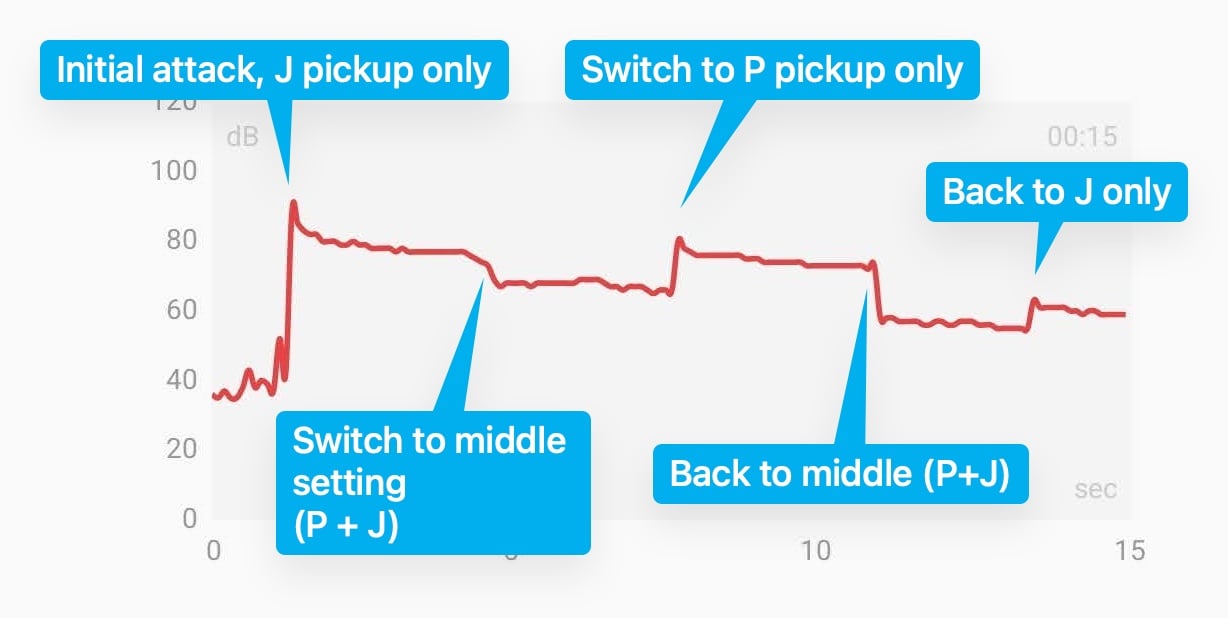
Today I had a chance to run it through my own gear, and play with the pickup height, but I still think there's something off with the middle pickup selection. To test it out, I set the bass up through a Fender rumble amp, all knobs set to 12:00 except master volume at 9:00, then plucked the E string and let it ring out while I changed the pickup selector from J only, to P+J, to P only, then back to P+J, then back to J and measured the volume the whole time:
pickup volume.jpeg

What I'm seeing is a noticeable dropoff in volume when going to the middle position. The volumes on the J only and P only settings are pretty consistent with what you'd expect if you just let the note decay but the whole thing shifts down like 10-15 dB when going to both pickups.

Is this normal, or do I have a bad pickup selector or faulty wiring? And, will changing the pickup heights really do anything to keep the volume consistent? The low end of the split coil was lowered down pretty far so I brought it up about 1mm but it still produced the graph above.
 
  • Like
Reactions: KimGT99
I have two Tony Franklin fretless basses and both maintain the same relative volume level at all three switch positions. Of course, the tone is different in each position as it should be and there is no significant difference in volume. By the way, I have no need for two and will be posting one for sale soon.

What I suspect the problem with your TF is that one of the pickup leads is wired opposite of the other pickup. In other words one is red-to-red and black-to-black while the other is wired red-to-black and black-to-red. This will cause the pickups to be out phase with each other when both are engaged. When two pickups are wired out of phase they will cancel each other out causing a significant reduction in volume.

You can easily determine if this is cause by removing the pickguard and visibly check the pickup wiring. If you want to positively test this, then swap the leads of one pickup and check the result.
 
Last edited:
I bought a Tony Franklin signature fretless yesterday and I love it, but there may be a problem. These basses are P/J configuration and there's a three-way selector switch. While demoing it in the store (Sweetwater mothership in Ft. Wayne) it sounded to me that the middle selection (both pickups) seemed much quieter than the other two. I asked the sales rep who was working with me and he noticed it too, but said that adjusting the pickup height should resolve the issue. (This might have been BS but I didn't know any better.)

Today I had a chance to run it through my own gear, and play with the pickup height, but I still think there's something off with the middle pickup selection. To test it out, I set the bass up through a Fender rumble amp, all knobs set to 12:00 except master volume at 9:00, then plucked the E string and let it ring out while I changed the pickup selector from J only, to P+J, to P only, then back to P+J, then back to J and measured the volume the whole time:
View attachment 5476469
What I'm seeing is a noticeable dropoff in volume when going to the middle position. The volumes on the J only and P only settings are pretty consistent with what you'd expect if you just let the note decay but the whole thing shifts down like 10-15 dB when going to both pickups.

Is this normal, or do I have a bad pickup selector or faulty wiring? And, will changing the pickup heights really do anything to keep the volume consistent? The low end of the split coil was lowered down pretty far so I brought it up about 1mm but it still produced the graph above.
I got mine today and I'm under the same impression. Could you solve the problem?
 
Might be an/the answer. When switching to both pickups, bridge & neck, that selection is in parallel for both pickups. When in parallel, the ohms are 1/2 of the two pickups. Lower ohm + slightly lower volume.

Example, on a J Bass, generally speaking, the 2 pickups are 7k ohm each. Play the neck p/u solo, 7k. Play the bridge p/u solo, 7k. Play both p/us together, 3.5k because they are wired in parallel.

Lower ohm = lower volume.
 
Not uncommon with passive two-pickup basses. The tone in the middle position is that of two different "listeners" at two different places on the same string. This gets slightly phase-y - each pickup hears a slightly different location of the string's "wave", and at the frequencies where those two locations cross paths (one on the way up the wave, one on the way down), they compete and cancel out by a certain percentage. Single-pickup selections don't have any competition. I'm grossly over-simplifying, but this is the gist.

This isn't necessarily a flaw, BTW; it's just physics. Passive EQ sometimes works similarly. The tone of a Jazz with both pickups all the way up sounds that way precisely because of this, and a lot of people love that tone (myself included).
 
  • Like
Reactions: Tim Skaggs
Not uncommon with passive two-pickup basses. The tone in the middle position is that of two different "listeners" at two different places on the same string. This gets slightly phase-y - each pickup hears a slightly different location of the string's "wave", and at the frequencies where those two locations cross paths (one on the way up the wave, one on the way down), they compete and cancel out by a certain percentage. Single-pickup selections don't have any competition. I'm grossly over-simplifying, but this is the gist.

This isn't necessarily a flaw, BTW; it's just physics. Passive EQ sometimes works similarly. The tone of a Jazz with both pickups all the way up sounds that way precisely because of this, and a lot of people love that tone (myself included).
I understand that to a certain degree but the amount of volume drop makes the bass almost unusable in that position, or at least the g an d strings.
I attached a screenshot of a recording I did just to check that my ears aren’t fooling me (don't mind the sloppy playing, I'm rather nervous now). The blue recording is both pickups. I played a simple g minor pentatonic and you can clearly see the drop in volume as soon as I hit the d and g strings.
 

Attachments

  • Tony_Franklin_PU.png
    Tony_Franklin_PU.png
    344.4 KB · Views: 11
I understand that to a certain degree but the amount of volume drop makes the bass almost unusable in that position, or at least the g an d strings.
I attached a screenshot of a recording I did just to check that my ears aren’t fooling me (don't mind the sloppy playing, I'm rather nervous now). The blue recording is both pickups. I played a simple g minor pentatonic and you can clearly see the drop in volume as soon as I hit the d and g strings.
You might want to raise the D-G half of the P pickup (and that end of the J pickup) to balance the volume across strings in all three positions. That'd make the test more valid. I like to use the Fender setup guide as a starting point: [This invalid link has been removed]

ETA: don't presume that Sweetwater did a pro-level setup - always check it yourself to make sure it's properly set. Apologies if this is remedial, but I don't want to assume.
 
@takeout Well the bass came from a big popular online retailer here in Europe and I assume that they haven’t done any setup. And whilst I raised the treble part of the p pickup (well beyond Fender's measurements), there's still a noticeable volume difference.
@sunbeast Yes, almost sounds like, but why does the p pickup work properly when soloed? No, no single coil hum when soloed.
Maybe it's just me; it’s driving me nuts…
 
@takeout Well the bass came from a big popular online retailer here in Europe and I assume that they haven’t done any setup. And whilst I raised the treble part of the p pickup (well beyond Fender's measurements), there's still a noticeable volume difference.
@sunbeast Yes, almost sounds like, but why does the p pickup work properly when soloed? No, no single coil hum when soloed.
Maybe it's just me; it’s driving me nuts…
P pickup coils can be out of phase with each-other without impacting the sound from that pickup soloed since they are both picking up different strings (no phase-cancellation of shared signal), but if they were in opposing phase with each-other then that would make one of the two coils out of phase with the bridge pickup which would make those two strings sound thin when both pickups are engaged
 
  • Like
Reactions: KimGT99
Well, if everything was wired & working exactly as designed, the “both pickup” position would be expected to have lower output than either pickup solo’d as explained by @takeout.

Just taking example numbers for pickup impedance; the P pickup might be around 12k ohms and the J pickup might be around 7k ohms impedance. When you select both pickups, the impedance of the two pickups in parallel will end up around 4.5k ohms, resulting in lower output and more high end. The ton change part of that result has been the allure of the PJ config since the 60s that had bassists breaking out their hammer and chisel to rout out a hole for a J pickup in their PBass.

If the wiring was altered to put the two pickups in series when both were selected, impedance would end up around 19k ohms, resulting in noticeably higher output and less high end.

As for the P pickup halves being out of phase, that’s not impossible, but highly unlikely, however, if one half of the P pickup was out of phase with the J single coil as was described by @sunbeast , it would probably be noticeable with both pickups on full.

My thoughts are the bass is operating normally for a two-pickup bass that has non-matching pickups by design.
 
  • Like
Reactions: takeout and Crater
@Tim Skaggs Although I have to believe you as I just don't know better, it seems a weird concept to me that both pu's have less noticeable output tha 1 pu alone. Of all the passive pj basses I held in my hands, I never noticed such a thing.
BTW, the bass came back today after being serviced by the seller. Now they're operating at more or less the same (noticeable) volume. Anyway, because of scratches and a crack in the pickguard, the bass is definitely going back for good.
 
it seems a weird concept to me that both pu's have less noticeable output tha 1 pu alone.
It’s not a given that all types of pickups have a noticeably lower output with both wide open in a pair than individually. There are a few factors involved. I’ve never played a PJ pickup configuration that didn’t behave this way, but I have played other basses with different pickups and different pickup placement that were NOT noticeably lower output when both pickups were wide open. That’s not to say they were louder with both PUs wide open, but they weren’t quieter.

The factors involved are pickup type, impedance, inductance, capacitance, magnet type, pickup placement, etc.

Generally, if two pickups have different impedance, the one with higher impedance usually has more output. I don’t know this to be true in all cases, but any two pickups I’ve put in series, which results in an increase in total impedance, have a higher output than the same two pickups in parallel, which results in lower total impedance.

The twist is that “impedance” is a combination of DC resistance, inductance, & capacitance. A pickup is more inductance & DC resistance and not so much capacitance but not zero capacitance.

Pickups that use different gauge winding wire could have higher inductance and lower DC resistance or vice versa resulting in higher or lower impedance. I don’t know how that would affect output, but it probably would to some degree.

Pickup placement also makes a difference. An Epiphone Allen Woody Rumblecat Bass has two pickups, but it’s like both pickups are in neck position. That bass might be louder with both pickups wide open, but I don’t know that to be a fact.
 
Last edited:
  • Like
Reactions: KimGT99