
Enjoy the benefits of a premium membership!
Upgrade Account
-
TalkBass has been independent since 1998. Add your voice.
Create a free account to reply to discussions, view embedded media, and browse with fewer display ads.
Join free Log in
Want zero display ads or expanded classifieds tools? Compare plans.
You are using an out of date browser. It may not display this or other websites correctly.
You should upgrade or use an alternative browser.
You should upgrade or use an alternative browser.
Warmoth neck......?
- Thread starter Sands
- Start date
More options
Who Replied?
Just some screen shots, nothing I can’t do. The newer MIA fender tuners ( at 364grams total ) are still pretty heavy compared against hipshot or gotoh’s ultra light tuners. I’m going with the “Y” Key tuners as they are the lightest hipshot makes.Could you retype that? I couldn't see that small print.


Why would their incorrect shaping around the area of the "E" tuner be such an obvious deviation from a Fender neck? This really gets me, to others perhaps not an issue.
I have had half a dozen Warmoth necks with 4 on a side tuners. Nothing about their headstocks has ever bothered me, other than I reshape the bottom side so it doesn't look like an old clunky Fender. What is it that you disagree with? And why is it that when someone does something different than Leo's design from the 1950's, it's "incorrect"? Are we allowed to try new things, and perhaps make progress?


smallbutmighty
Commercial User
Regarding fretwork, yes it's true Warmoth does not do fine fretwork at the shop. Please don't be afraid. I can say with certainly Warmoth fret ends are not going to cut or otherwise harm you. Warmoth ships necks all over the world, to and through every humidity, altitude, and temperature there is. Some don't even have frets installed yet. Many others do, but don't have a nut or a hard finish on them. Not a single one of them has ever been attached to a body, strung up, and tuned to pitch. Doing fine fretwork on such necks is a fruitless labor. Much better for the customer to receive them, assemble their instrument and string it up to pitch, allow it to acclimate to it's new home, and then do fine fretwork if necessary. If Warmoth were to do that on the front end as well the customer would just end up paying for it twice.
I personally have LOTS of Warmoth necks that I gig on regularly (or at least used to, pre-covid) and they are all straight out of the box. Not a single one has ever had extra fretwork done. I will admit I do have the advantage of living where they are made, but I can also tell you the vast majority of Warmoth necks out there are also fine out of the box. Will a good fret job from a trained luthier make them better? Absolutely, yes. Can they be played and enjoyed as is? In most cases, yes.
Yes, it is true that all our necks are dipped in a sealer prior to shipping. This is due to the fact that we ship them everywhere, in various states of completion, as I mentioned earlier.
As far as rolled edges, while Warmoth does not offer it overtly as an option, I can tell you that I have held a Warmoth neck in one hand and a competitor's neck in the other...several different necks, on several occasions. The edges of a Warmoth fretboard are roughly equivalent to what the other builder calls "Lightly Rolled". Perhaps a little more so. Warmoth does not offer "Heavy Rolled" edges as an option because unlike the other company that does oil finishes only, Warmoth offers hard finishes on our necks. Applying a hard finish on a heavy-rolled fretboard edge is very problematic, so we have opted not to offer it.
Hope that was all helpful.
I personally have LOTS of Warmoth necks that I gig on regularly (or at least used to, pre-covid) and they are all straight out of the box. Not a single one has ever had extra fretwork done. I will admit I do have the advantage of living where they are made, but I can also tell you the vast majority of Warmoth necks out there are also fine out of the box. Will a good fret job from a trained luthier make them better? Absolutely, yes. Can they be played and enjoyed as is? In most cases, yes.
Yes, it is true that all our necks are dipped in a sealer prior to shipping. This is due to the fact that we ship them everywhere, in various states of completion, as I mentioned earlier.
As far as rolled edges, while Warmoth does not offer it overtly as an option, I can tell you that I have held a Warmoth neck in one hand and a competitor's neck in the other...several different necks, on several occasions. The edges of a Warmoth fretboard are roughly equivalent to what the other builder calls "Lightly Rolled". Perhaps a little more so. Warmoth does not offer "Heavy Rolled" edges as an option because unlike the other company that does oil finishes only, Warmoth offers hard finishes on our necks. Applying a hard finish on a heavy-rolled fretboard edge is very problematic, so we have opted not to offer it.
Hope that was all helpful.
The edges of a Warmoth fretboard are roughly equivalent to what the other builder calls "Lightly Rolled". Perhaps a little more so. Warmoth does not offer "Heavy Rolled" edges as an option because unlike the other company that does oil finishes only, Warmoth offers hard finishes on our necks. Applying a hard finish on a heavy-rolled fretboard edge is very problematic, so we have opted not to offer it.
A little heavy on the sales pitch, but a good effort.
Warmoth fretboard edges are not "lightly rolled" in any shape or form.
The fretboard edges are sharp. Some like it, some don't, some refuse to acknowledge it.
Rolled edges are actually easier to finish because when you cut and buff a rolled surface, the risk of burn-through is very much reduced. Sharp edges always require more attention to detail to be sure the sharp edges aren't sanded or buffed through.
Last edited:

Regarding fretwork, yes it's true Warmoth does not do fine fretwork at the shop. Please don't be afraid. I can say with certainly Warmoth fret ends are not going to cut or otherwise harm you. Warmoth ships necks all over the world, to and through every humidity, altitude, and temperature there is. Some don't even have frets installed yet. Many others do, but don't have a nut or a hard finish on them. Not a single one of them has ever been attached to a body, strung up, and tuned to pitch. Doing fine fretwork on such necks is a fruitless labor. Much better for the customer to receive them, assemble their instrument and string it up to pitch, allow it to acclimate to it's new home, and then do fine fretwork if necessary. If Warmoth were to do that on the front end as well the customer would just end up paying for it twice.
I personally have LOTS of Warmoth necks that I gig on regularly (or at least used to, pre-covid) and they are all straight out of the box. Not a single one has ever had extra fretwork done. I will admit I do have the advantage of living where they are made, but I can also tell you the vast majority of Warmoth necks out there are also fine out of the box. Will a good fret job from a trained luthier make them better? Absolutely, yes. Can they be played and enjoyed as is? In most cases, yes.
Yes, it is true that all our necks are dipped in a sealer prior to shipping. This is due to the fact that we ship them everywhere, in various states of completion, as I mentioned earlier.
As far as rolled edges, while Warmoth does not offer it overtly as an option, I can tell you that I have held a Warmoth neck in one hand and a competitor's neck in the other...several different necks, on several occasions. The edges of a Warmoth fretboard are roughly equivalent to what the other builder calls "Lightly Rolled". Perhaps a little more so. Warmoth does not offer "Heavy Rolled" edges as an option because unlike the other company that does oil finishes only, Warmoth offers hard finishes on our necks. Applying a hard finish on a heavy-rolled fretboard edge is very problematic, so we have opted not to offer it.
Hope that was all helpful.
A little heavy on the sales pitch, but a good effort.
Warmoth fretboard edges are not "lightly rolled" in any shape or form.
The fretboard edges are sharp. Period. End of story. Some like it, some don't, some refuse to acknowledge it no matter how blatant.
Rolled edges are actually easier to finish because when you cut and buff a rolled surface, the risk of burn-through is very much reduced. Sharp edges always require more attention to detail to be sure the sharp edges aren't sanded or buffed through.
I would agree they are lightly rolled. It’s plain as the nose on my face they are not simply filed to the beveled edge, as that would be sharp as hell. There is a slight roll to them and it is consistent up and down the neck. I don’t find the light roll particularly comfortable because I often set my bass down into the stand by letting the neck slide brusquely down my hand. Lightly rolled edges on a Fender or Warmoth are not conducive to this activity. But as far as play, no issues for me with my left hand technique on either. So I roll them (myself) for comfortable handling purposes only. I’ve had some older necks that were very rolled and found them nice so I’ve often done those to mine. It’s fun work actually, except for the occasional gooch on a minty neck. You have to have a sense of humor.
Regarding fretwork, yes it's true Warmoth does not do fine fretwork at the shop. Please don't be afraid. I can say with certainly Warmoth fret ends are not going to cut or otherwise harm you. Warmoth ships necks all over the world, to and through every humidity, altitude, and temperature there is. Some don't even have frets installed yet. Many others do, but don't have a nut or a hard finish on them. Not a single one of them has ever been attached to a body, strung up, and tuned to pitch. Doing fine fretwork on such necks is a fruitless labor. Much better for the customer to receive them, assemble their instrument and string it up to pitch, allow it to acclimate to it's new home, and then do fine fretwork if necessary. If Warmoth were to do that on the front end as well the customer would just end up paying for it twice.
I personally have LOTS of Warmoth necks that I gig on regularly (or at least used to, pre-covid) and they are all straight out of the box. Not a single one has ever had extra fretwork done. I will admit I do have the advantage of living where they are made, but I can also tell you the vast majority of Warmoth necks out there are also fine out of the box. Will a good fret job from a trained luthier make them better? Absolutely, yes. Can they be played and enjoyed as is? In most cases, yes.
Yes, it is true that all our necks are dipped in a sealer prior to shipping. This is due to the fact that we ship them everywhere, in various states of completion, as I mentioned earlier.
As far as rolled edges, while Warmoth does not offer it overtly as an option, I can tell you that I have held a Warmoth neck in one hand and a competitor's neck in the other...several different necks, on several occasions. The edges of a Warmoth fretboard are roughly equivalent to what the other builder calls "Lightly Rolled". Perhaps a little more so. Warmoth does not offer "Heavy Rolled" edges as an option because unlike the other company that does oil finishes only, Warmoth offers hard finishes on our necks. Applying a hard finish on a heavy-rolled fretboard edge is very problematic, so we have opted not to offer it.
Hope that was all helpful.
Thanks for joining the thread. Great to see your participation!!!!
smallbutmighty
Commercial User
Thanks for joining the thread. Great to see your participation!!!!
Sure. Seeing as I'm primarily a guitar player, I'm much more active on TGP. I play just enough bass to get by.
Figured I would chime in on this thread to offer an explanation of Warmoth's approach to fretwork, and why we do or don't do certain things.
smallbutmighty
Commercial User
II don’t find the light roll particularly comfortable because I often set my bass down into the stand by letting the neck slide brusquely down my hand. Lightly rolled edges on a Fender or Warmoth are not conducive to this activity.
I know exactly what you're talking about here.
I have a similar hang up that centers around strap buttons.


Thank you much! Appreciate your input as always, just like the unofficial Warmoth forumSure. Seeing as I'm primarily a guitar player, I'm much more active on TGP. I play just enough bass to get by.
Figured I would chime in on this thread to offer an explanation of Warmoth's approach to fretwork, and why we do or don't do certain things.

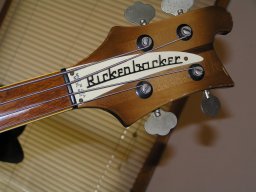
I would not hesitate to purchase a Warmoth neck. Every one I've encountered was a quality part. Another consideration is that people who have the scratch to buy one usually take care of them, too. Hope this helps.

Don't know why I've waited so long, but I finally ordered my 1st ever Warmoth neck in an attempt to salvage one of my instruments.
I've always heard very good things indeed about Warmoth quality and I suspect I'll probably be a very happy customer in 4-5 weeks after it arrives.
It's always good to read recent real world reviews of their product and from what I've seen, there are many satisfied & repeat customers in just this thread alone.
I opted for a Deluxe 5 Roasted Flame Maple, Indian Rosewood fretboard, White Pearloid Inlays, Stainless Steel 6105 frets.
Looking forward to it!
I've always heard very good things indeed about Warmoth quality and I suspect I'll probably be a very happy customer in 4-5 weeks after it arrives.
It's always good to read recent real world reviews of their product and from what I've seen, there are many satisfied & repeat customers in just this thread alone.
I opted for a Deluxe 5 Roasted Flame Maple, Indian Rosewood fretboard, White Pearloid Inlays, Stainless Steel 6105 frets.
Looking forward to it!
They make the best necks (IMO) but they do require some work. Not a direct out of the box, "plug and play" in my experience.
I've ordered 5 necks in my entire life. 2 of them needed fret levels because they would buzz. They ALL required fretboard edges being rolled. The fretboard edges were pretty much square and a bit sharp for my tastes.
Also the neck profiles are ALL different. I ordered slim jazz necks, and they all feel slightly different neck to neck.
I've ordered 5 necks in my entire life. 2 of them needed fret levels because they would buzz. They ALL required fretboard edges being rolled. The fretboard edges were pretty much square and a bit sharp for my tastes.
Also the neck profiles are ALL different. I ordered slim jazz necks, and they all feel slightly different neck to neck.
Last edited:

I love Warmoth necks but for a 5 string deluxe neck, You need a body that is intended to accept a 22 fret neck. I needed a 20 fret neck and it was just impossible to get.Don't know why I've waited so long, but I finally ordered my 1st ever Warmoth neck in an attempt to salvage one of my instruments.
I've always heard very good things indeed about Warmoth quality and I suspect I'll probably be a very happy customer in 4-5 weeks after it arrives.
It's always good to read recent real world reviews of their product and from what I've seen, there are many satisfied & repeat customers in just this thread alone.
I opted for a Deluxe 5 Roasted Flame Maple, Indian Rosewood fretboard, White Pearloid Inlays, Stainless Steel 6105 frets.
Looking forward to it!
I love Warmoth necks but for a 5 string deluxe neck, You need a body that is intended to accept a 22 fret neck. I needed a 20 fret neck and it was just impossible to get.
Not sure when they started offering it, but I believe their current Invalid Link Removed offers 20 frets.
They make the best necks (IMO) but they do require some work. Not a direct out of the box, "plug and play" in my experience.
I've ordered 5 necks in my entire life. 2 of them needed fret levels because they would buzz. They ALL required fretboard edges being rolled. The fretboard edges were pretty much square and a bit sharp for my tastes.
Also the neck profiles are ALL different. I ordered slim jazz necks, and they all feel slightly different neck to neck.
I'll see how it goes - I've become comfortable doing my own fret leveling over the past year or so.
So, no worries if I feel I could get more out of it in that regard. Also have a nice fret edge (Stew-Mac safe edge) file to take care of any winter sprout.
Just excited to finally get to give a Warmoth neck a spin!
Especially since this would be my first experience with a roasted neck! I've heard so much good things about them!
If you're comfortable doing a little bit of filing/sanding, I think you will like them very much. I'm a totally warmoth guy!I'll see how it goes - I've become comfortable doing my own fret leveling over the past year or so.
So, no worries if I feel I could get more out of it in that regard. Also have a nice fret edge (Stew-Mac safe edge) file to take care of any winter sprout.
Just excited to finally get to give a Warmoth neck a spin!
Especially since this would be my first experience with a roasted neck! I've heard so much good things about them!

When you final sand the back, you will smell maple, mmm , seriously .I'll see how it goes - I've become comfortable doing my own fret leveling over the past year or so.
So, no worries if I feel I could get more out of it in that regard. Also have a nice fret edge (Stew-Mac safe edge) file to take care of any winter sprout.
Just excited to finally get to give a Warmoth neck a spin!
Especially since this would be my first experience with a roasted neck! I've heard so much good things about them!
When you final sand the back, you will smell maple, mmm , seriously .
Would be lying if I said I am not going to smell this neck when it arrives, lol.
I've been watching a bunch of Warmoth videos that I've never seen before.
I like this one - he actually mentions the wonderful maple smell too!

Here's mine.
Sanded to 2000 all round fretboard included.
Rolled the edges of the frets with a flat file that I ground and polished the edges on.
(Of course I do this with many instruments )
Frets are fairly level, I will do a full dress and polish closer to assembly.
I rolled the edge of the fretboard first with a 45 degree angle file block . Followed by a soft block loaded with 800 grit, then 2000 .
Feels like a powdered pool cue. Silky.
You can see the sheen on the bare maple in the first pic.

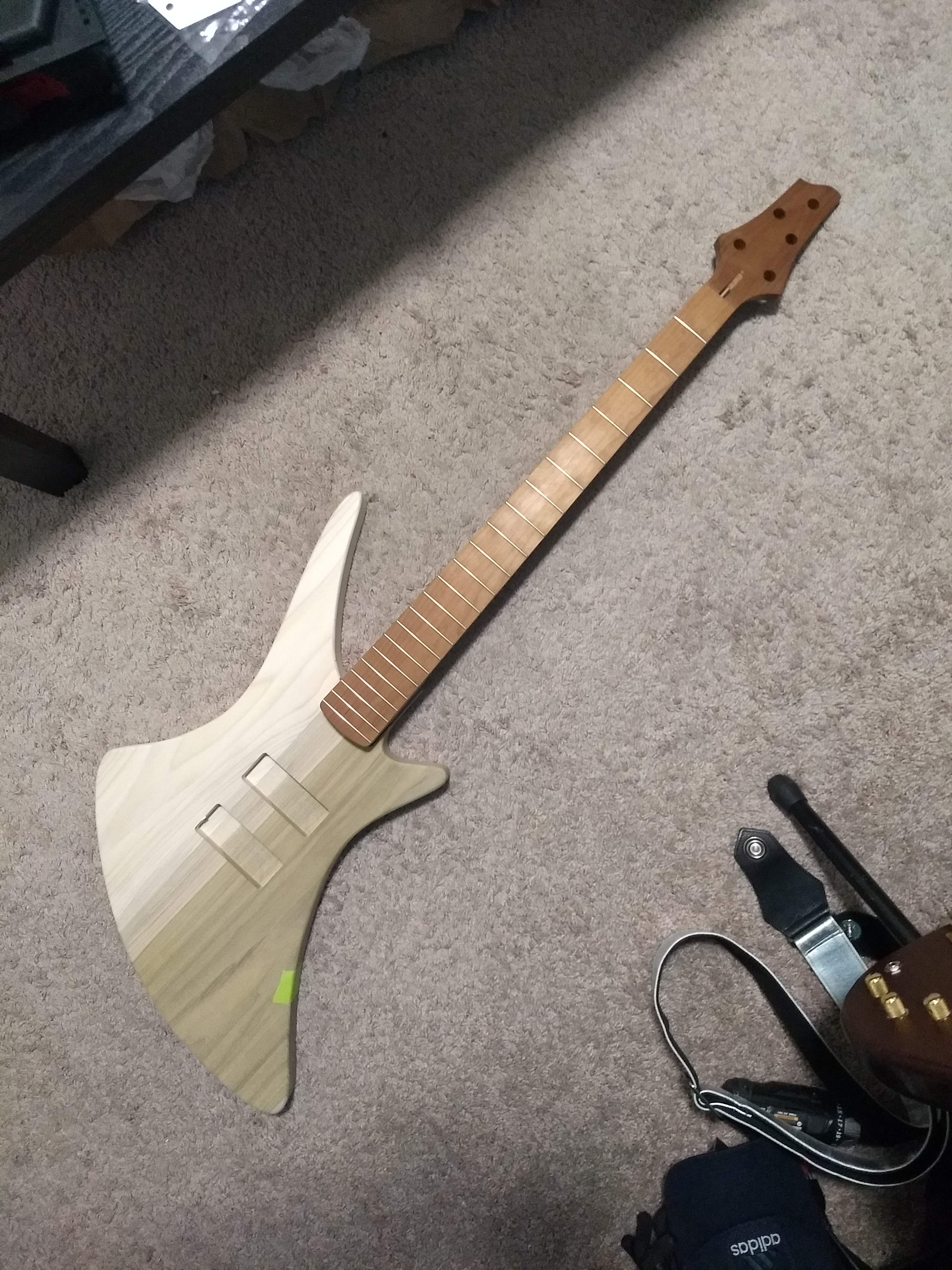
Sanded to 2000 all round fretboard included.
Rolled the edges of the frets with a flat file that I ground and polished the edges on.
(Of course I do this with many instruments )
Frets are fairly level, I will do a full dress and polish closer to assembly.
I rolled the edge of the fretboard first with a 45 degree angle file block . Followed by a soft block loaded with 800 grit, then 2000 .
Feels like a powdered pool cue. Silky.
You can see the sheen on the bare maple in the first pic.
Last edited:


