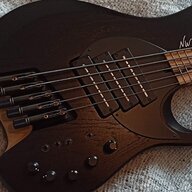
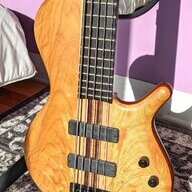
I have nothing to add here, I'm just surprised you got a 160 up to A without it snapping and taking out your eye
Why? It's gotta be about the same tension as a 080 tuned to the next-octave A, and a larger core.
It's funny how so many assume the OP went straight to 160 for their A0. In every likelihood they tried it all, from 130 up, and liked them even worse than the current string gauge.
@sokolasty:
- have you ever heard about "critical bands"? The short of it is that pairs of frequencies, even at an interval that normally sounds good, can be rough-sounding if they are at a distance that make them interfere with each other while exciting the basal membrane in the inner ear (the signal sent to the auditory centres by one of the two is partially masked, and the brain associates a sense of roughness to this masking). In short, this causes close-voiced chords to sound bad when played toward the left end of a piano keyboard - or on any instrument, for that matter - it's not a question of "tone" (which is determined by the balance of partials, as well as other factors such as note-attack noises), but of fundamental frequencies.
The thing is, A0 (which is, perhaps not coincidentally, the lowest note of a standard, 88-key piano) is in and of itself a little bit rough, internally, because any pair of its lowest partials fall within the same critical band.
- Anyway, your opening post clarifies you're not satisfied with the tone of the whole string, not just the open note.
If so, it may be the inharmonicity (which increases the shorter the active section of vibrating string becomes, with fretting - in practice, the higher up the board you go) you don't like.
Try a custom order from Newtone Strings in the UK.

newtonestrings.com
^ Specify 1) "Diamond" for the type, 2) round core, 3) a taper at the bridge (use the notes to tell them the ball-end to 5th-saddle distance, so that the tapering point is just past that, and no further) and 4) the thinnest gauge you found yourself comfortable using (regardless of tone, then) at A0 in your earlier experiments. Personally, I would also 5) choose stainless steel instead of nickel-plated.
If you're still not satisfied, and the vaguely chorus-like tone at mid-fretboard is still annoying (or becomes so at a lower point than you'd prefer),
check out Kemp Strings
University of St Andrews and Kemp Strings inventor Dr Jonathan Kemp has just developed a new concept in bass guitar strings design which reduces inharomicity, improving tone when playing high up th…
kempstrings.com
^ A warning: they're not cheap. In order to have a feel for their approach,
Check this out as well. Note last post about tungsten tape instead of lead tape by yours truly
https://www.talkbass.com/threads/low-inharmonicity-strings-esp-short-scale.1656545/
Tungsten Tape
- As pointed out by others, amplification, and specifically the speaker component, is crucial. What are you currently using?
- Oh, and no: string-through-body makes no difference.