
I smother my face in lemon juice and then no one can see me anyway.

Enjoy the benefits of a premium membership!
Upgrade Account
-
TalkBass has been independent since 1998. Add your voice.
Create a free account to reply to discussions, view embedded media, and browse with fewer display ads.
Join free Log in
Want zero display ads or expanded classifieds tools? Compare plans.
You are using an out of date browser. It may not display this or other websites correctly.
You should upgrade or use an alternative browser.
You should upgrade or use an alternative browser.
Wearing a mask, yes or no.
- Thread starter jd56hawk
- Start date
More options
Who Replied?

Hi jd56hawk 


greetings (take care!)
Wise(b)ass
Saw someone wearing this today at Shoprite.
greetings (take care!)
Wise(b)ass
Mike Rushton, a robotics engineer and member of Lowell Makes, a nonprofit shared community workshop and laboratory in Lowell, Massachusetts, said a Facebook post last week from a nurse at a local hospital requesting crowdsourced N95 respirator masks prompted him to reach out and offer to make her a few alternative particulate masks using his 3-D printer.
But she needed enough for her team of 100 people.
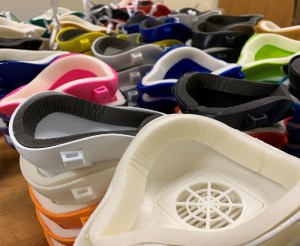
Dozens of 3-D printed masks created by members of nonprofit community workshop and laboratory, Lowell Makes. (Photo courtesy of Lowell Makes.)
Rushton solicited the help of his fellow makers and they now have a cohort of 20 people running 14 3-D printers at a time, making 50 masks a day.
They’ve made around 300 masks so far.
The masks are printed out as three pieces, with a teardrop shape that fits over the nose and mouth, a front grill that secures a filter, and a faceplate. The makers hot-glue high-density rubber foam, which acts as a sealer around the face, and attach two elastic bands which wrap around the wearer’s ears.
Sam Burdett, president of Lowell Makes and an aerospace quality engineer by trade, said the 3-D printed masks can extend the supply of available N95 and surgical masks by cutting up the masks into four to six squares for use as the filters inside the 3-D printed masks.
Burdett said they’re also testing using vacuum bags and furnace filters inside the masks.
“It’s not a medical grade piece of equipment; it should be seen as a last-ditch effort,” Burdett said.
“We’re doing this as an initiative to help our community, but we want to make sure we are not doing more harm than good,” Burdett added.
To make sure the health care workers who use their masks are safe, Lowell Makes is working directly with hospitals to test and distribute the masks, rather than providing them directly to individuals.
All masks are being donated and are not for sale.
Rushton said the masks are being fit tested at local hospitals in the Boston area. The process involves putting on a hazmat suit and using aerosol sprays that taste bitter or sweet to make sure the sprays cannot penetrate the masks.
Amy Wilson, who is also involved in the project, said the makers are happy to step up and fill the PPE void, but they shouldn’t have to.
“I’m glad we have the skills and volunteers to help, but we shouldn’t have to be doing this,” Wilson said.
“There are people better equipped to fill this need, and there has to have been a systemic failure for us to reach this point where people in houses are printing masks for doctors and nurses and grocery workers and police officers,” Wilson added.
Workforce Standing By
Volunteers aren’t the only ones ready to get to work. Many people who lost jobs or income during the pandemic have skillsets needed to create equipment to combat Covid-19.
Seamstresses, tailors and costumers off Broadway formed a collective to quickly produce high volumes of personal protective equipment including gowns, coveralls, scrub caps and booties.
Alexandra Engelson co-founded the Skilled Laborers Brigade to pair makers from the fashion and entertainment industry with hospitals that need PPE on a quick turnaround.
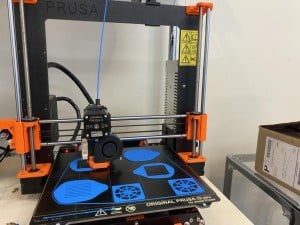
Plastic components for crowdsourced alternative particulate masks are printed on a 3-D printer at nonprofit Lowell Makes. (Photo courtesy of Lowell Makes.)
In the week since it was formed, the collective worked with set designer John Creech to make 300 reusable face shields that were donated to a doctor who works for Kings County and Queens Presbyterian Hospitals in New York.
The face shield design was approved by a Harvard medical engineer and other doctors, Engelson said.
The collective also just received an order for 1,500 masks for firefighters in California, Engelson said.
While the collective includes both volunteers and workers-for-hire, Engelson said 90% of the group’s 500 members have become unemployed during the pandemic.
She said putting them to work making PPE can help stimulate the economy, even if they’re not making what they were before the pandemic.
Professional tailors, seamstresses and costumers are hired with their “kits,” Engelson said, which includes sewing machines and other materials and equipment needed to produce high volumes of garments. Many of them have at-home studios in spare rooms or basements.
The collective is working directly with hospital supply chain managers to produce exactly what they need.
“We’re the ‘Rosie the Riveters’ of this generation,” Engelson said.
“Most of us work in entertainment, usually our jobs are not life or death,” Engelson added. “Most of us are creative, garment construction people. We just want to see the safety of our country go back to normal.”
But she needed enough for her team of 100 people.
Dozens of 3-D printed masks created by members of nonprofit community workshop and laboratory, Lowell Makes. (Photo courtesy of Lowell Makes.)
Rushton solicited the help of his fellow makers and they now have a cohort of 20 people running 14 3-D printers at a time, making 50 masks a day.
They’ve made around 300 masks so far.
The masks are printed out as three pieces, with a teardrop shape that fits over the nose and mouth, a front grill that secures a filter, and a faceplate. The makers hot-glue high-density rubber foam, which acts as a sealer around the face, and attach two elastic bands which wrap around the wearer’s ears.
Sam Burdett, president of Lowell Makes and an aerospace quality engineer by trade, said the 3-D printed masks can extend the supply of available N95 and surgical masks by cutting up the masks into four to six squares for use as the filters inside the 3-D printed masks.
Burdett said they’re also testing using vacuum bags and furnace filters inside the masks.
“It’s not a medical grade piece of equipment; it should be seen as a last-ditch effort,” Burdett said.
“We’re doing this as an initiative to help our community, but we want to make sure we are not doing more harm than good,” Burdett added.
To make sure the health care workers who use their masks are safe, Lowell Makes is working directly with hospitals to test and distribute the masks, rather than providing them directly to individuals.
All masks are being donated and are not for sale.
Rushton said the masks are being fit tested at local hospitals in the Boston area. The process involves putting on a hazmat suit and using aerosol sprays that taste bitter or sweet to make sure the sprays cannot penetrate the masks.
Amy Wilson, who is also involved in the project, said the makers are happy to step up and fill the PPE void, but they shouldn’t have to.
“I’m glad we have the skills and volunteers to help, but we shouldn’t have to be doing this,” Wilson said.
“There are people better equipped to fill this need, and there has to have been a systemic failure for us to reach this point where people in houses are printing masks for doctors and nurses and grocery workers and police officers,” Wilson added.
Workforce Standing By
Volunteers aren’t the only ones ready to get to work. Many people who lost jobs or income during the pandemic have skillsets needed to create equipment to combat Covid-19.
Seamstresses, tailors and costumers off Broadway formed a collective to quickly produce high volumes of personal protective equipment including gowns, coveralls, scrub caps and booties.
Alexandra Engelson co-founded the Skilled Laborers Brigade to pair makers from the fashion and entertainment industry with hospitals that need PPE on a quick turnaround.
Plastic components for crowdsourced alternative particulate masks are printed on a 3-D printer at nonprofit Lowell Makes. (Photo courtesy of Lowell Makes.)
In the week since it was formed, the collective worked with set designer John Creech to make 300 reusable face shields that were donated to a doctor who works for Kings County and Queens Presbyterian Hospitals in New York.
The face shield design was approved by a Harvard medical engineer and other doctors, Engelson said.
The collective also just received an order for 1,500 masks for firefighters in California, Engelson said.
While the collective includes both volunteers and workers-for-hire, Engelson said 90% of the group’s 500 members have become unemployed during the pandemic.
She said putting them to work making PPE can help stimulate the economy, even if they’re not making what they were before the pandemic.
Professional tailors, seamstresses and costumers are hired with their “kits,” Engelson said, which includes sewing machines and other materials and equipment needed to produce high volumes of garments. Many of them have at-home studios in spare rooms or basements.
The collective is working directly with hospital supply chain managers to produce exactly what they need.
“We’re the ‘Rosie the Riveters’ of this generation,” Engelson said.
“Most of us work in entertainment, usually our jobs are not life or death,” Engelson added. “Most of us are creative, garment construction people. We just want to see the safety of our country go back to normal.”
Last edited:
This is good information. I work with nursing home and assisted living providers and while homemade masks may help, obviously they have not been tested so their efficacy in preventing the spread of CVOD-19 can't be assured. But with homemade masks, it's sort of "better than nothing" as alluded to above. Certainly in a health care environment it would be last resort as an alternative to N95s. I believe the CDC has even said that homemade masks can't be classified as PPE because of the lack of testing on them. I saw a CNN article yesterday that perhaps the Asian countries who sort of have a culture of publically wearing masks (not for healthcare reasons in all instances - smog among the other reasons), may be right in that it stops the spread. Certainly I think it bests stops the spread by being worn by those who are infected and lowering the chance of them spreading it. Less so that non-infected people should wear masks to not get infection from others, at least in public situations. I've only been to the grocery store twice in the last 3 weeks and there were some wearing masks. At 5am last week, there were only 4 of us in the grocery store - best time to go! But I digress.....Mike Rushton, a robotics engineer and member of Lowell Makes, a nonprofit shared community workshop and laboratory in Lowell, Massachusetts, said a Facebook post last week from a nurse at a local hospital requesting crowdsourced N95 respirator masks prompted him to reach out and offer to make her a few alternative particulate masks using his 3-D printer.
But she needed enough for her team of 100 people.
View attachment 3769163
Dozens of 3-D printed masks created by members of nonprofit community workshop and laboratory, Lowell Makes. (Photo courtesy of Lowell Makes.)
Rushton solicited the help of his fellow makers and they now have a cohort of 20 people running 14 3-D printers at a time, making 50 masks a day.
They’ve made around 300 masks so far.
The masks are printed out as three pieces, with a teardrop shape that fits over the nose and mouth, a front grill that secures a filter, and a faceplate. The makers hot-glue high-density rubber foam, which acts as a sealer around the face, and attach two elastic bands which wrap around the wearer’s ears.
Sam Burdett, president of Lowell Makes and an aerospace quality engineer by trade, said the 3-D printed masks can extend the supply of available N95 and surgical masks by cutting up the masks into four to six squares for use as the filters inside the 3-D printed masks.
Burdett said they’re also testing using vacuum bags and furnace filters inside the masks.
“It’s not a medical grade piece of equipment; it should be seen as a last-ditch effort,” Burdett said.
“We’re doing this as an initiative to help our community, but we want to make sure we are not doing more harm than good,” Burdett added.
To make sure the health care workers who use their masks are safe, Lowell Makes is working directly with hospitals to test and distribute the masks, rather than providing them directly to individuals.
All masks are being donated and are not for sale.
Rushton said the masks are being fit tested at local hospitals in the Boston area. The process involves putting on a hazmat suit and using aerosol sprays that taste bitter or sweet to make sure the sprays cannot penetrate the masks.
Amy Wilson, who is also involved in the project, said the makers are happy to step up and fill the PPE void, but they shouldn’t have to.
“I’m glad we have the skills and volunteers to help, but we shouldn’t have to be doing this,” Wilson said.
“There are people better equipped to fill this need, and there has to have been a systemic failure for us to reach this point where people in houses are printing masks for doctors and nurses and grocery workers and police officers,” Wilson added.
Workforce Standing By
Volunteers aren’t the only ones ready to get to work. Many people who lost jobs or income during the pandemic have skillsets needed to create equipment to combat Covid-19.
Seamstresses, tailors and costumers off Broadway formed a collective to quickly produce high volumes of personal protective equipment including gowns, coveralls, scrub caps and booties.
Alexandra Engelson co-founded the Skilled Laborers Brigade to pair makers from the fashion and entertainment industry with hospitals that need PPE on a quick turnaround.
View attachment 3769164
Plastic components for crowdsourced alternative particulate masks are printed on a 3-D printer at nonprofit Lowell Makes. (Photo courtesy of Lowell Makes.)
In the week since it was formed, the collective worked with set designer John Creech to make 300 reusable face shields that were donated to a doctor who works for Kings County and Queens Presbyterian Hospitals in New York.
The face shield design was approved by a Harvard medical engineer and other doctors, Engelson said.
The collective also just received an order for 1,500 masks for firefighters in California, Engelson said.
While the collective includes both volunteers and workers-for-hire, Engelson said 90% of the group’s 500 members have become unemployed during the pandemic.
She said putting them to work making PPE can help stimulate the economy, even if they’re not making what they were before the pandemic.
Professional tailors, seamstresses and costumers are hired with their “kits,” Engelson said, which includes sewing machines and other materials and equipment needed to produce high volumes of garments. Many of them have at-home studios in spare rooms or basements.
The collective is working directly with hospital supply chain managers to produce exactly what they need.
“We’re the ‘Rosie the Riveters’ of this generation,” Engelson said.
“Most of us work in entertainment, usually our jobs are not life or death,” Engelson added. “Most of us are creative, garment construction people. We just want to see the safety of our country go back to normal.”
I would do that, but the stores here (SW Ohio) reduced their hours. I can only shop between 8am and 9pm. Theres already a crowd at 8am and no much of what I need left by the evening.At 5am last week, there were only 4 of us in the grocery store - best time to go! But I digress.....

I smother my face in lemon juice and then no one can see me anyway.
...unless they hold your face over a 100 watt lightbulb

I saw a dipstick walking down the street by himself wearing one today. I saw another literally walking down the highway wearing a mask. That mask should be on a doctor in New York, not a dipstick walking down the highway in rural North Carolina.

hey: there are "dipsticks" everywhere --- there is a boundless supply of them!

Or a toaster...unless they hold your face over a 100 watt lightbulb

There have now been a few articles circulating, to the effect that the quantity of virus that you're exposed to, has an effect on the severity of your symptoms. This would lend credence to the also growing body of support for the use of homemade masks under the present shortage of approved masks. If a mask is only 80% effective, it reduces your virus dose by that amount, meaning you might still get the COVID, but a milder case.
Granted, I'm no medical expert, so this is speculation. I've looked at some online instructions for making masks, including one published in the New York Times, and it seems like a property of the "better" masks is that they can be washed without falling apart.
Interesting history: During WWII, people were asked to save peach pits. They were collected and turned into the activated charcoal that was the filter medium in gas masks for the soldiers.
Granted, I'm no medical expert, so this is speculation. I've looked at some online instructions for making masks, including one published in the New York Times, and it seems like a property of the "better" masks is that they can be washed without falling apart.
Interesting history: During WWII, people were asked to save peach pits. They were collected and turned into the activated charcoal that was the filter medium in gas masks for the soldiers.
Here's a good article from the Wisconsin State Journal that was just posted on the developing mask-wearing issue
As COVID-19 pandemic intensifies, guidance on public use of basic masks may be shifting
As COVID-19 pandemic intensifies, guidance on public use of basic masks may be shifting

When I hold my hand up in front of my face, I can feel the air coming out when I exhale. When I slap on a bandana or the tube scarf, there is considerably less velocity.
I used to think masks in public were goofy. Now I don't feel OK volunteering alongside all the seniors at the food bank without some form of face covering.
I used to think masks in public were goofy. Now I don't feel OK volunteering alongside all the seniors at the food bank without some form of face covering.
Many thanks for your service!I wear a mask when I go into town. I live in a small, rural community and am the only serving EMT for a 1200 square mile area. I can't afford to get sick. The closest town is 30 miles away (for food, fuel or anything else) across the state line and they just reported their first 2 cases. That basically means it is and has been already circulating. I already ended up having to shave a chest length beard to wear the damn thing properly. Now folks look at me like I'm an alien. Better safe than sorry. I've been wearing one on emergency calls also. 90% of people I scrape up off the road in motorcycle wrecks/single vehicle rollovers are folks from big cities who are out having fun passing through our area near Death Valley. Mask good.

When I hold my hand up in front of my face, I can feel the air coming out when I exhale. When I slap on a bandana or the tube scarf, there is considerably less velocity.
I used to think masks in public were goofy. Now I don't feel OK volunteering alongside all the seniors at the food bank without some form of face covering.
I was surprised to learn how much spit flies out of your mouth just while you're talking, and it's not even noticable to you or the person you're spitting on, errrr talking to.
-Mike
I was surprised to learn how much spit flies out of your mouth just while you're talking, and it's not even noticable to you or the person you're spitting on, errrr talking to.
-Mike
I had to tell a neighbor not to smoke a J by my house today.
Normally I don’t care, but if I can smell his roach thru the kitchen window while I’m frying bacon then I’m more concerned about his raspy cough from a few days ago filling my house.

also leftover fat from cooking was collected up and turned into glycerin which then got converted to tri-nitro-toluene aka TNT.Interesting history: During WWII, people were asked to save peach pits. They were collected and turned into the activated charcoal that was the filter medium in gas masks for the soldiers.

I wear one of my dust masks I use for my projects when I go to the supermarket, mainly to make people around me be comfortable. Gloves I think are useless because to truly protect yourself, every time you touch something, you should replace them. I prefer to keep a small bottle of hand sanitizer that I can drip on my hands when I go to touch something (I bought a big bottle about a year ago).
Wipes are not a substitute for toilet paper, they do not dissolve in the toilet, they clog the sewer line, which happened in my apartment building a week into the stay home dictate. The plumber said they're completely inundated with clogged sewer lines which are filled with wipes.
Wipes are not a substitute for toilet paper, they do not dissolve in the toilet, they clog the sewer line, which happened in my apartment building a week into the stay home dictate. The plumber said they're completely inundated with clogged sewer lines which are filled with wipes.


we already had two N95 masks from before all this. we're saving them for a trip to the store or something. Arix X has one 2-cartridge mask with better filtration, but he uses that for finishing when he makes/mods guitars and basses.
i'm curious - what are you wearing to protect your eyes?
I wear a mask when I go into town. I live in a small, rural community and am the only serving EMT for a 1200 square mile area. I can't afford to get sick. The closest town is 30 miles away (for food, fuel or anything else) across the state line and they just reported their first 2 cases. That basically means it is and has been already circulating. I already ended up having to shave a chest length beard to wear the damn thing properly. Now folks look at me like I'm an alien. Better safe than sorry. I've been wearing one on emergency calls also. 90% of people I scrape up off the road in motorcycle wrecks/single vehicle rollovers are folks from big cities who are out having fun passing through our area near Death Valley. Mask good.
i'm curious - what are you wearing to protect your eyes?


