47th Street;- who is this Bernie Sanders you speak of......?

Augh, MAAN!! I may well get slapped down by the mods...and I couldn't
half blame them...I know the rules regarding Politics...but you asked, and I'm deeply enough involved in American politics to run the risk... I'll miss y'all if I'm gone...

.................................. Let's Go Rangers! Clap, Clap, ClapClapClap!!!!!!!
The Socialist Senator
By MARK LEIBOVICH
Published: January 21, 2007
When Bernie Sanders visits a high-school class, as he does regularly, students don’t hear a speech, a focus-grouped polemic, a campaign pitch or, heaven forbid, practiced one-liners. Nor, in all likelihood, do they hear Sanders tell stories about his family, childhood or some hardship he has endured. He makes no great effort to “connect” emotionally in the manner that politicians strive for these days, and he probably doesn’t “feel your pain” either, or at least make a point of saying so. It’s not that Sanders is against connecting, or feeling your pain, but the process seems needlessly passive and unproductive, and he prefers a more dynamic level of engagement.
Invalid Link Removed
Enlarge This Image
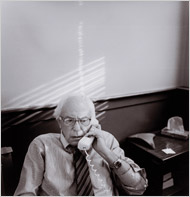
Larry Fink for The New York Times
Bernie Sanders.
University of Vermont. No matter. Sanders’s agitating style in Washington also constitutes a basic facet of anticharm, antipolitician appeal at home.
“I’m not afraid of being called a troublemaker,” Sanders says, something he’s been called many times, in many different ways, many of them unprintable. “But you have to be smart. And being smart means not creating needless enemies for yourself.”
In this regard, Sanders has not always been smart, especially when he was first elected to the House in 1990. He called Congress “impotent” and dismissed the two major parties as indistinguishable tools of the wealthy. He said it wouldn’t bother him if 80 percent of his colleagues lost re-election — not the best way to win friends in a new workplace.
“Bernie alienates his natural allies,” Representative Barney Frank, the Massachusetts Democrat, said at the time. “His holier-than-thou attitude — saying in a very loud voice he is smarter than everyone else and purer than everyone else — really undercuts his effectiveness.” The late Joe Moakley, another Massachusetts Democrat, waxed almost poetic in his derision for Sanders. “He is out there wailing on his own,” Moakley said. “He screams and hollers, but he is all alone.”
Frank says he came to like and work well with Sanders, with whom he served on the House Financial Services Committee. His early objections were over Sanders’s railing against both parties as if they were the same. “I think when he first got here, Bernie underestimated the degree that
Republicans had moved to the right,” Frank told me. “I get sick of people saying ‘a curse on both your houses.’ When you point out to them that you agree with them on most things, they’ll say, ‘Yeah, well, I hold my friends up to a higher standard.’ Well, O.K., but remember that we’re your friends.”
Among his House colleagues, “Bernie’s not a bad guy,” is something I heard a lot of. “You appreciate Bernie the more you see him in action,” says Senator
Chuck Schumer, the head of the Democratic Senatorial Campaign Committee, who served with him for several years in the House. A fellow Brooklynite who is nine years younger, Schumer attended the same elementary school as Sanders (P.S. 197) and the same high school (James Madison, which also graduated a third United States senator,
Norm Coleman, Republican of Minnesota). “Bernie does tend to grow on people, whether it’s in the House or in Vermont,” Schumer says.
But he has clearly grown bigger in Vermont, and more seamlessly. “His bumper stickers just say, ‘Bernie,’ ” says
Senator Patrick Leahy, Vermont’s senior Senator and a Democrat. “You have to reach a certain exulted status in politics to be referred to only by your first name.”
Sanders is particularly beloved in Burlington, which elected the recovering fringe candidate as its mayor despite the Reagan landslide of 1980 — thus christening the so-called “People’s Republic of Burlington.” Some supporters called themselves “Sanderistas.”
His election to the Senate in November came at the expense of a too-perfect Bernie foil — Richard Tarrant, a well-barbered, Bentley-driving Republican businessman who spent $7 million of his own money so he could lose by 33 percentage points.
“Congratulations, Bernie,” a fan yells to Sanders outside his district office in Burlington. Sanders was out for a quick bagel on a balmy December morning, temperatures in the 60s — another day of
Al Gore weather in the once-frozen north. He walked head down but kept getting stopped. “Now you gotta run for president, please,” the congratulator added, something Sanders gets a lot of too.
It is a reception that any natural, eager-to-please politician would relish — and accordingly, Sanders dispatches these glad-handing chores with the visible joy of someone cleaning a litter box, coughing out his obligatory thank yous and continuing on his way.
Sanders’s popularity in Vermont brings up the obvious questions: to what degree is he a quaint totem of the state, like the hermit thrush (the state bird), and could a Socialist be elected to the Senate anywhere else?
In recent years, Vermont has joined — perhaps surpassed — states like Massachusetts and New York in the top tier of liberal outposts. Several distinctions nurture the state’s credentials: It was the first place to legalize civil unions for same-sex partners; it is the home of Phish, the countercultural rock-folk band and contemporary analog to the
Grateful Dead and of Ben and Jerry’s ice cream (and its peacenik-themed flavors); and it is host to cultural quirks and ordinances like not allowing billboards, being the last state to get a Wal-Mart.
The state has also incubated several politicians who have achieved national boogie-man status among Republicans. They include Leahy, the Grateful Dead fan and chairman of the Senate Judiciary Committee; former Senator
James Jeffords, the liberal Republican who became an Independent in 2001, giving
Democrats a temporary majority; and
Howard Dean, the former governor whose presidential campaign boom (and perhaps fizzle) was tied heavily to his association with Vermont’s progressive politics.
Sanders fits snugly into this maverick’s pantheon. But Leahy says his fellow senator appeals to an antiestablishment strain in Vermont that is not necessary liberal. Leahy notes that he himself is the only Democrat the state’s voters have ever elected to the Senate. Before 1992, only one Democratic presidential candidate carried Vermont —
Lyndon Johnson in 1964.
“A lot of the lower-income parts of our state are Republican,” Leahy says, adding that many of them are populated by rural libertarians who are greatly suspicious of government intrusion into individual rights. “I saw Bernie signs all over those parts of the state.”
Sanders opposes some federal gun-control laws, which has helped him in a state where “you grow up believing it is legal to shoot deer on the statehouse lawn in Montpelier,” says Luke Albee, a South Burlington native who was Leahy’s House chief of staff.
But again: Could Sanders be elected to the Senate anywhere else?
No, not as a Socialist, Schumer says. “Even in New York State it would be hard.”
Massachusetts? “Maybe this year he could,” Frank says, meaning 2006. “But if he were running in any other state, he probably would have to comb his hair.”
Leahy says that just any Socialist probably couldn’t get elected in Vermont, either. But Sanders has made himself known in a state small enough — physically and in terms of population — for someone, particularly a tireless someone, to insinuate himself into neighborly dialogues and build a following that skirts ideological pigeonholes. Indeed, there are no shortages of war veterans or struggling farmers in Vermont who would seemingly have no use for a humorless aging hippie peacenik Socialist from Brooklyn, except that Sanders has dealt with many of them personally, and it’s a good bet his office has helped them procure some government benefit.
“People have gotten to know him as Bernie,” Leahy says. “Not as the Socialist.”
Sanders calls himself as a “democratic Socialist.” When I asked him what this meant, as a practical matter, in capitalist America circa 2007, he did what he often does: he donned his rhetorical Viking’s helmet and waxed lovingly about the Socialist governments of Scandinavia. He mentioned that Scandinavian countries have nearly wiped out poverty in children — as opposed to the United States, where 18 to 20 percent of kids live in poverty. The Finnish government provides free day care to all children; Norwegian workers get 42 weeks of maternity leave at full pay.
But would Americans ever accept the kinds of taxes that finance the Scandinavian welfare state? And would Sanders himself trade in the United States government for the Finnish one? He is curiously, frustratingly non-responsive to questions like this. “I think there is a great deal we can learn from Scandinavia,” he said after a long pause. And then he returns to railing about economic justice and the rising gap between rich and poor, things he speaks of with a sense of outrage that always seems freshly summoned.
Sanders crinkles his face whenever a conversation veers too long from this kind of “important stuff” and into the “silly stuff,” like clothes and style. “I do not like personality profiles,” Sanders told me during our first conversation. He trumpets a familiar rant against the media, its emphasis on gaffes, polls and trivial details.
“If I walked up on a stage and fell down, that would be the top story,” Sanders says. “You wouldn’t hear anything about the growing gap between rich and poor.”
When I first met Sanders in person on Church Street, there were big streaks of dried mud on his shoes and dried blood on his neck from what looked to be a shaving mishap. His hair flew every which way in a gust of wind. At six feet tall, he is wiry, but he walks with shoulders hunched and elbows out, like a big, skulking bird. From a distance, he looked as if he could be homeless.
Closer in, the overwhelming impression made by Sanders is that of an acute worrier. He evinces the wearied default manner of a longtime insomniac, eyes weather-beaten with big lines and a perpetual slight cringe. His brow appears close to collapse beneath the weight of an invisible sandbag.
Richard Sugarman, a professor of religion at the University of Vermont and a longtime friend, recalls that during Sanders’s days as mayor, constituents would sometimes call him at his listed home phone number in the middle of the night. “Someone would call at 3 a.m. and say, ‘Hey Bernie, someone just threw a brick through my window, what should I do?’ He was as hands on as anyone. ... Does he have an off-mode? Not really.”
Luke Albee, Leahy’s former chief of staff, says: “He has no hobbies. He works. He doesn’t take time off. Bernie doesn’t even eat lunch. The idea of building a fire and reading a book and going on vacation, that’s not something he does.”
As much as anything, this distills why Sanders has been an awkward fit in the chummy realm of Capitol Hill. He is no pleaser or jokester by anyone’s prototype. I don’t recall Sanders laughing more than two or three times in the 48 hours I spent with him in Vermont. His one memorably funny aside came when I asked if his Congressional office had a dress code.
“Yes,” he said. “You can’t come in if you’re totally nude,” he said. He instituted the rule, he said, when his outreach director, Phil Fiermonte, who is now sitting next to him, came to work naked.
“Totally nude,” Sanders said. “On three occasions.”
He was kidding, presumably.
Riding in the passenger seat of Fiermonte’s car, Sanders was shouting into a brick-size cellphone, the likes of which were all the rage in the 1990s. He was talking to a staff person who was about to meet with someone from the office of Senator
Edward Kennedy, chairman of Health, Education, Labor and Pensions, one of five committees that Sanders will sit on. Sanders voice filled the car.
“Dental care is yooge,” Sanders boomed into the phone. This has been a leitmotif of my visit — Sanders’s crusade to improve dental health among Vermont’s rural poor. He views this as an employment and economic issue. “How many employers are going to hire someone who doesn’t have teeth?” he asks. “You go around this state, and you will find a lot of people with no teeth. It is their badge of poverty.”
Improving dental care for the poor is a classic Sanders issue: unsexy and given to practical solutions and his obsessive attention. Sanders sees bad dental care among the poor as a “pothole issue” in Vermont, meaning it is pervasive and something that government should be active in fixing (like potholes). Teeth are tangible, especially when they hurt.
Sanders’s car pulled into the parking lot of H.O. Wheeler Elementary School in North Burlington, where he was visiting a drop-by dental clinic. The notion of “school-based dental care” excites Sanders immensely, and his gait speeds as he enters the school, past the main office, a classroom and several school officials he has come to know over multiple visits.
“If you’re a kid, and you’re having dental pain, you’re not going to be learning a lot,” said Joseph Arioli, of Burlington’s Community Health Center and one of a half-dozen program administrators — including a dentist in scrubs — convened around a dentist chair.
The clinic provides free access to dental care for kids at high risk of neglecting their teeth. Students are typically seen during the school day, which means they miss minimal class time and their parents don’t have to leave work to take them. Betsy Liley, a grant writer for the city, says that many households in Vermont own just one toothbrush.
“Lemme guess, a lot of the dietary habits you see here are not great,” Sanders said. Nods all around. He said he’d do his best to secure more financing and vowed to return. And he told Liley that he might bring her to Washington to testify before a Senate committee.
Walking out, Sanders didn’t bother with goodbye — just as he didn’t with hello — only a thank you and a “what you’re doing here is yooge” over his shoulder.
“Great program,” Sanders said in the car. He likes to check in whenever possible. That’s essentially what I did with Sanders in Vermont: check in, with programs that he’s been involved with or wants to learn more about. He likes to hit lots of meetings, quick, businesslike transactions.
Only once in six discussions I sat in on did Sanders indulge in a personal anecdote. He was in his office talking to Sharon Moffat, Vermont’s acting commissioner of health, and the topic turned to dental care.
“I have a personal story to tell you,” Sanders said, and my ears perked up as I fantasized of learning the “Rosebud” episode that might explain Bernie’s interest in teeth.
“I was in the House cloakroom about five years ago,” Sanders said. “And I was thirsty. I took a drink of grape juice. Blawww.”
He scrunched up his face.
“It was awful, awful. Then I looked at the label. The amount of junk they put in there is unbelievable.”
Moffat nodded.
“Anyway, I no longer drink that stuff,” Sanders said.
Sanders’s parents were Jewish immigrants from Poland. His father, Eli, a struggling paint salesman who saw his family wiped out in the Holocaust, worried constantly about supporting his wife and two sons. His mother, Dorothy, dreamed of living in a “private home,” but they never made it beyond their three-and-a-half-room apartment on East 26th and Kings Highway. She died at age 46, when Bernie was 19. “Sensitivity to class was imbedded in me then quite deeply,” Sanders told me.
Sanders spent a year at
Brooklyn College before transferring to the
University of Chicago, where he studied psychology and helped lead protests against racially segregated housing on campus. He spent time on a kibbutz in Israel after graduation and then moved to Vermont with his first wife. “I had always been captivated by rural life,” he says. As a child, Sanders attended Boy Scout camp upstate and used to cry on the bus as it returned him to New York at the end of the summer.
In Vermont, Sanders worked many jobs for meager sums — as a freelance writer, filmmaker, carpenter and researcher, among other things. (Sanders has one son, Levi, and three stepchildren from his marriage to his second wife, Jane O’Meara Driscoll, the president of a small college in Burlington whom he met at a party on the night of his first mayoral victory.)
Politics came to dominate Sanders’s life. He was an early member of Vermont’s Liberty Union party, an offshoot of the antiwar movement in Vermont. He ran as the party’s nominee for the Senate in a special election in 1971 and finished with 2 percent of the vote. The following year, he ran for governor and received 1 percent. He would run two more times for statewide office that decade as a third-party candidate and never come close.
That changed when he ran for mayor of Burlington in 1980, at Sugarman’s urging. Sugarman studied the race and believed Sanders could win, if few others did. Sanders knocked on doors all over the city, campaigned day and night and beat a six-term Democratic incumbent by 12 votes.
“People generally assumed this was a fluke and that he would be gone in two years,” said Peter Clavelle, a friend who succeeded Sanders as mayor.
Sanders spoke out against poverty in the third world and made good-will visits to the Soviet Union and Cuba, among other places that U.S. mayors generally didn’t travel to during that time. But a funny thing happened on the way to what many had dismissed as a short-running circus. Sanders undertook ambitious downtown revitalization projects and courted evil capitalist entities known as “businesses.” He balanced budgets. His administration sued the local cable franchise and won reduced rates for customers. He drew a minor-league baseball team to town, the Vermont Reds (named for the Cincinnatis, not the Commies).
Sanders’s appeal in Vermont’s biggest city blended the “think globally” sensibility of a liberal college town with the “act locally” practicality of a hands-on mayor. He offered sister-city relations with the Sandinistas and efficient snowplowing for the People’s Republic of Burlington. Before Sanders’s mayoral victory, Leahy says, it was easy not to take him seriously. “Then he got over that barrier, and got elected. He fixed the streets, filled the potholes, worked with the business community. He did what serious leaders do.” He was re-elected three times.
In a sense, Sanders’s stint as mayor become a template for his subsequent successes — and limitations — as a national officeholder. In the House, he gained great publicity and favor as an audacious critic with a geopolitical purview, but ultimately left his biggest mark with small-bore diligence to the local realpolitik.
I was reminded of this when I asked Sanders in early January what his immediate legislative goals would be in the Senate. He listed these broad-brush priorities: 1) ending the Iraq war; 2) reversing the “rapid decline of the middle class” (a corollary to “addressing the gap between rich and poor”); 3) reordering priorities in the federal budget; and 4) enacting environmental laws to thwart
global warming. When I asked how he would translate any of his priorities into concrete legislation, he nodded sheepishly and said, “I’m in the process of trying to figure that out now.” It is an unsatisfying response somewhat reminiscent of Sanders’s all-purpose invocations of Scandinavia whenever he’s pressed on how his socialist philosophy can be applied to the two-party system he exists in.
As a general rule, Sanders is much more convincing at proffering outrage than solutions. He can do this in Vermont, in part, because he is an entrenched political brand — “Bernie” — and voters will forgive a little blowhardedness (if not demagoguery) from someone they basically agree with and who has grown utterly familiar to their landscape, like cows. Sanders can also pull this off because, as he did in the mayor’s office, he has buttressed his bomb-throwing with rock-solid attention to the pothole matters of dental clinics, veterans’ benefits, farm subsidies, the kind of things an attentive politician operating in a tiny state (with a population of just 620,000) can fashion a formidable political base from.
After three terms as mayor, Sanders ran for Vermont’s at-large House seat in 1988 as an Independent and lost by a small margin to Peter Smith, the Republican former lieutenant governor. He won a rematch in 1990.
“When I came into the House, no one knew what to do with me,” Sanders says. “I was the only representative from Vermont, so I had no one to help me. And I was the only Independent, so no one knew where to put me in terms of committee.”
Sanders was known as something of a pragmatic gadfly in the House. His grillings of former Federal Reserve Chairman
Alan Greenspan became a running burlesque, much awaited by many Hill and Federal Reserve watchers whenever Greenspan appeared before the House Financial Services Committee. (“Do you give one whit of concern for the middle class and working families of this country?” Sanders asked Greenspan in one representative exchange.)
Sanders was not without his legislative triumphs. He was adept at working with people with whom he otherwise disagreed sharply — forging alliances with conservatives like Representative Ron Paul, Republican of Texas and a well-known libertarian, with whom he shared a common hostility to the U.S.A. Patriot Act. In what might have been Sanders’s signature triumph of recent years, he was instrumental in striking a provision from the Patriot Act that would have required librarians to release data on what their patrons were reading.
But in keeping with his pragmatic gadfly’s approach, Sanders was far more accomplished at filing amendments to House bills than actually writing and producing legislation of his own. He was also gifted at drawing attention to his issues and (just as important) to himself. He was the first congressman to lead a bus trip to Canada to help seniors buy cheaper prescription drugs.
As he makes the transition to his new job, Sanders says his former House colleagues have teased him about not becoming “like the rest of them” in the Senate. Sanders jokes about this, as much as he jokes about anything. He says he will be required to enter a machine that zaps his brain and transforms him “into a member in good standing in the House of Lords.”
“We’re talking about a completely different animal here,” Sanders says. The House fosters a more hospitable habitat for the audacious and eccentric; their ranks tend to be camouflaged by its larger numbers, curtailed by strict time limits on floor speeches and reined in by the outsize power of the House leadership. Senators can speak for as long as they want and single-handedly buck the wishes of 99 other senators by placing “holds” on bills and nominations. Tradition dictates that senators exercise such privileges sparingly.
“There will be times when he causes the Democratic leadership some agita,” Schumer predicts. “But knowing him, I think he’s smart enough not to make any gratuitous enemies. He might make enemies, but they won’t be gratuitous enemies.”
Sanders told me, “You have to ask yourself, Did the people send me here to give long speeches, or did they send me here to get things done?”
By “you” Sanders means himself, as his sleepless Socialist adventure proceeds into the House of Lords.
On a quiet morning in mid-December, Sanders was sitting in his new office in the basement of a Senate office building — it is a temporary office he will inhabit before he moves to another temporary office that he will occupy until a permanent space opens up, probably around March. It’s all very exasperating, he said, this office-space situation. But he asked that I keep the specifics of his exasperation out of the article. He is trying to meet a stepped-up standard of tact and decorum in his new home.
“Why can’t we get these phone calls forwarded from the House office?” Sanders asked a staff person who is working temporarily at a temporary reception desk in the temporary-temporary office. Everything seems temporary, but not as temporary as before. Sanders has a six-year term now instead of a two-year one. Friends have advised him to pace himself, curb his impatience. He would seem ill wired for this, but he is trying. He even took a four-day vacation last month — and to Palm Springs.
But now he has work to do, beginning with getting to know his colleagues. “Personal relationships are very important in the Senate,” he told me. He likes the Senate majority leader,
Harry Reid, a lot, appreciates that he gave him the committee assignments that he wanted — Health, Education, Labor and Pensions; the Environment and Public Works; Veterans’ Affairs; Energy and Natural Resources; and the Budget. And wouldn’t you know, Reid has an interest in dental care, too. He grew up dirt poor in Nevada, and his mother had no teeth. The first thing Reid did when he got his first job — at a gas station — was buy her a new set. So the Senate’s leading Democrat gets the importance of dental care, which could help save teeth in Vermont.
“Let’s go somewhere else to talk,” Sanders said, as we headed out the door of his temporary-temporary office. “We can get some coffee.”
We traversed a maze of hallways that lead into a Senate dining room. “Can we sit down in here?” he asked a busperson. Yes, but then Sanders looked at a bunch of tables covered in white linen table clothes, not what he had in mind.
We walked upstairs, in search of a quiet place in the new neighborhood, on the Senate side. He kept navigating short hallways and turning back. An elevator opened in front of Sanders. It said “Senators Only.” The attendant invited him on, but he hesitated, turned away and began looking for another route to wherever he was going.
Sanders zigzags the Capitol this way barely recognized, or acknowledged (or congratulated, or urged to run for president). A few people stare at the new senator as he walks by — maybe because he looks lost, or famous, or maybe just because he looks like a strange bird out of Vermont.
Mark Leibovich is a reporter in the Washington bureau of The Times. This is his first article for the magazine.
More Articles in Magazine »
Tips
To find reference information about the words used in this article, hold down the ALT key and click on any word, phrase or name. A new window will open with a dictionary definition or encyclopedia entry.
Related Searches
More Articles in Magazine »
<a target="_blank" href="[Invalid or Expired Link Removed]"> <img border="0" alt="" src="//s0.2mdn.net/3793550/a1415-1017_MS_Hospitality_NYTimes_300x250_default.jpg" width="300" height="250" /> </a> <A HREF="[Invalid or Expired Link Removed]" TARGET="_blank">< IMG SRC="
http://ad.doubleclick.net/ddm/ad/N6...;pc=nyt277263A404861;ord=2015.05.10.23.00.56?" BORDER=0 WIDTH=300 HEIGHT=250 ALT="Click Here"></A>
MOST POPULAR
- Invalid Link Removed
- Invalid Link Removed
- Invalid Link Removed
- Invalid Link Removed
- Invalid Link Removed
- Invalid Link Removed
- Invalid Link Removed
- Invalid Link Removed
- Invalid Link Removed
- Invalid Link Removed
- Invalid Link Removed
- Invalid Link Removed
- Invalid Link Removed
Go to Complete List »
- modern love
- nail salon
- social q's
- paul krugman
- russia
- 36 hours
- china
- baltimore
- nepal earthquake
- new york
Go to Complete List »
- Invalid Link Removed
- The Best and Worst Places to Grow Up: How Your Area Compares
- Invalid Link Removed
- Invalid Link Removed
- Invalid Link Removed
- Invalid Link Removed
- Invalid Link Removed
- Invalid Link Removed
- Invalid Link Removed
- Invalid Link Removed
Go to Complete List »
Ads by Google
what's this?
Link Removed
Inside NYTimes.com
Health »
Too Hot to Handle
Arts »
Invalid Link Removed
Opinion »
Should Beach Privatization Be Allowed?
Room for Debate asks whether shorefront homeowners should have to open their land to all comers.
Sports »
Invalid Link Removed
Opinion »
Menagerie: Streaming Eagles
U.S. »
Invalid Link Removed
[Invalid or Expired Link Removed]
Invalid Link Removed
Book Review »
Invalid Link Removed
Opinion »
Invalid Link Removed
World »
Invalid Link Removed
Opinion »
Invalid Link Removed
New York City’s top public schools must become more diverse.
Business »
Invalid Link Removed
Home
Copyright 2007 The New York Times Company