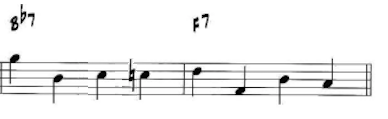
if i was reading that through, 1st time = i'd play E natural to the next measure...because it makes sense...it's 'natural'. in spite of the copy error.

TalkBass has been independent since 1998. Add your voice.
Create a free account to reply to discussions, view embedded media, and browse with fewer display ads.
Join free Log in
Want zero display ads or expanded classifieds tools? Compare plans.

I don't have an issue with the written D#...but that's me.
Also Too - I don't consider the E natural a "chromatic..." movement, as E is the #11 of the Bb7 chord. It is "in" the Bb7 chord as an upper extension, that just happens to result in a "chromatic.." movement. That's why it sounds "good/right", IMO.
But that's me, and not everybody would agree with me, IME.
Thanks!
Well, it's not that simple. If this were a gig it's a no brainer, I play what I want, but it's not a gigSomebody left out a natural sign. Play the note your ears and logic tell you to play and move on. Ray Brown wouldn't have even bothered to think about it, much less ask.


Key Signatures are so 19th Century!Well there’s a key signature that tells us there are issues with both of those things
I agree, that's almost certainly supposed to be an E natural in the last note of that bar.
 :
: :
:Thanks! There is such a wealth of knowledge here and I feel lucky to have it available to me.Please don’t say stuff like “you guys are going to get sick of me asking questions “. You have a question and you’re seeking an answer. Plus your inquiry is bass related which, unfortunately, is becoming more on more rare in this forum.
That's what I would have expected to see. Why put the D# in there when the E will do that job?If a lower chromatic approach is intended, wouldn't this be the correct notation?
Well, I will mention to him that I'd prefer to play it this way, but I am not sure he want to hear about how I will improve on Paul Chambers. I am actually not sure he wants to hear about how I wouldn't do that, either. And I don't even know how Paul actually played it.Oh and perhaps an op for you to be creative and alter that measure to your liking…
Yeah, that shouldn't have been a D#. Eb would have been better.There’s still the issue of the written D# but I agree, this feels like it has to be a chromatic walk up from D to F.

I believe you are right. I don't think he has a lack of theory knowledge with his credentials, though. I think there's a different reason for this. Either an oversight or a test. Also, it's not his transcription. It'll be interesting to hear what he has to say about this.It's written wrong. He might be a good bass teacher, but his lack of theory knowledge is showing. The first and second notes are correct. The third note should be written as an "E", which of course in this key/key signature, is really an Eb. The fourth note should have been written as E natural, as this is clearly intended to be a chromatic run up to the F chord. As someone who studied theory for five years at the conservatory level, trust me I am right

Technically, D# and Eb are referred to as “enharmonic equivalents”. It’s the same tone.Key of Bb, bass clef 4/4
View attachment 5124262
Aren't the last two notes the same tone, since the E is flat? I understand that in certain temperaments they would be different but this is written for bass. Why would you write it like this? Why not B D E E? Is this just to convey the upward movement of the overall passage? I'm confused. Maybe it's just to test to see if I play this correctly?
You guys are going to get sick of me asking questions in this forum.
Haha we just wrote the same thing literally 1 minute apart!It's written wrong. He might be a good bass teacher, but his lack of theory knowledge is showing. The first and second notes are correct. The third note should be written as an "E", which of course in this key/key signature, is really an Eb. The fourth note should have been written as E natural, as this is clearly intended to be a chromatic run up to the F chord. As someone who studied theory for five years at the conservatory level, trust me I am right

A few things to take note of in all this conjecture:
- This is a transcription of a bass line played by Paul Chambers.
- My teacher didn't transcribe it, one of his teacher's other students did.
- Teacher is a Berklee grad so I am pretty sure he knows his theory.
- It'd be a sad statement about Berklee if neither of them could read this as well as I can.
Is this a deliberate "mistake" that's in the book to help or assess students in some way? I don't know. But I can't for a minute imagine that they don't know it's there if half of TalkBass is chiming in to correct it.
It's certainly a talking point. Perhaps that is the intent?
Earlier I was confused, but now I'm intrigued.