
Enjoy the benefits of a premium membership!
Upgrade Account
-
TalkBass has been independent since 1998. Add your voice.
Create a free account to reply to discussions, view embedded media, and browse with fewer display ads.
Join free Log in
Want zero display ads or expanded classifieds tools? Compare plans.
You are using an out of date browser. It may not display this or other websites correctly.
You should upgrade or use an alternative browser.
You should upgrade or use an alternative browser.
What am I missing in this measure?
- Thread starter LBS-bass
- Start date
- Status
- Not open for further replies.
More options
Who Replied?
I asked the mods to close it, so it shouldn't go too far beyond hereI am guessing there is NFW you thought this thread on this topic would hit 120 posts, eh?

Somebody left out a natural sign. Play the note your ears and logic tell you to play and move on. Ray Brown wouldn't have even bothered to think about it, much less ask.
This. Not worth overthinking. Plenty of mistakes in published manuscripts, especially ‘educational’ ones
Edit (just saw posts about closing thread)!
Ha Ha. Prize for last post, please, LBC


The bottom line is that we don't know what he really played because I can't find the recording to verify, and I don't really want to end up learning this line by ear - which is what will happen if I listen to the record. So...
This is slightly off topic and I see the messages about closing the thread, and I agree with the reasoning, so sorry if this message is crossing a line.
But I find this idea that you don't want to learn it by ear so interesting! I see the motivation, that you really want to improve your sight reading skills and I commend you for that. It's interesting to me because I grew up taking classical piano lessons and went to college for piano performance. For me, I'm stuck to the sheet music, and I've struggled with breaking away from it my whole life. In my own mind, I'm lesser than you because I find it so difficult to learn by ear compared to reading from a score. I would give anything to just be able to jam with others as well as I can sight read from a grand staff. I guess it takes both sides to be a truly well rounded musician, and I just got to keep trying and maybe I'll get there. But it's so cool to me how people can approach music from these two different sides and struggle reaching across to the other side.
No real point to this post other than hoping others who come across this don't give up in their journey to either learn by ear or learn to read fluently, and that no one should think less of themselves if they can only do one or the other. I know you weren't talking down on yourself, it's just what comes to mind when I read that because of my own experiences.
Best of luck in your journey to sight reading fluency

I hear you and understand. We all learn differently. From my perspective, I would hear my teachers play something and then I would play it back; they would say "you weren't looking at the music" and I'd say, "but I just heard you play it." Now those were easy pieces, but it got in the way of my being able to sightread complex pieces because my ear was just faster than my eyes.This is slightly off topic and I see the messages about closing the thread, and I agree with the reasoning, so sorry if this message is crossing a line.
But I find this idea that you don't want to learn it by ear so interesting! I see the motivation, that you really want to improve your sight reading skills and I commend you for that. It's interesting to me because I grew up taking classical piano lessons and went to college for piano performance. For me, I'm stuck to the sheet music, and I've struggled with breaking away from it my whole life. In my own mind, I'm lesser than you because I find it so difficult to learn by ear compared to reading from a score. I would give anything to just be able to jam with others as well as I can sight read from a grand staff. I guess it takes both sides to be a truly well rounded musician, and I just got to keep trying and maybe I'll get there. But it's so cool to me how people can approach music from these two different sides and struggle reaching across to the other side.
No real point to this post other than hoping others who come across this don't give up in their journey to either learn by ear or learn to read fluently, and that no one should think less of themselves if they can only do one or the other. I know you weren't talking down on yourself, it's just what comes to mind when I read that because of my own experiences.
Best of luck in your journey to sight reading fluency
So now I'm a lot older and I kind of understand how that held me back, and I'd like to avoid that reliance on my ears for a change. It's not that I didn't somehow learn to read along the way, but I certainly haven't used it much. These lessons aren't about learning to read better but I expect that to be a side benefit
In response to post #124 above, I play euphonium in a community band, so I can read bass clef, although I don't sight read that well. I can play the electric bass part, if there is one, but I cannot sight read those at all. The shiftings don't come naturally to me. I have to woodshed those parts at home until I have them pretty much committed to memory.
Playing by ear I'm pretty good at, because I had an excellent "boot camp." Back in the mid-nineties a weekend gig pianist at a local restaurant/bar had a robo-drummer but also wanted a bass player. He chose me. I literally had to learn his repertoire on the fly. This guy played a nine-foot grand piano and his music rack extended the entire length of the keyboard. All the way across piled three inches deep with music. And he had three more like it in the trunk of his Cadillac. And we covered ninety years of music across at least six different genres. Huge fun.
The money never was very good (I got the tip jar), but the education was priceless. The gig was in Anniston, AL but the piano player lived in Chattanooga and only came in Fridays and Saturdays to play, so we never had a chance to rehearse. I literally was having to learn a lot of our repertoire as we performed it. This not only trained my ear very well but also gave me good anticipatory skills. I.e., I could sense a change coming before we actually got to it.
Money shoddy, but I would not trade the experience for anything.
Playing by ear I'm pretty good at, because I had an excellent "boot camp." Back in the mid-nineties a weekend gig pianist at a local restaurant/bar had a robo-drummer but also wanted a bass player. He chose me. I literally had to learn his repertoire on the fly. This guy played a nine-foot grand piano and his music rack extended the entire length of the keyboard. All the way across piled three inches deep with music. And he had three more like it in the trunk of his Cadillac. And we covered ninety years of music across at least six different genres. Huge fun.
The money never was very good (I got the tip jar), but the education was priceless. The gig was in Anniston, AL but the piano player lived in Chattanooga and only came in Fridays and Saturdays to play, so we never had a chance to rehearse. I literally was having to learn a lot of our repertoire as we performed it. This not only trained my ear very well but also gave me good anticipatory skills. I.e., I could sense a change coming before we actually got to it.
Money shoddy, but I would not trade the experience for anything.

Sight-reading.
1) Read the rythmn accurately.
2) Read the pitch.
3) Fingering, etc.
Many pros use this book for reading rythmn.
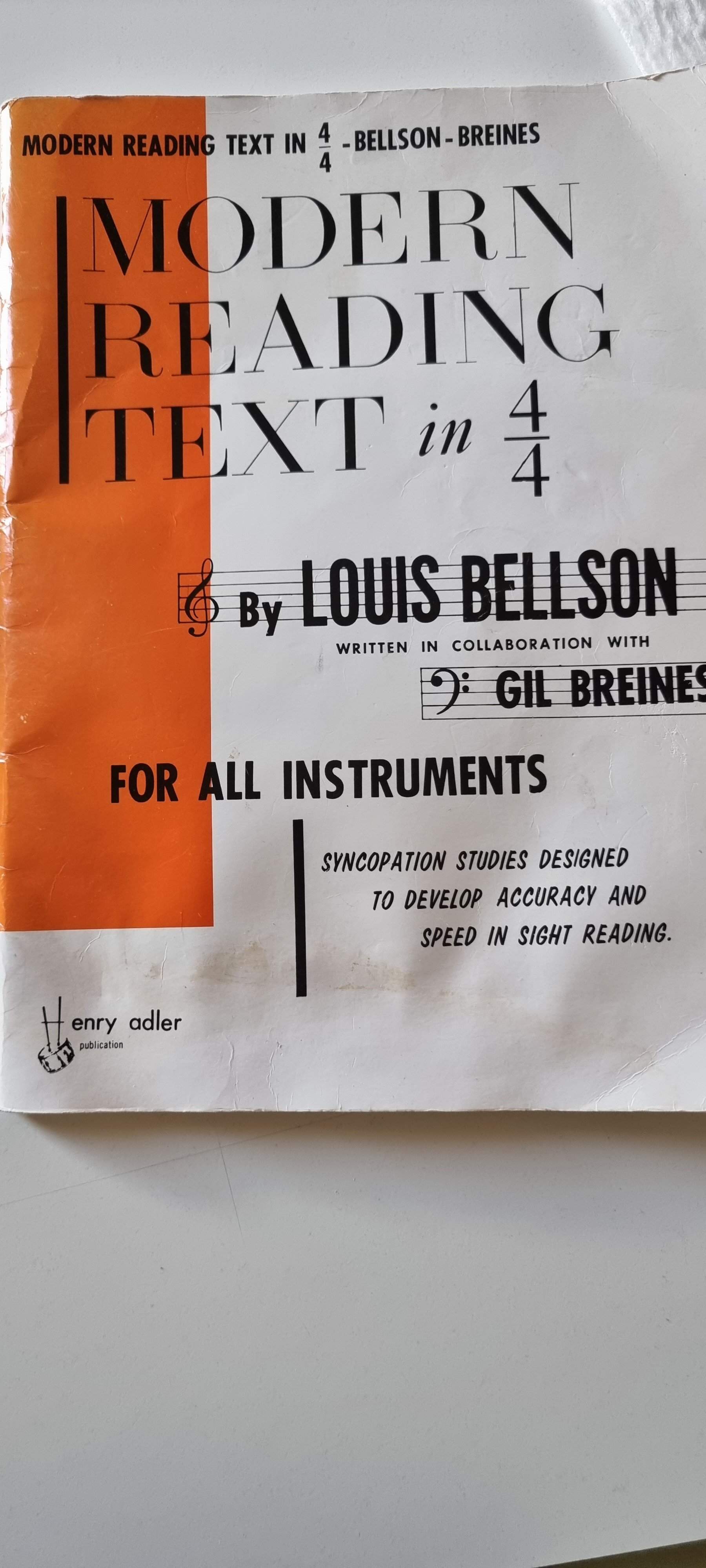
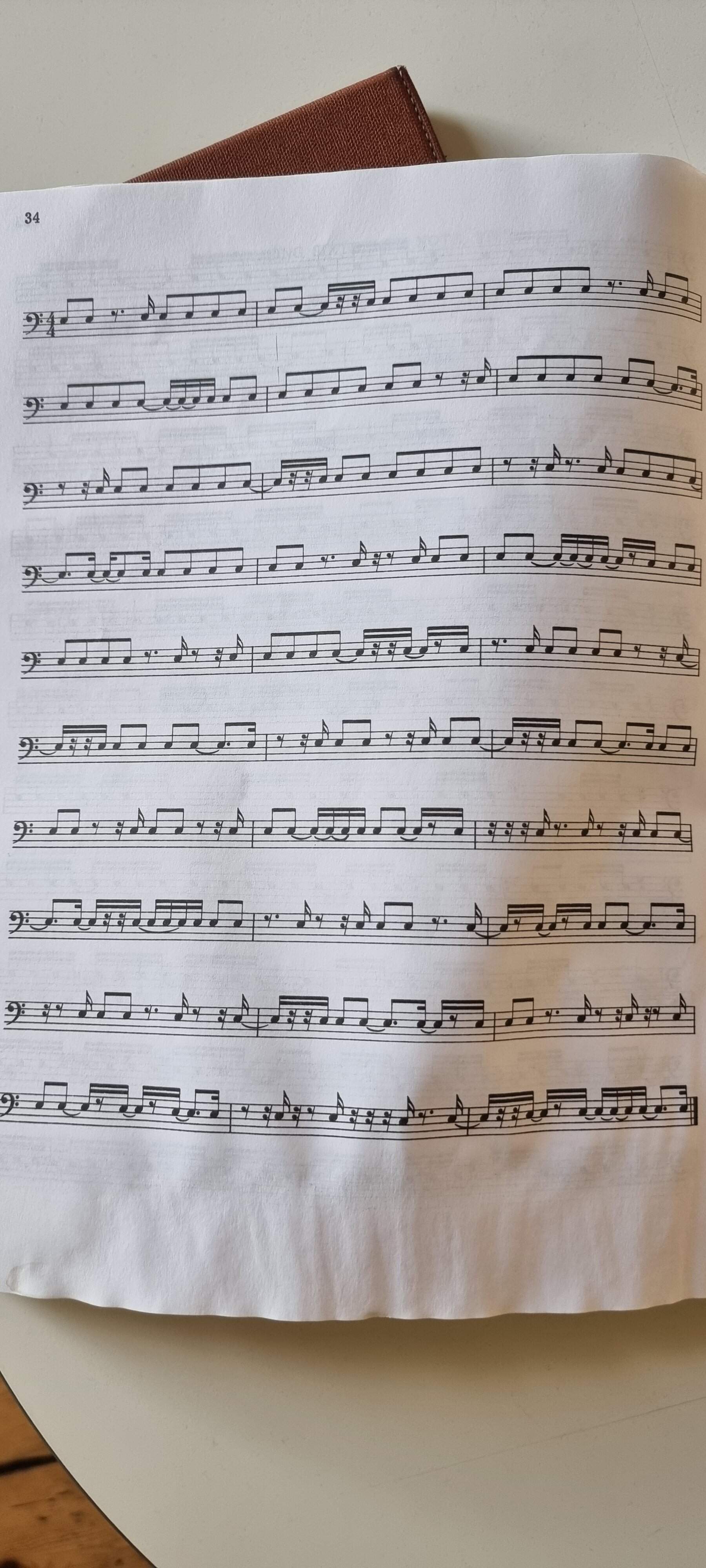
1) Read the rythmn accurately.
2) Read the pitch.
3) Fingering, etc.
Many pros use this book for reading rythmn.
Yeah sure... let's trap the student and confuse him to see if he is worthy enough to see the problem on his own ? nope, I stand my ground: this is not a right pedagogy here.I finally pulled down a bass and played that bar (OP #1). It is true that I lacked the context of hearing the entire composition. The 1-3-4-b5-5 cited in #118 above works. But so does 1-3-4-4-5. It's just that that sharp does not belong there before that D note. Period.
What is being debated here is not @LBS-bass 's reading skills nor her instructor's competence. It is whether an accidental should appear before that D note. Consensus is it does not. But its presence may be intentional, a deliberate flub created by the instructor to see if s/he gets called out on it. Maybe what is being tested, if anything, is LBS's attention to detail.
let's trap the student and confuse him
What is the real pitch for the highlighted note?
Is it Eb or D or Db, or C?
Not sure what the question is here. The "real" pitch is exactly what it says it is: Ebb, enharmonically equivalent to D. But D is not somehow more "real" than Ebb.
EDIT: Ohh, I see what you're asking. Again, Ebb is no less real than D, but as Groove Master notes, in this key there is absolutely no good reason to write Ebb rather than D in that spot.
Last edited:
The student isn't trapped, nor confused. I understand that I said I was confused in the OP, but if you will read that again, the confusion wasn't over what was written there. I can read it perfectly well, as many people confirmed. The question I was asking is not "how does it read?" The question is "why on earth would it be written this way?"Yeah sure... let's trap the student and confuse him to see if he is worthy enough to see the problem on his own ? nope, I stand my ground: this is not a right pedagogy here.
What most people are suggesting (likely thinking this is something I'm playing at a gig) is to just play a chromatic run there because it works, and because there's no good reason for it to be written that way. I hear that, but I'm choosing to play what's on the page because it works, too, and with an instructor you play what's written and then you ask about it (or you ask and then play what they suggest).
I think you and a few others are making way too much fuss over this, as though it's some egregious crime for which the teacher must pay, in the form of me going off to find some stale and stultifying instructor who's going to start me off even easier than this is.
Give me a break, dude. These are notes under blues changes. It doesn't get much simpler, for me, than this. He IS starting me off easy. My goal in taking lessons (shockingly) isn't to learn how to play, nor is it to learn how to read better. If you want to see me play, there's plenty of video out there. I do a lot of it. My goal as a somewhat advanced student is to learn how to find new and more interesting phrases and put them to work in a well-connected way, and my reading is just rusty from disuse. Though I've explained all this to you three times, now, you still don't get it. That shows me that, as a teacher, you're a lousy listener who would not give me a lesson plan that suits my goal. Why would I hire you?
If you have a problem with my goals, or can't even stop to consider that my goals might be different from those of your own students, you're still not selling your skills in "pedagogy" very well.
But again, people here are talking out of a place that doesn't have any information, and even with additional information are too stubborn to admit they are flat out wrong. That's not a pun BTW.
Last edited:
Groove Master
Commercial User
- Apr 22, 2011
- 1,808
- 1,291
- Disclosures
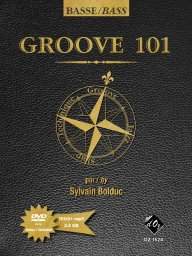
- Author of Groove 101, Slap 101 and Technique 101
Ohh that is a real trap! It should be D even if the writing is by the book. The note functions as a passing note between two chord-tones imo.We should not forget that notation should be used to ease the reading and not confuse the musician
. The enharmonic is sometimes a better way to simplify the reading. Just like the diminished 7th, the enharmonic is usually a better reading option then the double flat especially when we make a chord symbol out of it.
Last edited:
Groove Master
Commercial User
- Apr 22, 2011
- 1,808
- 1,291
- Disclosures
- Author of Groove 101, Slap 101 and Technique 101
Yes I agree. A good sight-reading skill start with a good understanding of the rhythms then the notes.Sight-reading.
1) Read the rythmn accurately.
2) Read the pitch.
3) Fingering, etc.
Many pros use this book for reading rythmn.
View attachment 5125630 View attachment 5125631
The enharmonic is sometimes a better way to simplify the reading. Just like the diminished 7th, the enharmonic is usually a better reading option then the double flat especially when we make a chord symbol out of it.
True. There are times when we write something in a way that's technically incorrect, or at least suboptimal, because we know it will be easier to read. For example, I have a keyboard-playing friend who refuses ever to write an Fb on a chart for guitar players. He says, they've got two E strings on their instruments, why would they want to see an Fb?

Thanks, Mark.Sight-reading.
1) Read the rythmn accurately.
2) Read the pitch.
3) Fingering, etc.
Many pros use this book for reading rythmn.
View attachment 5125630 View attachment 5125631
I believe you or someone else here sent me a PDF copy of this book way back during one of my attempts at brushing up my reading when we were all in lockdown. It might have been a different book. I'll have to dig it up, though I think that reading better will be a side effect of the studying I'll be doing anyway. My reading really isn't horrible once I get moving with it, but - as with all things I do - it could be better!
Yeah sure... let's trap the student and confuse him to see if he is worthy enough to see the problem on his own ? nope, I stand my ground: this is not a right pedagogy here.
Is there a "right" pedagogy for anything? When I was going through public school everything was based on the assumption that all we students were visual learners. We learned through print media: books, magazines, newspapers. Fast forward to the twenty-first century and we now know that that sort of learning does not work for some students. They are aural learners or learn better from videos or some other medium. Wise educators adopt. As long as the student's goal is achieved and need met, the pedagogy is appropriate.
Otherwise we fall into the trap referenced in the Indigo Girls' "Closer to Fine": I spent four years prostrate to the higher mind, got my paper and I was free.
Teachers in all disciplines come in a variety of shapes and sizes. Some - too many - only really know how to regurgitate things in the same formulaic way they've been taught. A few are willing to actually give some thought to a student's abilities and goals, and thoughtfully address those goals.Is there a "right" pedagogy for anything? When I was going through public school everything was based on the assumption that all we students were visual learners. We learned through print media: books, magazines, newspapers. Fast forward to the twenty-first century and we now know that that sort of learning does not work for some students. They are aural learners or learn better from videos or some other medium. Wise educators adopt. As long as the student's goal is achieved and need met, the pedagogy is appropriate.
Otherwise we fall into the trap referenced in the Indigo Girls' "Closer to Fine": I spent four years prostrate to the higher mind, got my paper and I was free.
I started to write a bunch of stuff about various teachers I've known - some I've taken lessons with and some who are friends and former bandmates, and some who have taught others I know, but I think the main point is that not everyone who teaches is right for every student.
- Status
- Not open for further replies.


