Contrabass saxophone in Eb, an octave below a baritone saxophone.
And you thought finding room for an SVT fridge in your car was difficult

Saxophones are transposing instruments, mainly in Bb and Eb. The typical order is soprano in Bb, alto in Eb, tenor in Bb, baritone in Eb, bass in Bb, contrabass in Eb. Each Eb sax is a fourth below the Bb sax above it in pitch, and from one Eb sax to another is an octave, just as from one Bb sax to another is an octave.
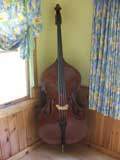
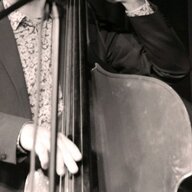
The double bass/string bass/upright bass/bass viol/
contrabass/ugly girlfriend

was originally intended to play the same part as the cello, but an octave below…in other words doubling the cello part. The reason you see string extensions for the E string on some DBs is because a cello’s lowest note is a C. Some DB players will tune C G D A like a cello but down an octave, rather than using an extension. DB is an outlier because unlike the other members of the violin family it’s normally tuned in ascending fourths rather than fifths:
violin G D A E
viola C G D A
tenor violin G D A E
cello C G D A
bass E A D G
octobass E A D G (an octave below DB)
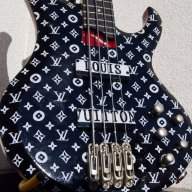
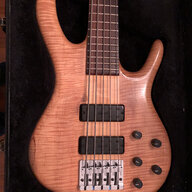
The EADG tuning of course was carried over to the bass guitar.
P.S. Apparently there was a
bass violin that existed in the 16th and 17th centuries prior to the adoption of the cello. It was tuned like a cello but had a larger body.
There are also
acoustic piccolo basses, Ron Carter plays one.
View attachment 7353702