
I accept that they exist, play through them but do try to not spend a lot of time on them.

TalkBass has been independent since 1998. Add your voice.
Create a free account to reply to discussions, view embedded media, and browse with fewer display ads.
Join free Log in
Want zero display ads or expanded classifieds tools? Compare plans.

I've had the same experience.I've used Warmoth steel-bar necks for decades and have consistently had no dead spots with them. Every non- Warmoth bass I've owned or played had dead spots.

Dead spot at 0:31, 0:59 & 2:19:
That’s what I thought too, but on repeated listening it seems like it consistently happens on the same C# and nowhere else. That doesn’t prove anything, but it does suggest it’s something about that note rather than the player.Sounds to me like he missed those notes more than anything. I could be wrong though.
Kinda demonstrates that dead spots aren’t really such a problem.


In my experience fives are just as prone to having dead spots as fours. As a matter of fact, the worst dead spot I ever had was on a graphite-necked five (it was so bad I sent it back to the company for a replacement).My 5 string basses have never had dead spots either.
Nah, definitely can't be the headstock can it?The only way to totally eliminate all dead spots is to saw the headstock off. Fender was playing around with this concept in the mid-70s. Interesting read here:
Fender Headless Bass | Vintage Guitar® magazine
Headless basses can have dead spots as well, unfortunately.What do I do? If the dead spot is severe enough, I will “tune” the headstock.
This is done by increasing or decreasing the mass of the headstock. Increasing mass causes the dead spot to move flat, decreasing mass moves the spot sharp. The trick is to find the correct headstock mass that places the dead spot a semi-tone between two fretted notes where it will have the least effect.
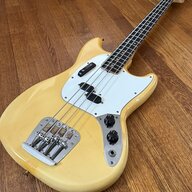
All basses with headstocks have dead spots, they are most prominent on Fenders and FSOs. Leo Fender was well aware of this and would demonstrate by clamping a heavy c-clamp on the headstock, thereby radically increasing mass and moving the spot flat past the nut. The other method is to reduce mass. Easiest way is to reduce the mass of the tuners with resolites or similar moving the spot a semi-tone sharp. This is what I do, and I can usually get the spot to open up. Since Leo was aware of the relationship between headstock mass and dead spot location, we may have a clue to why he designed the ray headstock much smaller and the original 1k much larger.
The only way to totally eliminate all dead spots is to saw the headstock off. Fender was playing around with this concept in the mid-70s. Interesting read here:
Fender Headless Bass | Vintage Guitar® magazine

Hold that note out on a different spot.What are your approaches to dead spots on the neck (7th fret G string and others)? Do you ignore them? Do you change out strings to fix them? Change tuners, bridges, something else? Sell the bass?
And have you found a reliable solution or is is really just hit or miss?
I currently own 6 and a guitar and have owned a number more, and not one has had a dead spot.Headless basses can have dead spots as well, unfortunately.
Well you’re lucky then. A few posts above I mentioned the worst dead spot I ever encountered: that bass was headless. It’s not the only headless bass I’ve played that had dead spots either.I currently own 6 and a guitar and have owned a number more, and not one has had a dead spot.
Possibly yes. It would then be the body mass causing the resonant freq of the neck to be in the fretting range. Then there ain’t much you can do but chamber or add mass somehow.Headless basses can have dead spots as well, unfortunately.



Maybe other: use an always on comp