• TalkBass has been independent since 1998. Add your voice.
    Create a free account to reply to discussions, view embedded media, and browse with fewer display ads.
    Join freeLog in
    Want zero display ads or expanded classifieds tools? Compare plans.

What do you do about dead spots?

What do you do about dead spots?

  • Ignore them

    Votes: 132 53.9%
  • Replace strings

    Votes: 7 2.9%
  • Replace tuners

    Votes: 1 0.4%
  • Replace the bridge

    Votes: 1 0.4%
  • Replace the neck

    Votes: 5 2.0%
  • Move on to a different bass

    Votes: 42 17.1%
  • Other (specify)

    Votes: 35 14.3%
  • All, as needed.

    Votes: 22 9.0%

  • Total voters
    245
OTHER!!!

I work around them depending on the song. If it's jazzy and/or I might be doing some string muting... lean in!

Otherwise, do I want to sustain? Find the note elsewhere. Do I want to let it die or be weird? Let the dead spot do the work.

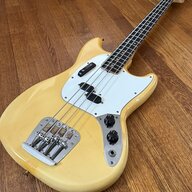
If I really really don't want any dead spots for the gig? Grab my Mustang (or if I had other short scale basses, grab any of them).

Or if I HAVE to have a certain 34" bass, but HAVE to get the dead spot issue treated or at least reduced... grab a Fender Fat Finger and clamp that sucker on in the right place. That's never happened, but I really like recording with a Fat Finger attached to a P bass.
 
Do these dead spots only happen on FSOs? :thumbsdown:

I don't play them, so I'm honestly curious.

In my experience, $2000+ basses made by insanely skilled builders still have a dead spot, if built to 34" scale. It's part of the nature of wood, period, apparently, along with the tension of 34"-range builds.

I've got them on an MGBass Extreman and an Ibanez SR1346B, and had one on both an Ibanez BTB7 and another 6-string J Ferro bass. The latter two were 35" scale, and maybe the dead zones were smaller, but they did not escape the issue.
 
  • Like
Reactions: Mili and KaraQ
In my experience, $2000+ basses made by insanely skilled builders still have a dead spot, if built to 34" scale. It's part of the nature of wood, period, apparently, along with the tension of 34"-range builds.

I've got them on an MGBass Extreman and an Ibanez SR1346B, and had one on both an Ibanez BTB7 and another 6-string J Ferro bass. The latter two were 35" scale, and maybe the dead zones were smaller, but they did not escape the issue.

That's interesting...I'll have to check my Thunderbirds, to see if they have it.
I've not noticed it on either the bolt-ons or neck-throughs, but maybe because of the type of music I play? I rarely use the G-string at all....
 
Dead spots mostly seem to involve resonances in the neck, not the body for a solid instrument. Again, anything that vibrates the body, which is a complex shape, is going to end up as heat. The neck more closely approximates a bar so there is more scope for the whole thing to vibrate and vibrate the string back and you get undamped strings vibrating normally. This is why resting on a wall or a Fat Finger helps as it shifts the resonant frequency. I don't find playing harder helps, though, as the issue is not ever overtone on a string, just some. What I find does work is fretting but not playing a string one octave down as the vibrating neck then vibrates the string at a lower overtone which the pickup can detect. My first bass with a dead spot I noticed was a Fender 'Cowpoke' on the G 7th fret and I wish I'd kept it as leaving the D open was all I needed to do. If you are playing chords, all bets are off.

I wish I could find the paper that showed the upper and lower horns on a P bass vibrating out of phase at some frequencies but it seems to have disappeared. But anyway you're right, every other vibration analysis paper I've read on the subject shows neck resonance out of phase with the note being the cause of dead spots. My Fender PBAC fretless has the classic dead zone at C# on the G string.
 
In my experience, $2000+ basses made by insanely skilled builders still have a dead spot, if built to 34" scale.

I have a Warmoth neck with steel bars in and it still has a dead spot in the traditional location, if a bit less prominent. Making the system as stiff as possible (solid neck joint - I drilled and doweled and retapped) moved the dead spot in the sense that there is one on C on the D string. The harmonic content is different there from the C on G string, so that's probably part of it.

I didn't notice a dead spot on my first bass which was a pointy-headed 1980s Washburn thing. The headstock was quite small.
 
I am very analytical and tend to find the dead spots quickly, when picking up an unfamiliar bass. Have even owned a luthier made five string with dead spots as bad as on any regular Fender. The otherwise praised Squier CV Jazz have them too, very consistently, and to the degree that the G string dead C also had some issue in the third fret A string C as well. Loved the rest of the bass, but a dead spot in the money zone made it useless for me.

Also my Fender American Standard Jazz from 2010 has a (smallish) dead spot on the fifth fret D on the A string. Luckily, when playing with the band, there is enough acoustic impact from my backline to almost completely hide the problem.

And contrary to what many say, these problems are often MORE pronounced when playing with a band. Having much less sustain on a note REALLY shows, as you suddenly disappear completely from the mix.
 
I play softly and use a bit of compression and a lot of volume. Never a problem with dead spots.

Then there's Carole Kaye's solution: deaden all the notes.

upload_2021-7-17_8-46-8.jpeg
 
The funny thing about dead spots is that until you notice them they're not a problem, but once you do they can be difficult to ignore. The basses I had them on made me play those notes more and unintentionally they can become an obsession trying to figure them out. I've used fat fingers, replaced tuners and bridges although I've also caved and replaced the bass, but usually found other things I didn't like to cause that outcome. The first time this happened to me was on a neck diver that I put ultralites on to cure and when I immediately encountered the problem just put the heavy tuners back on and realized that headstock mass was part of the overall operation of the bass and have never forgotten that and am wary of basses with very light headstocks. YMMV Been pretty lucky with that ever since, knock on wood!
 
  • Like
Reactions: JoshS
What do I do? If the dead spot is severe enough, I will “tune” the headstock.

This is done by increasing or decreasing the mass of the headstock. Increasing mass causes the dead spot to move flat, decreasing mass moves the spot sharp. The trick is to find the correct headstock mass that places the dead spot a semi-tone between two fretted notes where it will have the least effect.

All basses with headstocks have dead spots, they are most prominent on Fenders and FSOs. Leo Fender was well aware of this and would demonstrate by clamping a heavy c-clamp on the headstock, thereby radically increasing mass and moving the spot flat past the nut. The other method is to reduce mass. Easiest way is to reduce the mass of the tuners with resolites or similar moving the spot a semi-tone sharp. This is what I do, and I can usually get the spot to open up. Since Leo was aware of the relationship between headstock mass and dead spot location, we may have a clue to why he designed the ray headstock much smaller and the original 1k much larger.

The only way to totally eliminate all dead spots is to saw the headstock off. Fender was playing around with this concept in the mid-70s. Interesting read here:
Fender Headless Bass | Vintage Guitar® magazine