• TalkBass has been independent since 1998. Add your voice.
    Create a free account to reply to discussions, view embedded media, and browse with fewer display ads.
    Join freeLog in
    Want zero display ads or expanded classifieds tools? Compare plans.

What do you do about dead spots?

What do you do about dead spots?

  • Ignore them

    Votes: 132 53.9%
  • Replace strings

    Votes: 7 2.9%
  • Replace tuners

    Votes: 1 0.4%
  • Replace the bridge

    Votes: 1 0.4%
  • Replace the neck

    Votes: 5 2.0%
  • Move on to a different bass

    Votes: 42 17.1%
  • Other (specify)

    Votes: 35 14.3%
  • All, as needed.

    Votes: 22 9.0%

  • Total voters
    245
My old
What are your approaches to dead spots on the neck (7th fret G string and others)? Do you ignore them? Do you change out strings to fix them? Change tuners, bridges, something else? Sell the bass?

And have you found a reliable solution or is is really just hit or miss?
1961 J Bass had a dead spot on fret 4,5 & 6 on the G string, never could fix it with strings so I replaced it with a 1965 Gibson EB3, never had a dead spot since then
 
  • Like
Reactions: KaraQ
I own and have owned many Fender and Fender styled basses all have the dead spot
Ash body Graphite stiffeners doesn't matter you live with it it's no big deal .
I have also had boutique basses that didn't .
Every note on my Steinberger L-2 was great wish I still had it but moved on and back to Fender .
Check out the neck when you are buying the bass if you want a bass without dead spots don't buy one that has them .
 
When I've encountered the issue it has usually been some hardware not making best contact or the setup is out of whack. Unfortunately you won't know the true problem until you try. I've encountered several bolt-on necks with crap neck shims including sandpaper and wood fragments, , , other residual materials, or just some high spots in the mating surfaces. Even loose screws.. After removing the shim and/or addressing other neck joint issues and redoing set up the resonance improved greatly. Loose bridge parts and tuning pegs can also contribute.
 
  • Like
Reactions: CletusMarley
With the couple of Fender basses I own that have significant dead spots (which are in the 4th to 6th fret region and mostly noticeable on the G string), I actually embrace that characteristic. If I don't want it I'll use other basses that don't have any.

More problematic for me are hot spots, especially when recording. My '62 P-bass has a serious hot spot around the C on the E string which is very hard to tame.
 
I do not consider "dead spots" a pressing issue I ever think about playing any of my basses. Anytime I see a thread related to this, whatever bass I am playing at that time I check to see if this is something I need to be concerned about.

short answer - nope

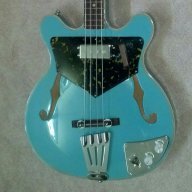
This one, (Coral Deluxe Bass - a Dano product) from 1968 has no truss-rod and two steel beams the length of the 34"scale neck. Absolutely no 'dead spots'.

upload_2021-7-21_22-17-8.jpeg
 
What are your approaches to dead spots on the neck (7th fret G string and others)? Do you ignore them? Do you change out strings to fix them? Change tuners, bridges, something else? Sell the bass?

And have you found a reliable solution or is is really just hit or miss?
My Stingray had awful dead spots for thirty years. Then I switched from Roundwounds to flats and the dead spots disappeared.
 
Dead spots are dependent on the design, materials, hardware and setup of each individual instrument, so there really is no one correct answer to your question. Dead spots tend to be caused by the sympathetic resonance of the instrument body and neck ending up out of phase with the string, which dampens sustain. Exactly where that happens depends on the instrument's sympathetic resonant frequencies, and that is dependent on the exact densities of the body and neck woods, as well as the dimensions of the neck and body. So, changing literally any of the major variables will change the behavior. The next question is, how, and how much, will a certain fix change the behavior? Again, because the issue is related to the interactions of specific pieces of wood and metal, it's difficult to say.

The ultimate answer is that if there's something else about the instrument that you want to change anyway, like a beefier bridge for more sustain overall, it certainly can't hurt to try, and in the bargain you might lessen the severity of the dead spot, or move it away from notes you commonly play. If you like everything about how the bass feels and responds except for the dead spot, be aware that any change you make can change feel, and if you don't want any change, the options are to live with it or look for a different instrument that feels as good without the downside.

I completely agree with you. I have a MiM Geddy Lee Jazz that had a dead spot on the third fret of the E string. Drove me crazy trying to figure out what was going on. I changed the strings, nothing. I removed the drop D tuner and put the old one back on, zippo. Adjusted the truss rod, tweaked the intonation, loosened and tightened the screws holding the neck to the body while under string tension (to pull the neck into the body), twiddled with the pickups... All with no change.

And then I added a Snark tuner to the head stock and it went away. Removed the tuner and the dead spot was back. Put a spring loaded capo on the head stock, no dead spot. Removed it, the dead spot returned.

At first I bought some small, round neodymium magnets and stuck them to the tuner plates on the back of the head stock. That worked until I got the tuners too close to a mike during a gig. >CLUNK!< as the magnets grabbed the mike and held tight. Not fun. I made sure that the end of the bass stayed away from the mikes the rest of the night.

I ended up ordering some "tungsten cub car weights" from Amazon, drilling holes to fit them under the tuners on the back side of the head stock and glued them in place. FYI, tungsten is heavier by volume than lead, but it'll work in a pinch. It worked like a charm, no one can see it unless they remove the tuners and best off all, no magnetic head stock.

The two pictures are 1) the first solution - neodymium magnets, 2) installed tungsten weights.

JazzDeadSpotSolution.jpg
JazzDeadSpotSolution02.jpg
 
What are your approaches to dead spots on the neck (7th fret G string and others)? Do you ignore them? Do you change out strings to fix them? Change tuners, bridges, something else? Sell the bass?

And have you found a reliable solution or is is really just hit or miss?

Well, I was reading about them and I was thinking it was a myth ;) Never really noticed anything while playing ... So when I saw this thread I finally decided to explore my Jazz and I noticed that C and especially C# decay faster on the G string. In a band situation/song context nothing really to worry about.

Well, if it bugs you - here is my tip:

Just fret at the same the lower octave C# (on the A string) and then pluck the high C# only. Then it rings way longer ...
 
Last edited:
  • Like
Reactions: Bartrinsic
I see people on this forum talking about "dead spots" all the time, but I honestly don't even really know what y'all mean by it. I've been playing guitar and bass for about 23 years, and I'm a guitar tech for a living - and I still don't know *** you are all on about.

Are you talking about notes fretting out/choking out? This can basically only be caused by one thing (provided that the setup is otherwise good) - a high fret. The solution is to file the fret down so that it isn't high anymore. I can't think of another thing that could be called a "dead spot."
I’ve been playing since 1982, and definitely know what a dead spot is. I’m surprised you don’t tbh. No, it’s not a high fret situation. There’s one fretted note, somewhere between the 6th-9th fret on the G string, and when you play that one note, the fundamental harmonic and several others lack sustain, they decay very quickly. It feels like it’s going “plunk” instead of singing like everywhere else.
 
What are your approaches to dead spots on the neck (7th fret G string and others)? Do you ignore them? Do you change out strings to fix them? Change tuners, bridges, something else? Sell the bass?

And have you found a reliable solution or is is really just hit or miss?
With two Jazz basses, one had a little bit of deadspotitis, the other more pronounced. I replaced the necks with Warmoth roasted maple necks, graphite stiffeners along with Tusq nuts, stainless frets and square block inlays. I doubt very much if the inlays played a part in the dead spots, though. Results were and are stellar, these basses are a joy to play!
 
I’ve been playing since 1982, and definitely know what a dead spot is. I’m surprised you don’t tbh. No, it’s not a high fret situation. There’s one fretted note, somewhere between the 6th-9th fret on the G string, and when you play that one note, the fundamental harmonic and several others lack sustain, they decay very quickly. It feels like it’s going “plunk” instead of singing like everywhere else.
Never come across it. I think it's probably one of those things that old dudes on the internet spend too much time obsessing over instead of actually playing.