• TalkBass has been independent since 1998. Add your voice.
    Create a free account to reply to discussions, view embedded media, and browse with fewer display ads.
    Join freeLog in
    Want zero display ads or expanded classifieds tools? Compare plans.

What do you studio guys think of this idea?

no engineer will want to f with that

I've seen studio guitars with 4 pickups and 4 outs so they could claim and bill 4 tracks and the player could get paid for playing 4 instruments.

The engineer is going to stfu and do what the producer tells him to do. Especially if it cuts down on time and his share hits his pocket.
 
I am in the process of building nearly the exact bass the OP describes. Running it through combinations of filters and processing located in racks and panels, much of which is DIY. The bass is being routed with a universal pickup cavity to accomodate any number of pickup combinations. Control cavity is rear routed and front routed. The front hole to be covered with simple 2" wide aluminum plates that can be replaced with another 2" plate in the event the one on the bass get's drilled witth too many holes from making changes. The plan being to run the pickups straight out and hitting processing gear outboard. My foot will do all of the pickup mixing with a sweep pedal connected to panning/fading modules. The EQing is done through modular synth filters that have variable states ... (LPF, HPF, BPF, Notch).

The body has been ordered through Warmoth. A solid maple "G4" shape with a "bathtub" pickup route and double batt boxes in the event I end up using active pickups.

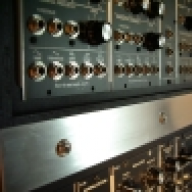
I've posted these pics a lot, but for those that haven't been exposed to them yet, here's SOME of the filter array. I have seven more modules enroute as I write this. Using Baer ML112 and a Mackie 1400i for monitoring. The Baer is here now, the Mackie is paid for ($220 shipped) but not here yet.

Nearlyloadedcab-1.jpg


Cab1perspective-1.jpg


Here's the super-fresh Baer ML112 bass cab.

IMGP5190.jpg


I'll be doing different signal routings. Sometimes going in stereo, other times in stereo-mixed-to-mono, other times both pickups mixed to mono and processed in mono. In any case, I can use my foot to mix the pickups with a sweeping "gas pedal" modulator. I also have gas pedals to change filter freq, filter resonance, pan position, all per-pickup.

I also have four tube mic-pres, and several DIY overdrives that may be inserted at any points in the signal chain. Going with modular synth gear opens up the entire signal chain to you in ways your brain hasn't thought of yet. Two filters can be parallel while the last one can be in series. All four filter can be in series. All four filters can be in parallel with overdrives applied to each one in differing amounts. So you can distort (let's say) just the upper mids while the low end remains totally clean. Whatever. If you can ~think it~ you can probably ~do it~. Noise? Nope ... this is pro-level synth gear. If output impedance becomes an issue just stick a DI at the end of the chain. The entire system is surgically sliced wide open.

The synth cabs are purpose built by a fella in Canada. $122 shipped to Arizona. However these synth modules can also be rack mounted if an adaptor is used. Here's what I used for the modules before I got the synth cabs made. It's a 12u rack that I made simple rack adaptors for out of 1/2" x 1.5" oak trim stock I had left over from another project.

12uracktemporaryinstallation-1.jpg


I'm going full rack mount using a Gig Rig that I have been tripping over for ten years. The modules will face ~up~ at me being mounted where a mixer board would normally go. The Mackie will sit in the lower rack portion along with Furman power conditioner and a few other niceties. The Gig Rig is castered so it rolls very nicely, it'll make this setup uber-convenient. The covers fit over the synth modules without having to remove any patchcords.

I'll have more modules and the two rack adaptors this week. More pics soon. I plan on doing a full-on info thread that will include audio demos very very soon.

This rig was less costly than buying a 4x12 and an SVT by the way.
 
I like the use of my volume and tone controls along with the eq on my amp. For anyone that gigs, having a "one trick pony" for a bass is just a waste.
But I thought the OP's idea was to construct a recording only bass?

Besides it seems they are both the same idea ... you said "along with the EQ on my amp". Does it make any difference if the EQ knobs are located on an amp head or in a rack of EQs/filters?

The OP's bass could be run to a submixer that's within reach of the player. Now the player has a "monitor mix" and the guy at the deck has the "straight out" sound. Total control over what the player hears, total control over what the deck receives. It's as "best of both worlds" as can be done.

It's essentially what's done on many (most?) recordings these days anyhow. There's a dry track, a mic'd track, and sometimes a track taken from a tap-point somewhere along the signal chain before it hits the monitoring system/bass amp. Two tracks (sometimes three) all mixed to suit.

It's the same thing, only difference being a different set of signal routers and effectors. Once it leaves the pickups the OP's idea is makes fair game of the signal. Route the unmolested signal where ever you please.

Seems to me that type of bass is anything BUT a one trick pony. It becomes an ANY trick pony.
 
What about Lee Sklar's bass that had a "producer" switch on it? The switch literally did NOTHING, but a flip of the switch produced a sound that made the producer happy. Point being that unless a bassist has a very distinct sound (which of course does not apply to studio musicians anyway) most producers and engineers want tried and true. Give them a good sounding bass, the types of strings they want, recorded direct or direct and a miked amp or the pre-out from an amp and they will get the sound they want in the mix.
 
I don't know if you've ever seen one of my Scroll Basses, but they have a feature similar to what's being described here. I introduced it on my Series III models in 2001.

There are three output jacks. One is the "normal" output, which uses the typical Volume, Tone and Blend controls in a passive circuit. That's the jack you plug in to for most normal playing and recording, giving you control on board the bass.

The other two output jacks are "hotwired" right to the two pickups. When you plug in to them, the pickups are disconnected from the main circuit and hooked directly to these jacks. There's no treble bleed-off loss from the pots.

So, in the studio, if you want to, you can plug two cords into these two extra jacks and run them into two separate channels in the console. That way, you can record the track in one take, and have the sounds of the two pickups recorded isolated from each other, but accurately synched together. During mixdown, you can adjust the blend and EQ of each pickup sound as you please.

It's not something that my customers use all the time, but they like it and find it useful in some recording situations. It's more useful with an instrument like my Scroll Bass, where there's a dramatic difference in sound between the two pickups.

A wiring harness like this wouldn't be complicated to add to a bass, and it could still be used in "normal" form too. I doubt that I'm the only builder who's putting this feature in my basses.