• TalkBass has been independent since 1998. Add your voice.
    Create a free account to reply to discussions, view embedded media, and browse with fewer display ads.
    Join freeLog in
    Want zero display ads or expanded classifieds tools? Compare plans.

What do you use for a back up?

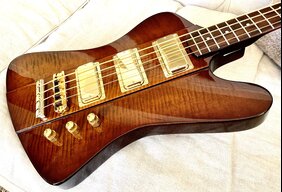
I have a Deluxe Jaguar and used to use my Jazz as a backup. Now I have the Troy Sanders Jaguar and take the two Jags with me, and play some songs with both. They sound similar, but the P-pickup on the Sanders works better for some stuff.
I'm thinking on converting my Jazz to fretless to have some extra options. So I could say I like to have some variations in my sound, but also that a bass could do the job of the other if one flops.
Do not be afraid to go crazy with your backup if it sounds good to you and gets you though the gig.

Just one thing! Once you start buying "backups" it becomes hard to stop :help:
 
Yep - identical....

Same strings and setup.

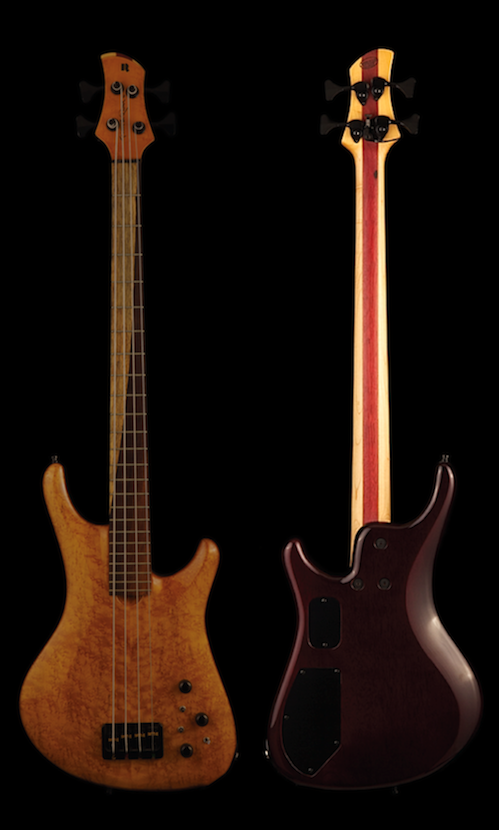
Back up this Roscoe:

Roscoe-1-side%20by%20side.png


with this Roscoe:

Roscoe-2-side%20by%20side.png


BassHappy
www.innertainment.net
 
Just take a bass you can respect, whatever you perceive that to be.

I take two basses to every important gig, usually a Jazz and a P, but not always. My backup bass is always every bit as nice and as competent the main player and often gets played instead.
 
For casual sets like open mic nights, I just bring one. For gigs with little to no security concerns, I'll bring two of my main players, usually a J-bass and my SB-2. If I need a true backup, it's an MIM Jazz I bought used, which I modded with a Gotoh bridge and U.S. Fender pickups, and sounds fantastic. For really sketchy venues (actually haven't played one in awhile), I'd just use the MIM Jazz.

I'm now playing in a musical that requires a five, and think a backup is important because I can't just stop the show to, say, replace a broken string. I'm using a G&L M-2500, for which the "backup" is a Fender Jazz V. But those are really alternatives, and I think a G&L dual MFD bass and a Fender J make an excellent combo. The J has Barden rails humbuckers, so it sounds closer to the M-2500 than does a J with stock single coils. I could swap between them fairly easily.
 
Usually a second Jazz, but in reality, it can be almost anything from my herd.

Even though I always carry extra batteries and change them out at fixed intervals, I tend to select a passive bass for my back-up instrument. I guess the rationale there is that in a potential moment of crisis, superfluous circuitry is not what I want to be worrying about.

“When you believe in things you don’t understand
Then you suffer
Superstition ain’t the way.”

— Stevie Wonder (1972)
 
I've never needed a backup live due to a bass failing during a show - odds of even breaking a string are pretty low. With that said, my reason for having a second bass at a gig is I like having one strung with flats and another with rounds. Both P-Basses set up to the same specs.

If I simply don't feel like carrying two basses, I never worry about just taking one - I just keep an extra cable and a set of strings in the case.

However, if you need to justify owning another bass to your significant other, then by all means, you absolutely need a backup :)
 
Do you bring two similar basses to shows or have some variety on deck?

Honestly, I don't think it matters. I can get an appropriate tone from any of my basses, which range from P-style to J-style to MM-style to none of the above.

What matters more are strings. I keep flats on one of my basses for use with my R&B band, and would never use that for my hard rock band (apologies to Steve Harris, but it's not my thing).
 
P.S. Bringing backup is the professional thing to do, props to you! In 30+ years I've only had a handful of failures, but because of backup, I never forced the band to halt the show while I dealt with a broken string... it's quick and easy to switch to backup.

And in those years I've had two failures that were neither preventable nor field-repairable: without backup I would have been out of action -- and so would the band. Backup saved the day both times.
 
If you gig regularly (or aspire to), my vote is to make sure that you would be reasonably comfortable playing anything on your backup bass that you would usually play on your main bass. After that baseline is established, the important question is whether you feel that you personally would benefit more from (1) the peace of mind of having a bass as close as possible to the main bass; or (2) variety/"something different."

For example, I gigged for a long time with my main Carvin LB70 (fretted 4-string active jazz bass) with a Carvin AC-40F as a backup (unlined fretless semi-acoustic 4-string). The AC-40F was a nice change of pace, but if the LB-70 had gone down I would not have felt very confident playing an hour's worth of original metal on an unlined fretless while singing backup vocals. So I ended up switching the backup to a Carvin B4, which is a fretted active 4-string jazz like the LB-70. That worked much better, because it was similar enough to make the switch easy but different enough to give a different vibe when needed (bolt-on instead of neck-though, 22 frets instead of 24, different wood combination, different pickups, usually different strings). The choice paid off at least twice -- once a few years ago with the active module on the LB-70 blew out, and once last year when I refinished the LB-70 -- as it was no problem to gig with the B4 while the LB70 was out of commission.
 
Since I travel to most of my gigs on the subway, I tend to bring one bass and forego a backup. I do have a double gig bag, so I could bring a second bass, but my lower back prefers it when I don't. It's maybe not the most responsible path, but it hasn't bitten me in the butt.... yet.

What I do bring is a backup head. I throw a micro in my gig bag for most shows since I never know how well I can trust the house backline in NYC bars.
 
A backup bass is always a good idea, not a necessity but a smart thing to do. If you bring a backup bass your soundman will love you if its similar in output levels and tone to your main bass otherwise he may need to fiddle with the house settings each time you switch basses. Not a big issue unless you bring two very different basses to the gig.

You said your main bass is a G&L 2500. I had one of those and found the pickups to be very hot when not in passive mode. So look for a backup that has a good strong output. Things that come to mind are another G&L, a Spector, or a Fender or Squier Precision.

As one of the earlier posters noted, a "backup" bass should be similar to the main bass, its purpose is to literally take the place of the main bass in the event of a failure. Don't confuse that with a "second" bass which is brought to be used on specific songs that may require a different sound not easily obtained with the main bass (i.e. frettless or acoustic...). Depending on your set list and skill level you may be able to use a second bass as a backup bass, many do.
 
First, I agree that having a backup is the professional thing to do. Just because the odds are small that a bass can fail on stage does not mean that it won't happen. I now have four bass guitars in the stable. 1) Kawai F2b. active; 2) '72 fretless P; 3) Brand new Carvin PB5 with active/passive switch; 4) Brand new Fender '50s Lacquer P MIM.

I used the first two for years because I also play URB and was using that for jazz gigs/weddings/functions - I always brought the fretless P as backup. Now, I'm in a classic rock cover band, and needed to up grade the bass guitar stable cuz the Kawai has really noisey electronics and I never really liked the sound. The fretless P (with flats) is just not a good rock 'n roll bass - doesn't cut through the mix.

My solution was to purchase the PB5 (with Carvin rounds) with active/passive switch - passive works even if active fails. The MIM P is backup if a string breaks for a quick change. A professional musician, IMHO, is ready for any emergency.