• TalkBass has been independent since 1998. Add your voice.
    Create a free account to reply to discussions, view embedded media, and browse with fewer display ads.
    Join freeLog in
    Want zero display ads or expanded classifieds tools? Compare plans.

Double Bass What is big band /really/ about?

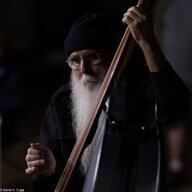
In this case he's obviously well enough away from anything that will get picked up by his mic. He's behind the piano, so I think that's intentional.

Agreed and the bass sounds nice in the video.

I have experimented with mics run into an amp and they have never provided enough isolation or sufficient gain before feedback. I tend to run a larger amp fairly loud, rather than using a little GK MB150 like a lot of the jazz greats.

A buddy of mine bought an AMT mic and it sounded fabulous solo. For big band work he blended it with a contact pickup using a Solstice preamp. I don't remember which pickup he used at the time as he tried several over the years. He would dial down the highs a bit to try and compensate for hash from the cymbals. To me this compromised his tone and just made the cymbal sound in his signal sound unnatural. Eventually he sold the AMT.

A year or so later he bought an Ehrlund EAP. This pickup gets closer to the sound of the instrument than any contact pickup I have ever heard, and it is very close to the quality of a mic. He used a stethoscope to find the best placement. From the what I understand, the Ehrlund is great if you have nice sounding bass, but don't put it on crappy instrument because it will faithfully reproduce the tone.
 
  • Like
Reactions: Fredrik E. Nilsen
This mic won't pickup very much else, I think.

View attachment 3556427

If you were to place the bass next to a drum set and then solo it into headphones, I think you would be surprised. Your not going to get a mic much closer to the bass's body though, so that's probably about as good as it gets.

I too noticed the bass player was standing over behind piano and think this is not a coincidence.
 
  • Like
Reactions: Fredrik E. Nilsen
Does anyone here use this sort of thing anymore?

People still recommend this technique. I tried it years ago, but it didn't work for me, as I rely too much on the amp. I preferred the results I was able to get with contact pickups and EQ.

It may work for you as long as you don't use much amp, so don't let me discourage you from experimenting. I do think distance and isolation from the drums will be important. The problem is the string bass is very quiet instrument in comparison to a drumset. The mic will pick up whatever sound source is loudest. Additionally the cymbals may produce sort of a flanging effect because the mic picks of the direct sound and also reflected sound off the body of the bass.

I have played in many bands that used drum shields. Perhaps mic'ing the bass would be more effective if a drum shield was placed around the the bass. Unfortunately they are expensive and heavy.

FYI, the bass itself will essentially act like a big microphone with a contact mic. When I was running audio, I once soloed up the string bass in my headphones to hear what was being discussed on stage.
 
Onstage with bluegrass it is still pretty common to find a standard mic in a sock under the DB tailpiece. I actually carry a mic and a wind muff and a sock for this purpose or to use as a double bass stand-mic, but haven't needed to use it yet because my pickups work pretty well.

The standard mic in a sock under the tailpiece is pretty effective at moderate volume, and for an FOH system, it's just another mic to EQ and balance. But, due to their primarily acoustic nature, bluegrass bands are typically small (3 to 5 players) and if they're good, they also usually will dynamically balance themselves for volume, meaning the sound team can usually just sit back and monitor.

As the instrumentalist head count goes up though, this becomes exponentially more complicated. I'm still having trouble understanding how good Big Bands and their leaders can accomplish this; there are just so many variables involved, their volume control is pretty amazing.
 
Last edited:
Onstage with bluegrass it is still pretty common to find a standard mic in a sock under the DB tailpiece. I actually carry a mic and a wind muff and a sock for this purpose or to use as a double bass stand-mic, but haven't needed to use it yet because my pickups work pretty well.

The standard mic in a sock under the tailpiece is pretty effective at moderate volume, and for an FOH system, it's just another mic to EQ and balance. But, due to their primarily acoustic nature, bluegrass bands are typically small (3 to 5 players) and if they're good, they also usually will dynamically balance themselves for volume, meaning the sound team can usually just sit back and monitor.

As the instrumentalist head count goes up though, this becomes exponentially more complicated. I'm still having trouble understanding how good Big Bands and their leaders can accomplish this; there are just so many variables involved, their volume control is pretty amazing.

Of course the other instruments in a bluegrass group tend to be low volume like a string bass. Bluegrass groups also use a technique where all musicians gather around a single mic, and take a step forward when you solo.
 
  • Like
Reactions: Fredrik E. Nilsen
Bluegrass groups also use a technique where all musicians gather around a single mic, and take a step forward when you solo.

Maybe it's a local thing, but I'm seeing less and less of single mic performances at festivals. The popular sound teams out here in the west still will support single mic if a band provides a sufficient mic to use for it, but they're really setup to provide and control multiple mics, individually supporting all instruments and all vocalists, and that's how most of the majority of bands in bluegrass festivals out here, including mine, tend to perform. In the midwest and the east, that may be different.

And, while they are lower volume than many band instruments, banjos, fiddles, mandolins, Dobros and guitars cover a higher, more penetrating frequency range than double bass. Some of them, especially banjo and fiddle, can nearly overplay the double bass by themselves, and of course the rest of the band together can. If a bluegrass band wants their acoustic double bass to be heard, they have to control their volume.
 
Maybe it's a local thing, but I'm seeing less and less of single mic performances at festivals. The popular sound teams out here in the west still will support single mic if a band provides a sufficient mic to use for it, but they're really setup to provide and control multiple mics, individually supporting all instruments and all vocalists, and that's how most of the majority of bands in bluegrass festivals out here, including mine, tend to perform. In the midwest and the east, that may be different.

And, while they are lower volume than many band instruments, banjos, fiddles, mandolins, Dobros and guitars cover a higher, more penetrating frequency range than double bass. Some of them, especially banjo and fiddle, can nearly overplay the double bass by themselves, and of course the rest of the band together can. If a bluegrass band wants their acoustic double bass to be heard, they have to control their volume.
We don't have too many bluegrass bands over here in Norway, but the single mic is the thing when we play it.
 
We don't have too many bluegrass bands over here in Norway, but the single mic is the thing when we play it.
We had our monthly bluegrass happening this evening. Basically just a bunch of people showing up at some bar and playing together for a few hours. Lot's of players tonight. At the most two fiddles, three guitars, three mandolins, two banjos, one lapsteel and two basses. All acoustic. Quite fun!

[Invalid or Expired Link Removed]
 
That's neat. The sound, the friendliness and the venue all feel like home. This is very nice to see for someone like me who hasn't traveled far -- yet. Thank you for sharing it!
Thank you, and nice to hear! It's a style that has no tradition over here of course, but there has been a couple of band that have played it and mixed it with other styles. In the later years, a lot of younger musicians have started to play it, and in a more traditional way. Great to hear young musicians taking it up, and doing it serious and well.
 
  • Like
Reactions: Don Hergert
Onstage with bluegrass it is still pretty common to find a standard mic in a sock under the DB tailpiece. I actually carry a mic and a wind muff and a sock for this purpose or to use as a double bass stand-mic, but haven't needed to use it yet because my pickups work pretty well.

The standard mic in a sock under the tailpiece is pretty effective at moderate volume, and for an FOH system, it's just another mic to EQ and balance. But, due to their primarily acoustic nature, bluegrass bands are typically small (3 to 5 players) and if they're good, they also usually will dynamically balance themselves for volume, meaning the sound team can usually just sit back and monitor.

As the instrumentalist head count goes up though, this becomes exponentially more complicated. I'm still having trouble understanding how good Big Bands and their leaders can accomplish this; there are just so many variables involved, their volume control is pretty amazing.

I've just started doing this in jazz with quieter groups. It works when the stage volume is under control. I wrap a mic in a black t-shirt and wedge it in tailpiece. Right now i am doing it with an SM58(only mic i own) into a powered Alto PA speaker.
 
[Invalid or Expired Link Removed]
Blått gress! You go!

I've played a lot of big-band over the years and am lucky to play with a good one, with our own book. That last part really matters.

My love is jazz combo music. I'd be missing out if all I played was big-bands. I turn down calls for the Tuxedo Junction Book on bass.

But there is no sound like seventeen players hitting together with all cylinders firing. I love it when people stop what they were into, turn around and grin when we start.

 
Blått gress! You go!

I've played a lot of big-band over the years and am lucky to play with a good one, with our own book. That last part really matters.

My love is jazz combo music. I'd be missing out if all I played was big-bands. I turn down calls for the Tuxedo Junction Book on bass.

But there is no sound like seventeen players hitting together with all cylinders firing. I love it when people stop what they were into, turn around and grin when we start.
I must admit I prefer big bands to combos (when it comes to playing, not logistics!). I write (almost) all the arrangements, that's probably one of the reasons. And yes, the sound of a big band is really something else.