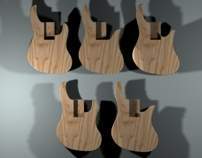
mock:
what you should be questioning is the method of equal temperment rather than note count convenience.
the notes we currently use derive from the harmonic overtone series...its physics, its the way we hear.
equal temperment is a compromise.
The first observation that can be made about the overtone series is that its lower elements together form a MAJOR seventh chord, lending weight to the words of taxonomic distinction "major" and "minor". A major chord is somehow more natural in the context of simple vibrating things.
If we tune the C major scale according to the overtones of C, using also the overtones of the F (a perfect fifth below) and G (a perfect fifth above).
C = (1) C
D = (9/8) C
E = (5/4) C
F = (4/3) C
G = (3/2) C
A = (5/3) C
B = (15/8) C
C' = (2) C
This defines the relations between the frequencies of a justly tempered major scale; C major when the frequency of C is inserted into the formulas. This pattern of ratios is extensible in both directions to tune all the white keys of the piano.
Keyboard and tuning to C, we are also ok for the harmonically closest keys of G major (with only F#) and F major (with only Bb). The next Generate from F and from G F F' C' F'' A'' C'' Eb'' From this we get the ratios for A and F given above 1 2 3 4 5 6 7 G G' D' G'' B'' D'' F''
The just tempering scheme ulimately based on the perfect fifth runs into problems in constructing a circle of fifths because the circle does not close. The gap or discrepancy in frequency that appears at 12 consecutive fifths and 7 octaves down is known as the Pythagorean Comma.
The various schemes to reconcile the Pythagorean Comma, that is to close the circle of fifths are called cyclic temperaments. Well or equal tempering is one of them. There have been other schemes to divide the octave not only into 12 parts but also into 5, 14, 16, 19, 31 and 53 parts. These are all cyclic temperaments. The ancient Greek tuning was not cyclic and is one of the linear termperaments. Various linear temperaments have been used, throughout musical history under circumstances where the music was not essentially harmonic but linear; hence there was no need to define intervals of relative consonance and dissonance. [Helmholtz 1877] , appendix XX.
There is a mathematical story to tell associated with this construction of overtone series that centers around a very important theorem of Fourier. Cast into the current context the theorem says that any vibration that the string is capable of can be expressed by a suitable addition of the fundamental modes each with some weighting coefficient. The actual mathematical theorem takes into account that the vibrational modes can be given in terms of sinusoidal functions (sine and cosine) of trigonometry. Even among mathematicians, Fourier's theory is also called "Harmonic Analysis".
What is so bad, harmonically speaking if we approximate musical notes with an equal temperament?
It is clear that each string of a piano will have its set of overtones whose fequencies are determined by simple ratios of whole numbers. To get the G above C as above, multiply the frequency of C by (3/2)-1.500. The equal tempered G that is now there would use a factor of 1.498. So now the the equal tempered G and its overtones will beat with those of the C, where this would be minimized if the G were tuned using the 1.5 factor. Beats happen when two tones are played together that are just slightly different in frequency. The double angle formula from trigonometry is:
sin( A + B ) = sin( A ) cos( B ) + cos( A ) sin( B )
and then also
sin( A - B ) = sin( A ) cos( B ) - cos( A ) sin( B )
Adding these two formulas gives
sin( A + B ) + sin( A - B ) = 2 sin( A ) cos( B )
Change variables by letting
u = A + B, v = A - B
so that inverting and solving for A and B in terms of u and v
A = (1/2)(u + v)
B = (1/2)(u - v)
Then substituting in the last trigonometric eqation gives
sin(u) + sin(v) = 2 sin[(1/2)(u + v)] cos[(1/2)(u - v)]
The expression sin[(1/2)(u + v)] is a sine wave with a frequency
that is the average of the two frequencies u and v. If u and v
are close then (u-v) will be verry small and the factor
cos[(1/2)(u - v)] modulates the average sine wave with a
frequency that is low with respect to the average frequency.
The amplitude of the sine wave, hence it's loudness swells
and dimishes. This swelling and diminishing of loudness is
called beating.
The more beating going on, the less consonant is the perception
to the ear. Therefore, equal temperament makes fifths and fourths
(the inversions of fifths) less consonant. Since the very basis
of harmony is the interval of the fifth, some of the consonance
of all harmony has been compromised by equal tempering.
With the advent of computers and computer software powerful enough to handle the digital and analog manipulations of sound, the music of the future, providing there is one, can be free of the equal temperament that has been imposed on western music by the piano keyboard and still allow free modulation to maintain natural harmonic relations when wanted, and at the same time allow for music that can also be expressed using the rich nonharmonic linear language that has been created in many other cultures. Should this revolution come about, music may itself still not be universal, but at least it will have a much richer and universal alphabet.
for this and more:
http://graham.main.nc.us/~bhammel/MUSIC/ovrtns.html
hope that helps.
fred



 but otherwise I am afraid Mock Turtle Regulator, I have to agree With Pacman and Bruce Lindfield.