okcrum
in your chest
what??? nicole bass isn't sexy to you?
This thread has gotten downright creepy. That pic was worse than Munji's Amy Winehouse one. Now I gotta wash my mind out with soap again.


TalkBass has been independent since 1998. Add your voice.
Create a free account to reply to discussions, view embedded media, and browse with fewer display ads.
Join free Log in
Want zero display ads or expanded classifieds tools? Compare plans.
what??? nicole bass isn't sexy to you?


what??? nicole bass isn't sexy to you?


NO MILK CRATES EVER!!!


what I find interesting re: this whole debate... when placed into the context of a traditional rock band (bass, guitars, drums)... no matter how much thought we bassists might put into things like stage dispersion, I can't imagine any guitarist buying into it. and therefore, there are probably very few guitar cabinets that would feature the ideal positioning anyway... mostly rendering the whole point rather moot, no?
Given, just cuz one or two members of the band are going to ignore science doesn't mean we should too... But I wonder how much an audience really cares if the full frequency response of my bass is being properly dispersed when my guitarist is beaming all his highs straight out of an AC-30 horizontal 2x12... with an open-backed cabinet.
.
Reggae and classic rock tones... absolutely ZERO issue.

just kidding around, not flaming. but i do think it's tacky...sorry.
If you've never listened to a 4x10 compared to a pair of vertical 2x10s side by side while wandering through the audience there's no basis for comparison. Ignorance is bliss, and there's a lot of blissful 4x10 owners out there. It's certainly not their fault, they can only use what's offered.I have used 410's for years and never had any issues
Catch 22. Manufacturers don't make vertically arrayed guitar 2x12s because they don't think they'll sell, guitar players can't try them because manufacturers don't make them, and besides, who wants their amp overhanging the speaker on both ends?To the best of my knowledge guitarists really haven't had options that combine a fairly wide, uniform pattern with the sort of tone they're looking for at a reasonable price.
410's can sound very good. i've got a real nice one out in the garage that i haven't used in 3 years. bill would say it was horribly designed but i bought it from dave larue so it's niceI have used 410's for years and never had any issues
To the best of my knowledge guitarists really haven't had options that combine a fairly wide, uniform pattern with the sort of tone they're looking for at a reasonable price. I hope to change that one day.


A 1x12 with a beam blocker does a pretty good jobTo the best of my knowledge guitarists really haven't had options that combine a fairly wide, uniform pattern with the sort of tone they're looking for at a reasonable price. I hope to change that one day.
 .
.
A 1x12 with a beam blocker does a pretty good job
Catch 22. Manufacturers don't make vertically arrayed guitar 2x12s because they don't think they'll sell, guitar players can't try them because manufacturers don't make them, and besides, who wants their amp overhanging the speaker on both ends?
Yes, I had read about that before - very interesting idea, especially for an un-mic'd amp. The beam blocker that I saw wasn't designed to increase dispersion - it allowed the guitarist to hear the amp (mostly) as normal but attenuated the "beam" that fries the audience members directly in front of it. Then the PA and monitor system handles the dispersion to the audience and other band members. Or at least that's my understanding of it. I've run sound for a band that has one and it sure made my job easier!The beam blockers I've seen cover up the middle of the cone and that's not going to solve the problem.[...]A professional loudspeaker designer named Jay Mitchell has invented a more effective device, but your guitarist would have to DIY it:
Link Removed
Beam blockers do work, just not all that well. They operate the same way all phase plugs do, they're just not sophisticated enough to work really well. A well engineered phase plug would cure beaming but 'well engineered' and 'electric guitar cabs' is even more of an oxymoron than it is with electric bass cabs. I may do one someday, but as the average guitar'd player would just want to screw up the works by trying to use them in a stack it's a very low priority item for me. OTOH all of my full range bass and PA woofer cabs now have phase plugs.The beam blockers I've seen cover up the middle of the cone and that's not going to solve the problem. At best it will reduce the highs somewhat because it's blocking some of them while longer wavelengths will wrap around, but it doesn't address the basic mechanism by which beaming occurs (sound from one side of the cone encountering sound from the other side with a path-length-induced phase shift that results in frequency-variant patterns of reinforcement and cancellation... in geekspeak).
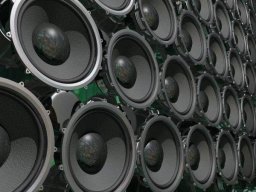
The inherent problem with all 4x10's is that they are not an 8x10.


Which reminds me. I've seen a lot of (well a few anyway) players with 8x10s lay them on their side. What's up with that?