• TalkBass has been independent since 1998. Add your voice.
    Create a free account to reply to discussions, view embedded media, and browse with fewer display ads.
    Join freeLog in
    Want zero display ads or expanded classifieds tools? Compare plans.

what pattern do dead notes usually follow?

I've got a really dead note on the 10th fret of my A string, and not so awesome on 9 and 11 of the same string, but i can't find any anywhere else. Also the same not played anywhere else is fine.

I don't think it's an imperfection in the neck since it didn't appear till i switched what type of strings i've got on it. I'm thinking it's more the sort of thing that could be fixed by a bit of truss-rod tweeking? but it seems strange that it's just on that one string.

It's an acoustic so there's not terribly much i can do with the bridge, unless i'm supposed to be able to shape that removable bit?
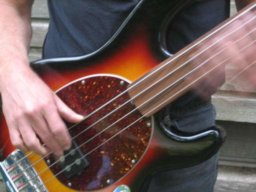
 
If you do a search you'll find lots of info regarding "dead notes". That said, finding a "dead note" on a bass guitar is quite common. A typical location is on the G string, somewhere around the 5th thru 7th fret, give or taken a couple. What you've described is typical. For the most part, it's inherent in the instrument.... caused by a combination of scale length, neck wood and shape, bolt on tension, etc, etc. Some folks can send the "dead note" elsewhere to a less noticeable place via a "Fat Finger" -or- sometimes it's a change of strings -or- string gauge -or- change of season and humidity -or- fill in your own blank.
 
wait, are we talking about dead frets or "dead spots"?

two different things.

a dead fret means a note that won't sound due to the fret being in the way of the string, and is a set up issue.

a dead spot is a thing where certain notes play fine, but just have no sustain. that's a resonance problem, not really fixable.
 
wait, are we talking about dead frets or "dead spots"?

two different things.

a dead fret means a note that won't sound due to the fret being in the way of the string, and is a set up issue.

a dead spot is a thing where certain notes play fine, but just have no sustain. that's a resonance problem, not really fixable.

thanks

"dead spot" i guess, plays but no sustain

It doesn't seem like resonance issue though, the exact same note carries fine on the other strings. I switched the riff i was playing to play it on the 5th fret of E and it sounds fine.

And i'm not exactly sure what you mean by fret-out but the action's the highest of any of the instruments i own, so i doubt it?

If it was an instrument i hadn't played before i'd assume it was a lumpy bit in the neck, but i have never noticed it before.

Maybe i'll swap the strings just to see if that helps, sounds like the simplest thing worth trying? What's "Fat-finger"?
 
Maybe i'll swap the strings just to see if that helps, sounds like the simplest thing worth trying? What's "Fat-finger"?

Changing strings really doesn't make a "dead spot" go away, but they might minimize it slightly. Certainly worth a try.

A Fat Finger is a small weighted device. It was meant to clamp onto the headstock of a bass guitar. Adding weight to your headstock was supposed to (1) add sustain (2) eliminate dead spots. I have one. It does add a little sustain but the effect is small. By attaching it to different spots on the headstock I was able to move a dead spot to another place on the affected string, but I never actually eliminated it. I'm not sure it's made anymore.
 
Weird, wouldn't a truss rod adjustment give the same effect rather more elegantly? or is it for a greater range of control on neck tension? like turning it sideways instead of just back and forward.

Also, what exactly causes dead spots? I thought of resonance, but surely that would effect the same note on all 4 strings?
 
Necks vibrate inconsistently WRT different frequencies. For some reason, the classic dead spot of Fender-style necks is due to the specific materials used in those necks; and the degree to which a Fender-style neck has this dead spot is based on the subtle variations of specific pieces of maple used.

The idea of the Fat Finger (whether right or wrong) is that the vibrational qualities (including resonance) of the neck itself are affected by the mass at either end. Increasing the mass at the far end, and changing its center of gravity, is supposed to alter the vibration of the neck--and this is supposed to have an effect on sustain, and on the presence or location of the dead spot. People that say it works, have often said it did not remove the dead spot, but that they were able to relocate the dead spot to a less-used higher note.
 
I've had a damaged string cause that problem. The string got "crushed" somehow (probably got bumped by someone - surely not my son... *ahem*) anyway, the string got flattened a little right over the fret. At first I thought the fret got tweaked, but upon closer examination, it was just the string.
Or maybe it's just the new strings, you may need to either tweak your setup a bit, go back to the old strings, or try different set.
Good luck, hope you get it sorted out!
 

Latest posts