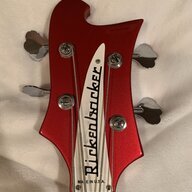
Neither can I. My main basses are Ric 4003s, which have 2 Ric single coil pickups. That’s what’s the most useful for me.That’s an incredibly limited poll. I can’t vote.

TalkBass has been independent since 1998. Add your voice.
Create a free account to reply to discussions, view embedded media, and browse with fewer display ads.
Join free Log in
Want zero display ads or expanded classifieds tools? Compare plans.
Neither can I. My main basses are Ric 4003s, which have 2 Ric single coil pickups. That’s what’s the most useful for me.That’s an incredibly limited poll. I can’t vote.
That's very clever. So I assume it is passive, since I do not see a battery box? I like it.View attachment 7228563View attachment 7228562
The back pickup (yes it really is a BACK pickup) allows this thing to use only single coil pickups, yet have two distinct modes that are both fully hum cancelling. One is a J mode - with both front pickups up full. The other involves the back pickup as part of the circuit - that mode gives you a blend with the neck favored - it's literally halfway between a neck only (P) sound and a J. And no, you can't get the same sound with a blend control - the fact that pickups are highly reactive (not resistive) means you need a reactive combining network, and the back pickup is precisely that nd it is part of the hum canceellation for that mode. I have the two modes loaded differently, so the pots are a volume control and a tone control for each mode.
To me, a straight up neck only (P bass) sound has a bit too much low mids. While I like the regular J sound, it doesn't work for every tune (it's too scooped in some situations). I need something in between, and this (it took years of experiments to get here) is it. At least until my next idea....
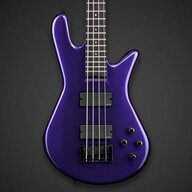
Versatilitiy isn't needed if your one pickup sounds great. I'd say versatility often is a crutch. You think you need it, but you don't, and it just makes you indecisive.
You are correct, it's the reason I almost never use the active settings on my active basses. My SR has so many options, and I usually end up just passive and on the neck p'up. I can do more with my fingers anyway, and choice of where I play.This is my thinking too, and it's why I went for the 4H Stingray instead of the 4HH.

Well...The most popular bass guitars seem to be some form of either a jazz bass, Precision bass or Stingray as far as pickup configuration goes. What have you found to be the most useful?

You are correct, it's the reason I almost never use the active settings on my active basses. My SR has so many options, and I usually end up just passive and on the neck p'up. I can do more with my fingers anyway, and choice of where I play.
I know I can get more boost out my basses active EQ than I can out of my amp's but it's not worth fiddling with it. I can get more out of my fingers. Mostly I play a fairly dark tone so it's just a matter of inches either way?I find the active EQ is mostly a substitute for the amp's EQ, at least in my use case. I have no need for both so one just stays flat.
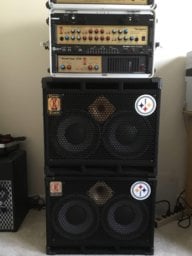
I have a 90’s PBj with BVT controls. For best results, volume and tone controls wide open. From there I modify the EQ, with a slight boost at about 165 hz, the is set at flat with the tone controls on my amp. Our sound guy handles the FOH from my pre-effects send to the board for the PA. On stage it is clear and articulate and sits in the mix at lower volumes. In the house, the sound guy has full control. From what I can tell, I’m really happy with how I sound on stage and since nobody is throwing bricks at me, I guess the house is good as well.The most popular bass guitars seem to be some form of either a jazz bass, Precision bass or Stingray as far as pickup configuration goes. What have you found to be the most useful?




You’re not right, and yet you’re not entirely wrong. If you jack the mix by experimenting too much, that’s not a good thing, but there’s nothing indecisive about having a couple of different sounds at your disposal.Versatilitiy isn't needed if your one pickup sounds great. I'd say versatility often is a crutch. You think you need it, but you don't, and it just makes you indecisive.

Please explain to me the dual sans-amp arrangement. I don't think I've ever seen that before?I tune in D standard. I like simplicity when it comes to controls and pickups. My main bass, this Aria SB1000, has just one pickup of course. It looks more complicated with its chickenhead switch, but I perpetually leave it on the highest/trebly setting. And tone all the way up. Basically nothing to mess with. I use my dual sansamps to adjust everything else, never touching the controls on my bass.View attachment 7232718
The most popular bass guitars seem to be some form of either a jazz bass, Precision bass or Stingray as far as pickup configuration goes. What have you found to be the most useful?
Basically it’s like Geddy Lee’s 2112 rack mount, having two seperate XLR outs. So one channel on the sound board handles cleaner low end with more scooped mids, and the other channel handles more treble/boosted mids and distortion. It allows for more flexibility when it comes to the mixing process, and also you can achieve tones you wouldn’t be able to otherwise.Please explain to me the dual sans-amp arrangement. I don't think I've ever seen that before?