• TalkBass has been independent since 1998. Add your voice.
    Create a free account to reply to discussions, view embedded media, and browse with fewer display ads.
    Join freeLog in
    Want zero display ads or expanded classifieds tools? Compare plans.

What specs do you play at?

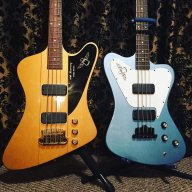
Usually go with the manufactures suggested specs and then fine tune them to my liking string action of course depends, the jazz I like 5/64 for the E and G of course the A and D are then set using the neck radius gauge :) But I like 6/64 for my P bass so yeah none of the others are too far off from these two specs except for my Gibson Ripper, which is 6/64 at the bass side and 5/64 on the treble side action at the 12th fret Gibson suggests 7/64 on the bass side just doesn't work for me. and yes I keep notes of what works for all of my basses.
 
I use the Sadowsky guide to set up my basses. It's a good, no nonsense, intuitive, middle of the road setup.

I used to worry a lot about measuring neck relief when it came to setup; now I flatten the neck until the frets buzz up by the nut, then add relief until the buzzing stops. Done.
 
  • Like
Reactions: bholder
Mine are "what feels good at the moment on this particular bass". Meaning they're all probably slightly different, guess I should settle on specs I like, but I'd rather tweak until happy. I don't want each bass to feel or sound the same, that would defeat the point of having more than one.
 
I use the Sadowsky guide to set up my basses. It's a good, no nonsense, intuitive, middle of the road setup.

I used to worry a lot about measuring neck relief when it came to setup; now I flatten the neck until the frets buzz up by the nut, then add relief until the buzzing stops. Done.
I do the same with neck pickup height - raise it until it causes problems, then back it off until it doesn't. :) The approach seems to work for a lot of setup procedures.
 
Learning how to set up my own bass took a lot of stress off of my mind, mostly about the mystery (or fear) of what is actually going on with the truss rod. It was kind of like learning scales, helping make sense of what notes to play, and clearing my mind of uncertainty. I start by setting the neck relief, saddle height, and pickup height to Fender's own specs, which is pretty darned comfy enough for me. Then I might drop the action down just a tad more (maybe 1/4 to 1/2 turn of each saddle screw) if I can get away with it. It was easy to do this with higher tension strings like Chromes, but I've noticed lower tension rounds aren't as forgiving under pressure, when it comes to fret buzz.

I wish I had learned how to do it years ago. I've took on some serious dogs, and made them play great. You can make people think you actually walk on water sometimes, with just a few adjustments. And that's not even getting in to fret leveling, which I will learn, eventually.
 
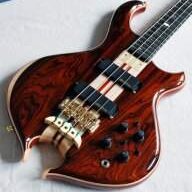
For my Pedulla ETB5:
  • Relief: I capo the 1st fret, hold the string on 22 and adjust until I just start to get clack when tapping at 12.
  • String spacing: I'm still playing around with this one but I think I'm settling into around 18mm.
  • Action: As low as I can get without buzzing. I don't mind percussive clacks but a buzz on a sustained note totally yanks me out of the "zone".
  • Pickups are adjusted for a nice growl with full bottom. When the neck is "out", things start sounding thin.
  • Strings are 45-120 Nickel rounds
On my (ca. 1992) Ibanez SDGR:
  • See above except the neck on this one cannot be adjusted to quite the same tolerances without buzzing. I'm sure it's due a fret leveling.
  • Strings are currently 45-105 steel rounds but I'm contemplating a move to flats on this one.
 
I set up / level my frets so that ALL my basses when strung with 40 - 100 strings have:

A little neck relief
An action of 1.5mm (just under 1/16") to 1.75mm (5/64") from G to E at the 12th fret

All of which results in the action at the last fret being only a hair higher than those measurements at the 12th fret.

Peace,

Rob.
 
Like others, I start with the manufacturer recommended specs and move on from there.

Neck Relief: With the first fret held down with my left hand and the string held against the bottom of the neck with my elbow, I put a .008" feeler gauge in around the 7th fret.

String height: 2.5mm to 2mm gap between the 12th fret and the bottom of the string with the 1st fret held down. I usually use a hex wrench as a gauge.

Pickup height: People ignore this. I don't have the measurement handy, but I stick to Lakland's recommendations.

String spacing: Whatever comes from the factory. I don't mess with that.

String type: Depends on my tuning and the bass. For 4 string 34" scale basses I tend to use .105-.045 DR Hi Beams; 4 strings tuned CGCF I use a custom set (.120, .090, .070, .050, DR Hi Beams); for my 35" scale 55-02 I use .120-.040 DR Lo-Riders.
 
  • Like
Reactions: Dan Bass
It's my personal opinion that measuring those kind of specs is a waste of time. I adjust till things are where I like them. I can see no benefit whatsoever to knowing what my neck relief, bridge action, or string spacing is. More power to anyone who measures those things but I really don't see the point.

I know my strings are 89-68-51-43 because that's what it says on the TI jazz rounds box.
Wow, those are some light gauge strings, I bet you don't drop tune at all with those. Steve Harris of Iron Maiden uses a Fender P-Bass tuned standard E A D G with string gauges 50.75.95.110. What a big difference, and those are flat wounds.
:) :bassist::bassist:
 
The setup on my basses moves a bit with string age. Bouncing the strings off the frets needs to be possible without too much force - part of my playing style. Conversely, I also have to be able to play without hitting strings at a reasonable force. As strings age, the optimal height changes, and thus the setup changes. Usually don't need to change the truss rid, string height changes are usually enough.
 
I play all Fenders, so I use their specs as a starting point. I then adjust string height according to the particular strings I have on the bass, going as low as I can without fret buzz.
I don't get all the head slapping going on in this thread about people measuring specs... Seems to me like it's the only way to get your basses to play well and consistently.
 
  • Like
Reactions: onda'bass
It's my personal opinion that measuring those kind of specs is a waste of time. I adjust till things are where I like them. I can see no benefit whatsoever to knowing what my neck relief, bridge action, or string spacing is. More power to anyone who measures those things but I really don't see the point.

I know my strings are 89-68-51-43 because that's what it says on the TI jazz rounds box.
89? I use thicker than that on my guitar :D
 
Wow, those are some light gauge strings, I bet you don't drop tune at all with those. Steve Harris of Iron Maiden uses a Fender P-Bass tuned standard E A D G with string gauges 50.75.95.110. What a big difference, and those are flat wounds.
:) :bassist::bassist:
I drop down to D for one Foo Fighters song. I forget which.
89? I use thicker than that on my guitar :D
There was a time when I liked much heavier strings but I got used to super light. It fits me better. Also, TI jazz rounds aren't just light. They have a really unique and awesome supple feel to them.
 
  • Like
Reactions: Dan Bass
People actually measure neck relief? I just feel it, as well as look at it. It's easy to tell if it's bad.

I measure string-height-over-the-fret at the 12th fret and pickup-to-string height with the string depressed at the 12th fret. It works.

Fender's official specs are a good place to start.
 
Last edited: