

Enjoy the benefits of a premium membership!
Upgrade Account
-
TalkBass has been independent since 1998. Add your voice.
Create a free account to reply to discussions, view embedded media, and browse with fewer display ads.
Join free Log in
Want zero display ads or expanded classifieds tools? Compare plans.
You are using an out of date browser. It may not display this or other websites correctly.
You should upgrade or use an alternative browser.
You should upgrade or use an alternative browser.
What to use as a neck Shim?
- Thread starter Bassgrowl95
- Start date
More options
Who Replied?


Factory shim on my 1962 Jazz. About .015" - .02" thickFor as thick as the Badass III bridge is, I guess I'm just a little surprised that a single business card would be sufficient as a shim... am I wrong?

Factory shim on my 1962 Jazz. About .015" - .02" thickView attachment 598833
Thanks, man, a business card is .010 from what I'm reading. I guess it could work.
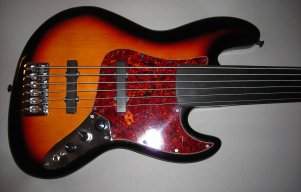
This is a semi-related so maybe someone here can tell me if this is a good idea or not. I need to figure out some sort of shim since my new bridge is too tall even with the saddles bottomed out. I am considering routing out the bridge a little instead of shimming the neck. I need a good .5cm difference and that seems like a lot for a shim. The wedge shaped shim is sounding like a good idea to me too.
The wedge-shaped full shim is THE way to go. I've had great luck with just a strip of card or veneer at the end of the pocket to tilt the neck but a wedge shaped shim gives you a full contact of the neck and body. Lowering a bridge into a rout is usually a bad idea. Because of the long lever arm of the neck it takes VERY little wedge to give you a decent adjustment down at the bridge. The hard part is sanding the wood veneer into a wedge shape. Worth the effort though.
I recently cut a piece of sandpaper to the dimensions of the pocket, then cut several more pieces decreasing in length each time and then glued them together to make a sort of stair-step/wedge-shaped shim so that there wouldn't be any empty space in there. Worked well!
Nice! And sandpaper does grip the wood really well for a stable neck joint! I've often thought that what the world (bass world, that is) needs is sandpaper with grit on both sides for neck shims! That sanding stuff that sort of looks like window screen comes close and many recommend it for shims!
I used a piece of 1/8" lexan on a bass that needed a whole pocket shim. It actually worked great, and is very stable.
Bob
Bob



Cut & stack for thickness.
6 Feet x 50mm Copper Foil Tape EMI Shielding for Guitars Pedals 6 ft x 2" | eBay
6 Feet x 50mm Copper Foil Tape EMI Shielding for Guitars Pedals 6 ft x 2" | eBay
As an eBay Associate, TalkBass may earn a commission from qualifying purchases.

I just did the business card shim in a new Fender Jazz Bass V I just bought and that was the ticket. The bass delivered with action close to what I like but the B and G string saddles were bottomed out to get it where it was. The screw pieces were way above the bridge saddles so I could easily see myself scratching a hand on it and there was no more room for adjustment. Now the saddle screws have plenty of adjustment either way and the action is just where I like it.
I've used a strip of aluminum (tin) foil that I cut to the width of the neck pocket. I've folded it over a few times to get it to a starting thickness, then continued to fold it until I reached the desired effect. The results have been great for my bass.


Anyone take apart a set of automotive feeler guages (spark plug gap guages?). Multiple small thin strips of steel, in hundredths of an inch increments.
Anyone take apart a set of automotive feeler guages (spark plug gap guages?). Multiple small thin strips of steel, in hundredths of an inch increments.
Actually a good idea, but probably overkill in terms of fiddling with incremental thickness, unless you feel like taking the neck on and off a dozen times to try different thicknesses. Still, very flexible. You can probably pick up a well-worn thickness gauge at a pawn shop in the "mess o'tools" bin.
However, the side of a beer can is similar in thickness and easily available.
LOL! Yeah, it would be tedious if you "built up" to it a hundredth at a time.
I'd take a swing at it with a middle-thickness strip, then if necessary, scooch up or down a few guages until it was just right. Best of all, the strips are stamped for thickness, so you'd know pretty much exactly how much shim you have in there.
I'd take a swing at it with a middle-thickness strip, then if necessary, scooch up or down a few guages until it was just right. Best of all, the strips are stamped for thickness, so you'd know pretty much exactly how much shim you have in there.

Hopkins
Commercial User
This thread is proof, some people can complicate Corn Flakes.


I'm with Pilgrim on masking tape in layers- or any kind of tape that won't compress. It's especially nice on basses which don't have access to the truss rod in the body. With tape, your shim stays in place when you remove and reattach the neck. On any bass, it won't shift as you place the neck and begin driving the screws like a loose shim will.

I'm about to shim a bass using my usual, decades old method. A full pocket wedge made of masking tape in a stair-step 1,2,3,4 layer pattern.
Or maybe my other method of a full pocket flat shim using thin birch ply but that means I'd have to go the the hobby shop for the wood so I'll stick with the tape (pun intended).
Or maybe my other method of a full pocket flat shim using thin birch ply but that means I'd have to go the the hobby shop for the wood so I'll stick with the tape (pun intended).
Last edited:

Turnaround
Commercial User
Wow! So many options being offered - business card, beer can, emery cloth, credit card, card stock, veneer, even a potato. I think I will suggest a banana - no one has suggested that yet and we might as well throw it into the pile.
But seriously, the answer is - it depends. A partial neck shim will work fine with 4-bolt necks, and the material used is not critical. But if a full pocket shim is needed (as in the case where there are more than 4 bolts), you will need to taper it in thickness and that rules out most of the materials suggested. If you are really picky you might want a full pocket shim regardless of the number of bolts. And in that case you might well want it glued in, or alternatively go with my first choice - a re-rout of the pocket.
Depends.
But banana is probably not a good choice after all.
But seriously, the answer is - it depends. A partial neck shim will work fine with 4-bolt necks, and the material used is not critical. But if a full pocket shim is needed (as in the case where there are more than 4 bolts), you will need to taper it in thickness and that rules out most of the materials suggested. If you are really picky you might want a full pocket shim regardless of the number of bolts. And in that case you might well want it glued in, or alternatively go with my first choice - a re-rout of the pocket.
Depends.
But banana is probably not a good choice after all.


