• TalkBass has been independent since 1998. Add your voice.
    Create a free account to reply to discussions, view embedded media, and browse with fewer display ads.
    Join freeLog in
    Want zero display ads or expanded classifieds tools? Compare plans.

What's On Your Workbench?

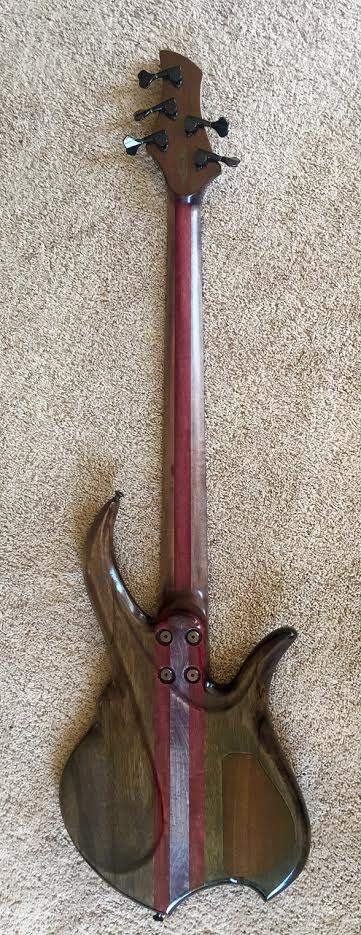
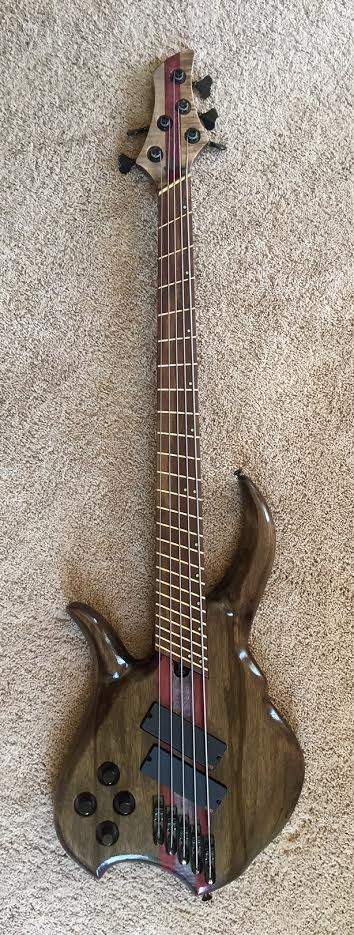
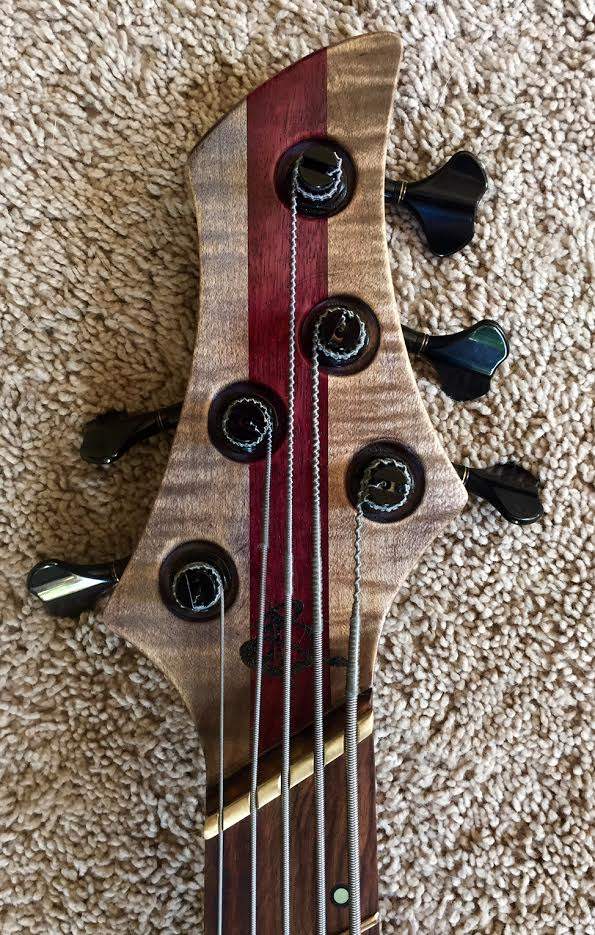
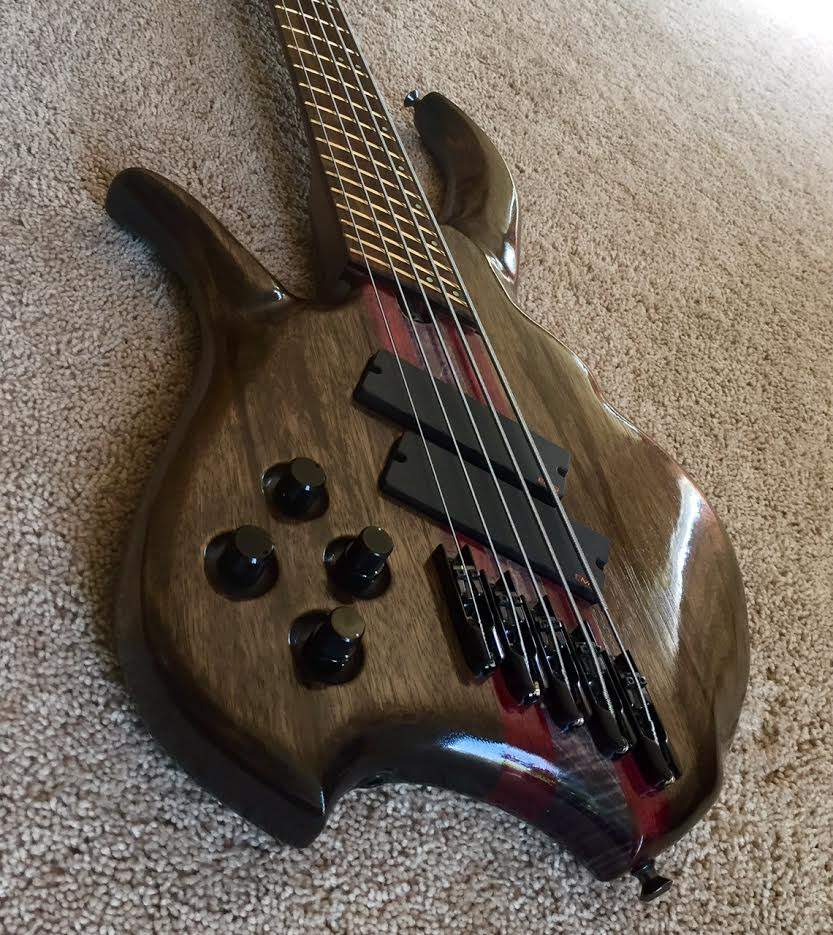
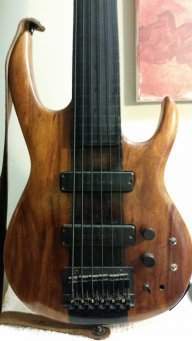
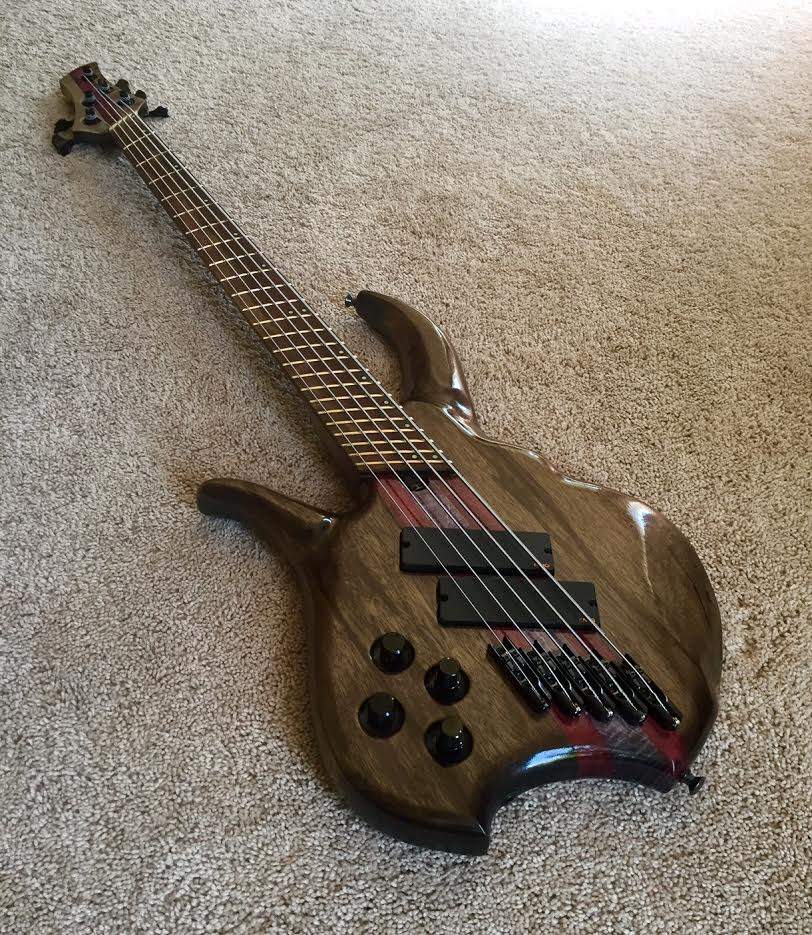
Still setting her up but she plays like a dream and sounds huge. The B is 36" and the G is 33" I never had a chance to play a multi scale bass because I'm a lefty so I had to make one to try it. All from raw lumber and hand carved. Sorry for the phone pics I have to get a good set up to take pictures of my builds I have a few getting completed shortly.
f1.jpg
f5.jpg
f2.jpg
f4.jpg
f3.jpg
 
Looks.much better as a righty (righty bias I guess). How did you decide where to lay the frets? Did you mark off the fret positions for the longest and shorest scales, and cut the slots across the fingerboard between them?
 
Actually I feel that FretFind2D to be more of a pain in the butt than a help. I did do a full size drawling of the bass body and neck starting with the decision of having the 7th fret is the perpendicular 90 degree meeting point.

I use a Stew Mac jig for cutting fret slots and I had a custom template guy make me templates for it including 32”, 33”, 34”, 35”, 35.5”, 36” and I chose the 36” for the B and 33” for the G. I drew out the fingerboard width exactly how I wanted it for 18mm spacing at the bridge and 45mm at the nut. I drew out exactly where the strings would follow along the board to the bridge pieces. I used the 36” notched edge first and went from zero fret (nut) to the B saddle then at the 7th fret notch I drew a perfect vertical straight across fret line using my centerline giving me the perfect point for the 7th fret of the 33” G string. I lined up my notched 33” template using the 7th fret mark and finished marking where all the frets would line up giving me the angle of the bridge pieces and nut angle. So I don’t use the edge of the fretboard for reference my actual B string is 36” and the G string itself is 33”.

Then using a straight edge draw a line from the corresponding frets off the B to the G. Then draw in the D, A, and E and all their frets are already marked out being correct already without any math needed. I then cut out with a Xacto the drawling of my perfect fingerboard and used spray adhesive and fixed it to the fingerboard before radiusing it.

I used a block of wood trued up and carefully cut the beginnings of my fret lines right through the paper not all the way but half of the needed depth. I removed the paper stencil which was a pain in the butt with goo gone and some light sandpaper. Then radiused the board to 16” and then with my guide on my Japanese fretsaw finished cutting the fret slots. The rest is just basic building. I will say it is best to try and keep a good centerline at all times trying to figure out the perfect center on a slanted fingerboard made me nuts and curse more than usual if that’s even possible.

I thank Ben Crow of Crimson Customs for taking the time to make a good YouTube video and making sense of it all. I found this easier for me than that fretfind site personally. I will also say I took right to it I love it ergonomically and the B string sounds as clear and useable as an E on a 4 string bass. I always felt 4 string basses sound better than 5 string basses but I play only 5 string basses or 6 anymore. The cons to me are the E string being close to 35.5" to me is too long and has too much tension maybe I'll look into different strings but is sounded a little twangy to me. The 33" G string sounds great much better than 34" in my opinion so am I going to stop making regular fretboards no way but it is cool to have a multi scale bass.

 
That's what I thought. Seems a good deal easier than working out every scale. So there's no fudge.factor at the nut for intonation based on string thickness?
 
I always use the center of the string for measuring other than that I'm not 100% sure what you are asking. The other strings like the D, A, and E it doesn't matter where you place them between the B and the G they will work out perfectly. This I can attest to I have a rack mount Peterson Strobo tuner on my bench in my shop for doing set ups and setting intonation. The Multi scale bass intonated like a breeze and it seems to in tune all over the neck as good as I have ever had.
 
I see how the.scales line up, based on the highest and lowest. After that is worked out, do you change the nut position slightly for each string based on its gauge? Like the bridge intonation adjust at the other end. Like the Earvana nuts try to do.
Nevermind, I just looked at the pics again and see the nut is a straight line. Probably not an issue for basses anyway.
Good looking instrument. Kudos for taking on the fanned fret challenge. Any sound clips planned for our enjoyment? Thanks for sharing.
 
I'm recovering from knee replacement surgery (both knees) so I've been out of commission since the first week of July but these are what's waiting for me to get back to and what was completed before getting my magic knees...

Sorry for the large photos.

First, what's in progress:

Early 50's style build. it will have a red metalflake body (body is northern ash, chambered) and figured maple neck with reversed headstock.
20160623_134401_resized_zpsvzkvhepr.jpg

20160427_145810_resized_zpssmjzjkxl.jpg


Mandolin/8 st. bass Mandobass doubleneck (swamp ash body, contoured... think Spector):
20160526_093816-1_resized_zps23xnvlig.jpg

20160526_110027-1_resized_zpslzj7yayw.jpg


SG style guitar (thicker Mahogany body with flame top):
Angus%202_zpsjeeqgfar.jpg

Angus%203_zps5q6m678g.jpg

Angus%204_zps3qsrqbgt.jpg


These were some that were completed earlier in the year:
AstroBird%20SS%20_zpskvmzuchn.jpg

Mikey%202_zpsdu05vhcs.jpg

20160509_112212-1_resized_zps9clyo2og.jpg


The last guitar was built to be auctioned off for my Daughter's High School Band...


Moonshine :bassist:
 
I'm recovering from knee replacement surgery (both knees) so I've been out of commission since the first week of July but these are what's waiting for me to get back to and what was completed before getting my magic knees...

Sorry for the large photos.

First, what's in progress:

Early 50's style build. it will have a red metalflake body (body is northern ash, chambered) and figured maple neck with reversed headstock.
20160623_134401_resized_zpsvzkvhepr.jpg

20160427_145810_resized_zpssmjzjkxl.jpg


Mandolin/8 st. bass Mandobass doubleneck (swamp ash body, contoured... think Spector):
20160526_093816-1_resized_zps23xnvlig.jpg

20160526_110027-1_resized_zpslzj7yayw.jpg


SG style guitar (thicker Mahogany body with flame top):
Angus%202_zpsjeeqgfar.jpg

Angus%203_zps5q6m678g.jpg

Angus%204_zps3qsrqbgt.jpg


These were some that were completed earlier in the year:
AstroBird%20SS%20_zpskvmzuchn.jpg

Mikey%202_zpsdu05vhcs.jpg

20160509_112212-1_resized_zps9clyo2og.jpg


The last guitar was built to be auctioned off for my Daughter's High School Band...


Moonshine :bassist:

very cool as always @moonshinegtrs , I hope the knee replacements are allowing you to to do stuff without the knee pain (I will be getting them in the next few years myself)
 
more wooden cover goodness, this time three sets of dual-coils and a set of split-coils are being epoxy cast into the cover so they for a singular solid
View attachment 943778
Very nice. On the two-pole / three pole split coils, do you use the same number of winds on each coil, or do you increase the number of winds on the small coils in order to get it closer to full humbucking?
 
  • Like
Reactions: Rodent
Very nice. On the two-pole / three pole split coils, do you use the same number of winds on each coil, or do you increase the number of winds on the small coils in order to get it closer to full humbucking?

I spent a LOT of time tweaking the winds between the two coils to optimize IMO the trade-off between balance and humbucking to arrive at what I wind these to.
 
  • Like
Reactions: pilotjones
More goodness on the bench today - a batch of 6-string split-coils, and a bunch of 5-string dual-coils.

The dual-coil set in red is for a P2 sized plastic cover, the other dual-coil sets are for P2 sized wooden covers. All of these split-coils are for P4 sized plastic covers.
OnTheWindingBench_2016_0906.jpg
 
  • Like
Reactions: thebassbuilder

Latest posts