Or get one of these -
Uvex Bionic Face Shield with Anti-Fog Coating
I have one for turning and I love it.
Uvex Bionic Face Shield with Anti-Fog Coating
I have one for turning and I love it.

TalkBass has been independent since 1998. Add your voice.
Create a free account to reply to discussions, view embedded media, and browse with fewer display ads.
Join free Log in
Want zero display ads or expanded classifieds tools? Compare plans.
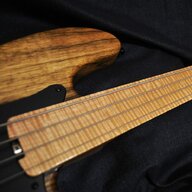



First practice with my router.
View attachment 4487953View attachment 4487955View attachment 4487956
First time I ever used a router. I was aware of the usual horror stories about accidents and improper handling, so I was careful. Still managed to give myself a scare: I unplugged in order to change the bit, then plugged in again, and then I reached for the on/off button to verify it worked...
The router jumped an inch toward me. Always hold the router with two hands!
Questions:
1. Do you wear protection glasses when working with a router? I did, and it didn't seem necessary.
2. Do you use a router as a surrogate drill press?
3. What is this bit for?
View attachment 4487960

What makes you think the V groove is one pass? It is in fact many passes. The V groove is the first thing I tried, and I initially routed about 1/32" deep. Then I went deeper step by step.you're cutting off way too much in one pass
Thanks for your reply, dwizum. All of your points are well taken. One question:
What makes you think the V groove is one pass? It is in fact many passes. The V groove is the first thing I tried, and I initially routed about 1/32" deep. Then I went deeper step by step.


You've had a lot of good feedback but I wanted to add a couple things.
With respect to the drill press question. A drill press used on wood will typically be spinning the bit around 2,000 - 3,000 rpm, max - if not slower. That's the speed that's best for typical drilling operations in wood. A router, on the other hand, is usually spinning between 10,000 - 20,000. Not really appropriate for drilling. There will be a ton more friction (the sides of the bit against the hole you're drilling). Not to mention it'll be hard to position the big precisely in order to plunge into the wood.
Looking at your test cuts - especially the first with the V groove bit - you're cutting off way too much in one pass - especially for a "slot cut" which is what it's called when you're cutting in the "middle" of the workpiece, versus cutting against the outside edge, or the edge of a pocket. The difference is that in a slot cut, the bit is essentially touching the wood on all sides except directly behind itself. Router bits are generally not intended for slot cuts, and chip evacuation won't be very efficient. The bit is pressed against the wood for roughly half it's travel, so it only has half of each revolution to eject chips. If you're ever doing slot cuts for real, it's a good idea to use a bit with a low flute count and ideally an upcut bit that will help itself pull chips up and out.
The only other thing I'd add to the good advice you have so far is learning the difference between a climb cut and a conventional cut. The difference is the direction you're pushing versus the direction the bit is spinning. Imagine there's a workpiece in front of you - just a plain rectangle (or a bass body!) and you're going to route around the perimeter. If you run the router around counter-clockwise, you're conventional cutting. Run it clockwise around the workpiece, and you're climb cutting.
When you're conventional cutting, the bit is spinning such that it's scooping up away from the workpiece as it cuts. In a climb cut, the bit is pushing down into the workpiece as it cuts. The difference is important in terms of the way the torque of the router will "fight" you maintaining control of the machine. In a conventional cut, the scooping cut direction tends to keep the router pulled tight against the workpiece and resists you pushing it along. That pulling and resistance actually makes the router much easier to control, since you have feedback that's "fighting" back against what you're doing. In a climb cut, the opposite is true - as the bit attempts to cut down into the workpiece, it tends to "climb" up out of the workpiece. This can be very difficult to control, since the router will tend to want to run away from you along the edge of the workpiece.
Most people that are scared of routers are scared of them because they didn't know about that difference, and they unintentionally climb cut something, and the router "suddenly jumped out of my hands" which can be really scary!
Routers are definitely the most important and most versatile tool in an instrument building workshop but they can be frustrating and scary too, so it's good that you're practicing before working on an instrument.
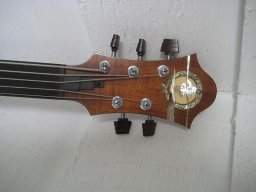


I'm a little curious what they're for.

That should be kept a secret if possible.Should I mention that I made another, secret ring? One that controls them all?
It is. No one here will ever tell anyone.That should be kept a secret if possible.
ExcellentIt is. No one here will ever tell anyone.