
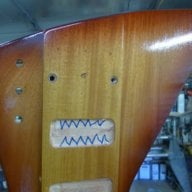
It's about as basic as a solid-body guitar can be, although it is a bit extravagant having 2 pu's!
About as basic as it gets. Pickups riveted to the pickguard, rosewood bridge. But an unusual scale length-26 inches.

TalkBass has been independent since 1998. Add your voice.
Create a free account to reply to discussions, view embedded media, and browse with fewer display ads.
Join free Log in
Want zero display ads or expanded classifieds tools? Compare plans.
It's about as basic as a solid-body guitar can be, although it is a bit extravagant having 2 pu's!

About as basic as it gets. Pickups riveted to the pickguard, rosewood bridge. But an unusual scale length-26 inches.
24.75" (Gibson) 25" (PRS) and 25.5" (Fender) are the common scales for electric guitars. Baritone guitars are anywhere between 27" and 30"Not being versed in guitars, how is that unusual? Is that long? Like a baritone?
24.75" (Gibson) 25" (PRS) and 25.5" (Fender) are the common scales for electric guitars. Baritone guitars are anywhere between 27" and 30"
interesting ... does it sound different/good?
I have only played it with the old (very old) strings so can't really say yet. I'm thinking this one wants flatwounds.


My fretted Cigar Box guitars are 26" the wound strings sound great but the plain strings get a little harsh. I use jazz light chromes because I can get them locally.I have only played it with the old (very old) strings so can't really say yet. I'm thinking this one wants flatwounds.


So I have eleventy hundred projects going on, but nothing has happened recently. Well, except, I bought this Bosch drill set on cyber monday for $100.00. The cheapest I could find just the drill, was $130, so I went for the extra drill and battery for $30 less. And of course, they're sitting on my workbench, waiting to be used.
View attachment 3230974
I'm interested to see how you get along with that impact driver. Mine confounds me. It's 20v and is very touchy, and has way too much power for me to be comfortable using it on a musical instrument.
I have a full sized hammer drill, a Makita, so I really saw no use for the impact driver. I can't imagine that a 12v unit will be powerful enough to drill through concrete, or gentle enough to use for anything having do to with use on fasteners for wood. But like I said, the regular drill alone was $130, yet with the impact driver and another battery, it was $100. Even if I never use the impact driver, the package was a bargain.
I work with some guys who use their cordless impact drivers all the time, almost exclusively in fact, but these guys also cross-thead a lot of screws and cam out the heads sometimes both on the same screw.
I have a Milwaukee kit that came with an impact that I almost never use. They are really only good for putting long screws or lag bolts in lumber. Definitely not a fine woodworking tool but then I am kind of old-school and still use a screwdriver to put screws in most of the time.
I work with some guys who use their cordless impact drivers all the time, almost exclusively in fact, but these guys also cross-thead a lot of screws and cam out the heads sometimes both on the same screw.
I have a Milwaukee kit that came with an impact that I almost never use. They are really only good for putting long screws or lag bolts in lumber. Definitely not a fine woodworking tool but then I am kind of old-school and still use a screwdriver to put screws in most of the time.
From a career of pressing buttons all day, I have developed some wicked carpal tunnel syndrome and a touch of arthritis in both hands, so using a hand-screwdriver tends to be an excruciating experience. I get shooting pain from my palms, up my arms, and then my hands go numb. It's sucks.
So, I have a selection of various electric screwdrivers for various jobs. I have a 4v low-speed guy for delicate jobs like tuner and cavity cover screws, and a 12v non-impact one for things like bridge screws. Of course, sometimes only a manual one will do, so obviously I have a bunch of those as well. I just tend to avoid them unless it's completely necessary. If you use the right power level (4v, 12v, 20v, etc.) and adjust the clutch accordingly, they are very controllable.
I work with some guys who use their cordless impact drivers all the time, almost exclusively in fact, but these guys also cross-thead a lot of screws and cam out the heads sometimes both on the same screw.
I have a Milwaukee kit that came with an impact that I almost never use. They are really only good for putting long screws or lag bolts in lumber. Definitely not a fine woodworking tool but then I am kind of old-school and still use a screwdriver to put screws in most of the time.


