• TalkBass has been independent since 1998. Add your voice.
    Create a free account to reply to discussions, view embedded media, and browse with fewer display ads.
    Join freeLog in
    Want zero display ads or expanded classifieds tools? Compare plans.

When does a Baritone Guitar become a Short scale bass?

While baritone tuning isn't widely standardized yet, the tuning is usually understood as B E A D F# B or A D G C E A, and that's what you'll usually find in packaged sets.

That said, I think it's about intent. If you play a baritone guitar like a bass, you can make the argument that at that point, it's a short scale bass. The large majority of artists that play a baritone guitar do not play it in this fashion, but use it either for just a lowered tuning or to help augment their sound (if playing with a standard tuned electric). But at the end of the day, it's still mechanically a baritone guitar, no matter what you do with it.

The same argument can be applied to extended range guitars, where 8 strings easily fall into the lower end of the bass frequency. You can comp a fairly convincing bass sound with one of those, but it's still mechanically a guitar.

I agree with that, but then how do you classify folks like Royal blood, plays short scale bass and uses effects to cover bass and guitar parts. Cause I have two musicman basses, no guitars and and I have an effect loop for a similar vibe for my 1 guitar band.
 
Well say you built a 29.5 scale length 6 string instrument... half way between long baritone and short bass and don't put strings on it. Which is it? If the determining factor is tuning and intent then this hypothetical instrument could be either at this point? Is it there for both or neither?

Is an instrument only it's use?

It's all semantics really. String it for tension and tuning needs. Call it what you want, play it how you will.

I have several baritones, the common range descriptor for a six-string tuned to A or B on string six, and strings tensioned accordingly. I play them like low-tuned guitars both in terms of chording and melody/soloing.

I have a Bass VI, tuned E to e, which extends the guitar's range from bass to standard tuned six-string range. Bass VI tuning has been used to record and perform both bass and guitar lines, so trying to pigeon-hole any of them is an exercise in futility.
 
Last edited:
Thanks for indulging my pointless thought patterns.

Dan

You're welcome! Things are getting even more interesting now in the extended range world. Nowadays the consensus is that it is all about scale length and string spacing. In other words, the classic Fender Bass VI is a bass GUITAR, not a BASS guitar.

So, a djent guy playing a 9-string guitar tuned to "Drop E" (their nicknames for tunings make no sense to me) with a B string on the bottom that is tuned the same as the B string on a standard 5-string bass is still a guitar due to a 31" scale-length and guitar string spacing. The 13-string fan-fret bass that looks like a harp is still a bass if it has a 38" scale at the lowest strings even though the highest strings go higher than a 6-string guitar.

Guitar:


Bass:


Touch guitars seem to really be in-between. Tony Levin plays them like a bass, some guys play counterpoint like a piano, and guys like Colin Marston from Behold the Arctopus play them like guitars sometimes and like bass other times.
 
Interesting question, OP. I think it has mostly to do with tuning as opposed to scale length.

The way I've understood it is that baritone is the range that is found a perfect 5th below a guitar and the bass is a perfect 5th below baritone, or full octave below guitar. So it's the overlapping range between guitar and bass. Tune it up a 5th you've got a guitar, tune down a 5th you've got a bass.

I think there used to be a clef for baritone, but now it's read on the bass staff? Or baritone parts are now written using a bass clef that is placed a 5th higher on the staff. Dunno, but someone may clarify that.
 
Last edited:
Octave below guitar and you have a Bass VI not to be confused with a baritone guitar which lives somewhere in the middle. My guess is that the bari guitar was invented so that guitarists could emulate baritone sax solos. Hmmm, would that make a fretless bari a stringed trombone? Yikes.
 
Last edited:
Octave below guitar and you have a Bass VI not to be confused with a beritone guitar which lives somewhere in the middle. My guess is that the beri guitar was invented so that guitarists could emulate beritone sax solos. Hmmm, would that make a fretless beri a stringed trombone? Yikes.

I'm wondering why you are consistently spelling baritone as beritone? I am not instantly assuming you are wrong.
 
Octave below guitar and you have a Bass VI not to be confused with a beritone guitar which lives somewhere in the middle. My guess is that the beri guitar was invented so that guitarists could emulate beritone sax solos. Hmmm, would that make a fretless beri a stringed trombone? Yikes.
Someone, somewhere, just got a tromboner.
Rondo
 
  • Like
Reactions: Gvernon and Matt O
Interesting discussion. I have commissioned a dual course, ten string instrument that if tuned like a bass would be an octave bass. But, I will be tuning the lighter strings to the fifth of each fundamental string so that playing a pair of strings will always play a Root & Five. Not really a bass anymore but not a guitar or a baritone guitar. Not sure what to call it, and I'm not sure it really matters. The roll it will fill for me is that of a bass/rhythm guitar in a 3 piece band: It, drums, and guitar or sax or harmonica. Should be a fun experiment.
Rondo
 
  • Like
Reactions: ScottMatt
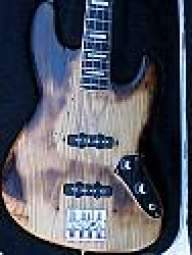
If this is a bass guitar:

?u=http%3A%2F%2Ftse3.mm.bing.net%2Fth%3Fid%3DJN.aYlrizxIBcOF1vR4LQtvHg%26pid%3D15.jpg


What do you call this?

kie.net%2F__cb20100801181534%2Frush%2Fimages%2F1%2F17%2FRickenbacker_4080_Doubleneck%252C_White_.jpg
 
I think the points on timbre and intent are very true. I'd say intent comes first, and then selecting the instrument that gives you the right timbre for what you intended. I've played acoustic guitars in a bass-like role before.

Ones about waves.

Feynman played bongos. So with schroedinger's bass and feynman's bongos the rhythm section is covered. Bohr played piano. It's uncertain what Heisenberg played.
And I guess they all commutate to gigs just like all the musicians on the subway?
 
This is just me, but I think that the Baritone guitar enjoyed its finest moment, when Glen Campbell played the riff in 'Witchita Lineman' on a Danelectro Baritone. That was some pretty sexy 'Ear Candy'.
(By the way, Glen did a rendition of that song with Stone Temple Pilots Eric Kretz, Robert and Dean DeLeo, on STP's DVD, 'Thank You'. Definitely worth a look, if you are a fan of the song.)
 
  • Like
Reactions: DirtDog
Bass:


Touch guitars seem to really be in-between. Tony Levin plays them like a bass, some guys play counterpoint like a piano, and guys like Colin Marston from Behold the Arctopus play them like guitars sometimes and like bass other times.

I went on a youtube listening spree of this guy from your post. Really like his playing, thanks for the recommendation!
 
  • Like
Reactions: Kragnorak
Well, this is what Fender has to say, and it doesn't completely agree with what I said in my earlier posts. But let's face it, I couldn't even spell baritone. According to Fender's tech talk blog, it's all about scale length and string gauge. Apparently, you can tune a baritone guitar however you like, but it will never be a bass. I guess at Fender, a bass starts at 30" and wears bass strings. Bari, wears guitar strings. But, that's Fender so who knows...

Invalid Link Removed
 

Latest posts