
Enjoy the benefits of a premium membership!
Upgrade Account
-
TalkBass has been independent since 1998. Add your voice.
Create a free account to reply to discussions, view embedded media, and browse with fewer display ads.
Join free Log in
Want zero display ads or expanded classifieds tools? Compare plans.
You are using an out of date browser. It may not display this or other websites correctly.
You should upgrade or use an alternative browser.
You should upgrade or use an alternative browser.
When "E" isn't "E" - 4 vs 5
- Thread starter Road Hat
- Start date
More options
Who Replied?


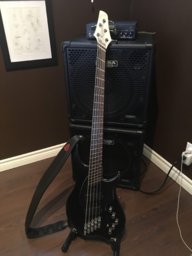
When I'm sporting a 5er, I spend a lot of time on the low B string, above the 5th fret. IME the notes feel a LOT thicker when I sound them there. (Playing like that up on the neck is like having a 26" scale bass with a .130 E-string - how could that possibly not sound & feel way different?)
Does that by itself make it worth getting a 5-string? Perhaps not, but it's definitely a bonus!
For styles that call for it, the extra range can be plenty handy BTW - all the way down to B. (I've even been known to tune down to A.)
Does that by itself make it worth getting a 5-string? Perhaps not, but it's definitely a bonus!
For styles that call for it, the extra range can be plenty handy BTW - all the way down to B. (I've even been known to tune down to A.)
When I'm sporting a 5er, I spend a lot of time on the low B string, above the 5th fret. IME the notes feel a LOT thicker when I sound them there. (Playing like that up on the neck is like having a 26" scale bass with a .130 E-string - how could that possibly not sound & feel way different?)
Does that by itself make it worth getting a 5-string? Perhaps not, but it's definitely a bonus!
For styles that call for it, the extra range can be plenty handy BTW - all the way down to B. (I've even been known to tune down to A.)
Did you perhaps mean 36" scale?

J
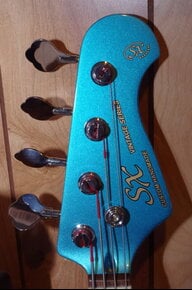
Given the string size of the B-string vs. the string size of the E-string, you're hearing much more of the fundamental and lower overtones than the higher overtones.
If you had a zero fret and used a .125E and a .125 B, the open E and the 5th Fret B would sound extremely similar.
I don't think they would sound all that much the same then either. The tensions would be significantly more different than when the strings were different diameters. I suspect that this will affect the overtones (of the E string) significantly.

It has very little to do with the extra five notes.. IMHO.
Sure, they're there and they give bass players a bit more low-end to play with. But I would imagine most bassists who prefer to have five strings do so for the timbre and 'tone', and for the fact that it makes more notes available without shifting. Same goes for a six string - say your fingers spanned four frets; on a four string you'd get 16 notes under your fingers, and you add another four with each string.
For example, with a fiver, you can play a two octave major scale with only the slightest of shifts. On a four string, you'd have to starting moving up the neck in the second octave. For people who need to be more fluid in their playing - for whatever reason, ie needing span a large pitch-range - having more strings is a blessing!
I play a 4-string, but for me, this is *the* benefit of a 5 string.
Plus tone... there's a huge difference on a 4-string between playing a high Bb on the 3rd fret G string and playing a high Bb on the 13th fret A string, the A string is thicker and the note has a lot more meat, balls, umph, whatever. Same applies for the notes between the low E and the A on the E string, versus playing the same notes on the 5th fret B string and up. I play in upper positions a lot, mostly for those thicker notes, and typically only shift down to play the lower ones on the first four frets of the E string.
Not gassing for a fiver though, but I imagine someday I will own one. Almost bought a P fiver a year ago.
I play a 4-string, but for me, this is *the* benefit of a 5 string.
Plus tone... there's a huge difference on a 4-string between playing a high Bb on the 3rd fret G string and playing a high Bb on the 13th fret A string, the A string is thicker and the note has a lot more meat, balls, umph, whatever. Same applies for the notes between the low E and the A on the E string, versus playing the same notes on the 5th fret B string and up. I play in upper positions a lot, mostly for those thicker notes, and typically only shift down to play the lower ones on the first four frets of the E string.
Not gassing for a fiver though, but I imagine someday I will own one. Almost bought a P fiver a year ago.
Bill summed it up well re: thicker tone, plus being able to play higher up and sytill maintain bottom - for me on the 5, that is a huge advantage. I've started using the E on the B string more now for both ease of position and the extra depth of tone. It wasn't until I got my D'Addario .135 gauge B string that the E on the B became as useful for me - that gauge and tesnion mad eit work great on my ATK, whereas lighter gauged Bs just weren't cutting it. A lot depend on the bass, setup, scale, etc etc
Probably use the Eb more than any other "below E" note, but it is great o be able to walk up to E from notes below.....
J
Did you perhaps mean 36" scale?
J
Oh, I meant 26".
 That's the measurement I took between the 5th fret and the bridge on a standard 34" scale bass.
If someone were to build a 26" scale 4-string and set it up with a .125 or .130 E-string, that would be the equivalent of what you get when you play on or above the 5th fret on a low B.
For a while I got to liking that sound so much, I hardly ever played back by the nut. (I'm in good company too - I just saw Midnite and that guy spent the entire night up around the 10th fret. I'm not sure he ever went below E but he sure used the heck out of that B string.)
Bill summed it up well re: thicker tone, plus being able to play higher up and sytill maintain bottom - for me on the 5, that is a huge advantage. I've started using the E on the B string more now for both ease of position and the extra depth of tone. It wasn't until I got my D'Addario .135 gauge B string that the E on the B became as useful for me - that gauge and tesnion mad eit work great on my ATK, whereas lighter gauged Bs just weren't cutting it. A lot depend on the bass, setup, scale, etc etc
Probably use the Eb more than any other "below E" note, but it is great o be able to walk up to E from notes below.....
J
Hello! Long time no see!
Still jamming the ATK? I'm still without a fiver. I agree, Eb would come in handy too, especially for down-tuned stuff like Superstition.
Hello! Long time no see!
I agree, Eb would come in handy too, especially for down-tuned stuff like Superstition.
I'm great Bill - nice to hear from you! Living in London now....
Stevie has lots of tunes in Eb.....Superstition is one of those that I always wanted that low Eb for when I had a four......


