
Enjoy the benefits of a premium membership!
Upgrade Account
-
TalkBass has been independent since 1998. Add your voice.
Create a free account to reply to discussions, view embedded media, and browse with fewer display ads.
Join free Log in
Want zero display ads or expanded classifieds tools? Compare plans.
You are using an out of date browser. It may not display this or other websites correctly.
You should upgrade or use an alternative browser.
You should upgrade or use an alternative browser.
When is it OK to lie?
- Thread starter Quickie
- Start date
More options
Who Replied?
The question presupposes a moral hierarchy of activities. Based on this, one would assume that lying is appropriate when counteracting activities with greater harm, or inversely creating greater good that would offset the negative moral value of the lie.
Of course, to do this, we'd have to have a uniform (or for you blind idealists out there, an "objective") set of moral rankings of all activities, by all people, in all situations, and be able to comprehend the value of all alternative outcomes.
Unfortunately the time, research, computation, and compilation involved in the study of any particular act and its associated nearly infinite set of lies, half truths, misleading statements, and sins of omission would almost immediately crush society's resources, and we'd all die starving and soaking in our excrement while eaten by various taxa of scavengers, and low level predators.
And your parents thought that liberal arts education would be a waste of money...........

Sometimes people have to lie.
Quickie, I enjoy your threads and have cherished your time on the forum.
"honey, was that you?"
"no dear, it was the dog"
A lie I told about ten minutes ago. Am I a bad person?
"no dear, it was the dog"
A lie I told about ten minutes ago. Am I a bad person?
"honey, was that you?"
"no dear, it was the dog"
A lie I told about ten minutes ago. Am I a bad person?
Yes, be proud of your manly flatulence.

I lie to myself all the time when I think I can become a good bassist...
...when I tell my wife she looks better today than the day we got married...
...when I tell my children that I'm not steaming mad at how badly they just screwed up and that I understand, and always will, no matter what...
...when my boss asks me if I agree...
...and my favorite... "Is everything good?" "Oh, everything's fine!!!"
...when I tell my wife she looks better today than the day we got married...
...when I tell my children that I'm not steaming mad at how badly they just screwed up and that I understand, and always will, no matter what...
...when my boss asks me if I agree...
...and my favorite... "Is everything good?" "Oh, everything's fine!!!"
Droot said:For that matter, when the kind, gentle, and elderly police officer asks you if you are guilty, you will always be best served if you state that you are innocent. If you are guilty, it is best to allow the powers that be to do their job and prove it, and you are always better represented by a lawyer in matters of law. Given this, I think it is wrong to lie but sometimes expedient.
Droot
Not necessarily true. Was pulling a 16 hour drive coming home from a funeral. Was doing about 90mph in a 70 mph zone. Cop passed me going the other way. I saw his lights come on and I had pulled myself over before he even finished his u turn. He asked if I knew I was going that fast, and I said "honestly, yes". In the end, I only got a ticket for going 5mph over. In this instance, truth prevailed with a better outcome because the officer appreciated the honesty.

if your wife or girlfriend asks "does my butt look big in this" and your name isn't Sir Mix A Lot, what do you do
"Yes, baby, youre butt looks big in everything, frankly, because you have a big butt. Now bring that big sexy ass over here and gimme some lovin'"
Not necessarily true. Was pulling a 16 hour drive coming home from a funeral. Was doing about 90mph in a 70 mph zone. Cop passed me going the other way. I saw his lights come on and I had pulled myself over before he even finished his u turn. He asked if I knew I was going that fast, and I said "honestly, yes". In the end, I only got a ticket for going 5mph over. In this instance, truth prevailed with a better outcome because the officer appreciated the honesty.
Similar thing happened to me on the way home from a gig. I noticed I was doing about 90 on the freeway and thought to myself "Hmm, its been a long time since Ive pushed a car up to 100mph" and did it for the hell of it. I then backed off the gas and let my speed slowly decline. A minute later I seee some blue lights flash me. "Crap". I pull over and the cop asks if I know why... "Yes officer, I was going a little fast there" He tells me its a good thing he didnt clock me at 100, only 97mph, otherwise I could have lost my license. The ticket he wrote me only said 85+. Im sure he knew I was going faster...
I'm not sure that the basketball v. morality comparison is an appropriate one. One has a clear set of finite rules and a goal. The only thing that we're left to interpret is a strategy: when and how to apply those rules to achieve that goal.
The point of the basketball comparison was not to say that moral decisions are like playing basketball, and certainly not in every respect; I was just trying to explain what "habitus" means.
It had been proposed that you should never ever ever lie, even if it seems to be for the sake of a greater good, because you cannot rationally calculate all the ramifications of your actions. Therefore, it was implied, you have to follow some Kantian categorical imperative to obey the "don't lie" rule no matter what the apparent circumstances.
The whole point of "habitus" is that people almost never can rationally calculate the effects of our actions. It's unreasonable to expect that they should. That doesn't mean that people don't, on the basis of experience and intuition, have a pretty good sense of what will work or not work in a given situation. It's not infallible, but most of the time relying on experience and successful, positive habit-formation works pretty well.
Bourdieu doesn't use the idea simply to talk about basketball, he actually formulated the concept to explain economic behavior. Do people make purchase or investment decisions "rationally" or "impulsively?" He argued that it was neither - they make these decisions on the basis of habitus.
Morality doesn't have a clear set of rules, or even an air tight working definition. It's entirely subjective, based on empathy levels, and liquid social politics. Nor does it have a concise goal, like "have a higher ending score than your opponent within a set time period." Lying is just one fluffy piece of the undefined cloud of morality. A three point shot is a very defined part of a very defined goal.
"Morality" defines a type of question - "How should I act?" and its variations. There are many different approaches to this question and therefore many different moral frameworks, many of which DO have quite clear-cut rules and goals. In any case, though, your concept of "liquid social politics" actually is much more amenable to dealing with morality on the basis of habitus rather than a categorical imperative. The whole point is that the moral agent, deciding what to do under given circumstances, will (and should) decide on the basis of his "feel" for what the situation is and what its rights and wrongs are more than on absolute inflexible dictates.
If we knew, out of "habitus" what morality was, we wouldn't need this discussion, because we'd all be doing it, no?
"Habitus" is not itself a moral doctrine or system. It is a model for understanding human decision-making. The model does not imply that people know the right thing to do automatically or instinctively - quite the opposite. The basketball player can make the three-point shot because he's practiced a lot, he's done it a hundred times, and he has a "feel" for how to hit it this time -- not because he was born able to make three-point shots. He may still miss, of course, but the point is that he makes the shot on the basis of his acquired experience and not by consulting a textbook on how to play basketball when he's in the middle of the game.
Moral decision-making develops in a person the same way. They learn moral principles from internalizing rules, from their upbringing, from the things they get punished for and the things they get rewarded for, and from a certain amount of reading and cogitation. When confronted by a particular decision, like "Do I lie or do I tell the truth now?", they decide on the basis of all this accumulated experience, not by sitting down and rationally calculating all possible outcomes. Sometimes a fixed rule they learned blazes out as the clear and unambiguous guide, and sometimes not.

Unrepresented
Something Borderline Offensive
The smiles I can offer the world with a pithy turn of phrase effortlessly exceed the $174 pittance of a monthly repayment I make on my student loans. Huzzah!guy n. cognito said:And your parents thought that liberal arts education would be a waste of money...........
Sometimes people have to lie.

My phone allows enough text capacity for snarky responses only, I'll have to wait until tonight to give a fair reply to you hrodbert696.

Sidenote: I can't count the number of times I've been asked by an artist of some kind (visual, musical, otherwise) how much I like their work. Nine times out of ten, it's awful but they'll never think that I think that . I'm seriously about to just tell everyone to stop asking me for my opinion on their art. Funnily enough, the best artists I know don't give a damn about my opinion and yet their work is clearly better.
. I'm seriously about to just tell everyone to stop asking me for my opinion on their art. Funnily enough, the best artists I know don't give a damn about my opinion and yet their work is clearly better.
^ If someone asks for an opinion of their artwork I tell them "art is subjective, and frankly, your subject sucks"
"Yes, baby, youre butt looks big in everything, frankly, because you have a big butt. Now bring that big sexy ass over here and gimme some lovin'"
Jesus H. Christ, I think I love you
 . This folks, is a real man.
My wife is 5'2" and about 120 lbs. She looks great and has a big butt, especially for a white girl.
Rather than have her always thinking her butt looks too big and she needs to lose weight I have engrained in her a sense of pride for having a big backside. It certainly helps that Im an ass guy.
Rather than have her always thinking her butt looks too big and she needs to lose weight I have engrained in her a sense of pride for having a big backside. It certainly helps that Im an ass guy.

My wife is 5'2" and about 120 lbs. She looks great and has a big butt, especially for a white girl.
Rather than have her always thinking her butt looks too big and she needs to lose weight I have engrained in her a sense of pride for having a big backside. It certainly helps that Im an ass guy.
Matticus, the...

When you can remember every word you ever uttered.
If you can't, the one thing you lied about will be the one thing you are certain to contradict. The person you told it to will be certain to be the person you tell the contradiction to.
There are rules, you know.
If you can't, the one thing you lied about will be the one thing you are certain to contradict. The person you told it to will be certain to be the person you tell the contradiction to.
There are rules, you know.


I'm extremely honest when I'm talking to people and speak my mind...
Everyone thinks I'm a dick.
I should lie more.
I can relate to that. People have a hard time with brutal honesty.
When asked if you placed a personal ad as a couple looking for another girl to play with your wife on/for your birthday...
Not even then
Not even then
Matticus, the...
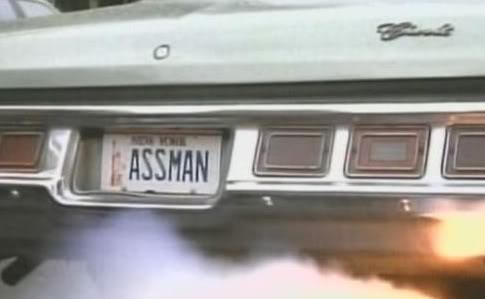
Old school New York plates 8) I miss those, they had to be my favorite ones. Hell, I miss the 90s when things like "AssMan" did not cause so much controversy and people did not have a cow man.


