• TalkBass has been independent since 1998. Add your voice.
    Create a free account to reply to discussions, view embedded media, and browse with fewer display ads.
    Join freeLog in
    Want zero display ads or expanded classifieds tools? Compare plans.

Where to notch mids?

Where to notch mids?


  • Total voters
    81

YourGuitarist

Commercial User
Jan 31, 2024
351
399
Denver
Disclosures
Myself, Nothing ATM
I've noticed in isolation that many bass tones benefit from some sort of smiley face curve. However, the location of de-emphasized frequencies is quite different across gear and mixes.

My question is when you want to notch mids, where is your preference, and how deep?

Do you boost elsewhere to make up for it?
 
there is no right answer devoid of source material. always use your ears to make the move that the track needs based on what has been recorded. I notch the frequencies that sound the worst -- if the mix calls for it at all.

a trick I use is to solo the track i'm looking to improve, take an EQ with a very narrow Q, boost it as far as it will go, and sweep the frequency around until i found what sounds the very worst. then i'll pull this narrow-band EQ down so it's cutting a few dB. usually it sounds better after that.
 
Yeah I understand that it varies by scenario but I'm curious to see where individuals land.

Like I personally prefer cutting around 360-450 then tilting towards treble above 1k but interestingly enough, those same low mids can add a lot of definition in the mix. Slap guys seem to like cutting around 800 and the sansamps cut around 500. I do the sweep method to an extent though I typically prefer mid-forward sounds where my cuts are dictated by other elements in the mix.
 
i get what you're asking but will double down on there is no good answer other than use your ears and don't even try to pick a number. ;)

i land where the track puts me. it's not (or shouldn't be) a matter of personal preference. it is (or should be) a matter of what serves the song best given what's on tape/disk. even in the same style of music, a different player, different strings, different bass, different preamp, different drum kit, different guitar part, different vocalist, etc, etc, etc is going to dictate different EQ moves.
 
I've noticed in isolation that many bass tones benefit from some sort of smiley face curve. However, the location of de-emphasized frequencies is quite different across gear and mixes.

My question is when you want to notch mids, where is your preference, and how deep?

Do you boost elsewhere to make up for it?
I always change my eq depending on the room. My amp never really stays in one place eq wise
 
Mids cut thru the mix. Don't scooped mids. YMMV

eq (1).jpg
 
I've noticed in isolation that many bass tones benefit from some sort of smiley face curve. However, the location of de-emphasized frequencies is quite different across gear and mixes.

My question is when you want to notch mids, where is your preference, and how deep?

Do you boost elsewhere to make up for it?

I will also say, there’s no right answer. If I cut anything it’s usually lows or highs, not mids.

I understand that it varies by scenario but I'm curious to see where individuals land.
where I land varies with different scenarios. My eq settings are different at every gig since every stage/room vibrates differently.
 
Mids cut thru the mix. Don't scooped mids. YMMV

A lot of the amplifiers that bass players use scoop mids - Fenders are a classic example. If you crank the mids (on 10), and set treble and bass to 5, you'd think you are boosting mids, but you're not - you're still scooping mids a fair amount. This behavior has, unfortunately led people to think that scooping mids at all is a bad thing. It isn't - bass is a rather mid heavy instrument, and scooping them some (but not a lot) is often a good thing. The eq in my rig is a Source Audio EQ2. Unilke a Fender tone stack, flat is actually flat. On some of my basses , I do scoop mids a bit, centered at around 300 Hz - 3 to 5 dB - a shallow, wide scoop. On a J, I don't - A J has mid scoop from the pickup positions, it doesn't really need any more.
 
Live sound in my church - I find I either don't dip mids (J bass) or I dip them around 300 Hz (P bass). Maybe -6 dB with Q of 1.5 or so? Doing so allows me to bring the bass level up a bit to sort of wrap those lows and highs around the rest of the band. And, yes, I'm often boosting in the 1k - 3k range by a handful of dB. HPF of 40 to 60 Hz and LPF of maybe 4k to 6k.

Years ago I compared my SWR amp against a GK. SWR mid-cut at 220Hz, GK is around 500Hz. I came to the conclusion that I preferred the GK sound. But that was then, with that band, in that room. Things shift.

I'm looking for the bass to have note definition in the mix. Not just sub lows with clanky highs. I want some harmonics and body to come through. It is much harder than just dialing in the super lows and letting everything else get masked by guitar / piano / toms / vocs / room acoustics.
 
When actually playing, I almost never notch the mids. I may have a little bass and treble boosted at times, but my mids dont get rolled back. I will boost mids as needed though. Low or high depends on the room I'm in. Usually high mids.

I use my treble knob more than anything to get the sound I want. Up for slap or adding attack, back for a fatter sound.

In fact, right now my amp is dead flat, pre on the bass is.. bass at 11, mids at 12, treble at 1 oclock. This is pretty typical for me with this cab.

Cutting mids just sucks too much energy out of the sound to me, even when playing alone.
 
Last edited:
The answer is genre dependent to some degree, also the size of the band and instrumentation.

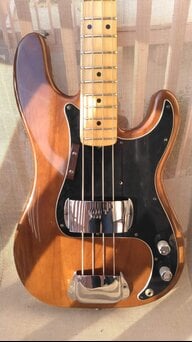
The reason the Fender Pbass is ubiquitous throughout it's history is that is middy and woody sounding by its nature with no real top or ultra low bottom. These sonic characteristics allows the pbass to fall into a perfect sonic space in the mix without much effort. What sounds dull and unexciting by itself, works so perfectly in the rhythm section. There is a reason why so many records have been made with this instrument.

Modern sounding basses with extended range often have sparkling high end and deep bass. In some situations this is wonderful but as you get into larger ensembles this extended range becomes problematic.

Anyone that has done any producing and mixing knows that you have to find sonic space for all the instruments. With the bass fidelity extension, you may find the low end is competing with the kick and the sparkly high with keys and brass. This either makes the bass disappear in the mix or obliterates definition of other instruments.

The more instruments in the mix, the better off you will be with a middier bass sound, the exact opposite of the smiley face the op describes.

Again, this is also genre dependent. If you have some favorite recordings, analyze them and study where the bass guitar frequency range is. You may be shocked to realize in professional sounding mixes that space is very often pretty middy.

One of my personal favorite producers is Mutt Lange. Listen to ACDC's Thunder Struck, a killer track. Check out the bass sound, or Def Leppard's Hysteria or any of Shinia Twain's hits. These are some very well produced and great sounding recordings. Dua Lipa's Don't Start Now or Lizzo's About Damn Time for wonderfully recorded Pop Tracks.
R&B tracks like Daft Punk's Get Lucky, Bruno Mars' Leave the Door Open or Modern Jazz recordings by Snarky Puppy which is a very large band. The bass sound is not scooped on any of these recordings because it will not be heard or, it will step on the other instruments. This is true for live performance too.

Marcus Miller or Brian Bromberg are examples players that use a very scooped sound which works so beautifully in their music but is very problematic for other styles and orchestration styles. They are both big time slap style bassists.

Rather than notch the mids, I start by high passing the bass, the exact frequency depends on the room and style of music. Around 40-50hz is where i start rolling off with a 4 string bass, leaving room for some kick drum thump. I often roll down my tone control as well. I use this same approach when producing in the studio. Make your eq evaluation in context of the actual music and instrumentation you are working with. The EQ you like in your bedroom by yourself is probably not a great choice when you start adding other instrumentation.

You may also have noticed that in live situations, in rectangular rooms, you are going to have a low mid/hi bass resonance somewhere between 200-300 Hz, this is something you will also have to attenuate with when trying to achieve a very articulate eq the works in full band mix. A smiley face eq will accentuate the problem.
 
Last edited: